
AdBlue & Your MOT — What You Need to Know
Can an AdBlue Fault Fail Your MOT? What Every Driver Needs to Know
AdBlue warning light on with an MOT coming up? Whether it fails depends on the type of fault, what the tester checks, and the current MOT inspection rules. This guide gives you the full picture.
Quick Answer
An active AdBlue warning light does not automatically fail an MOT — but it can. MOT testers check whether the engine management light (EML) is on: if it is, the vehicle fails. Many AdBlue system faults trigger the EML. Vehicles must also pass tailpipe emissions tests, which a failing SCR system can affect. Resolve the fault before your test to be safe.
In This Guide
What Does the MOT Test for on Emissions?
The MOT checks diesel vehicles for emissions in three main ways. Understanding all three explains why an AdBlue fault is a real risk — not something that can safely be ignored until after the test.
1. Engine Management Light Check
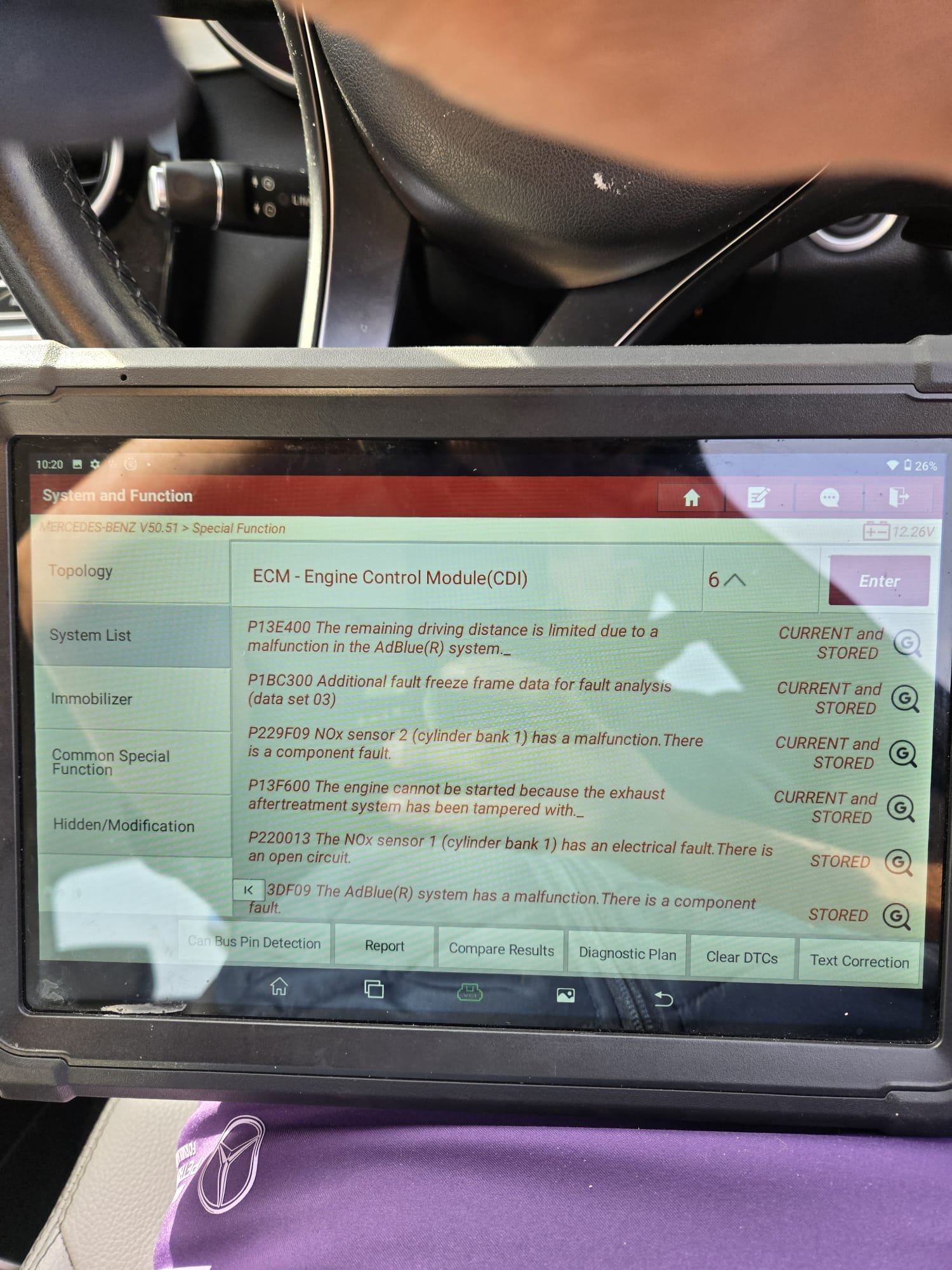
One of the first things an MOT tester does is confirm the EML is not illuminated. Under current MOT standards, an illuminated EML is an automatic fail — regardless of what triggered it. Many AdBlue system faults (P20EE, P204F, NOx sensor faults) trigger the EML.
2. Tailpipe Emissions Test
Diesel vehicles are tested for exhaust smoke opacity with a free acceleration test. This primarily checks the DPF, but a non-functioning AdBlue system can indirectly affect combustion and particulate output in some engine calibrations.
3. Visual Inspection of Emissions Components
MOT testers check that emissions-related components are present and have not been obviously tampered with. A missing AdBlue tank, cut wiring, or a clearly removed SCR component can result in a fail on grounds of emissions tampering.
MOT Testers Are Increasingly Alert to AdBlue Issues
DVSA guidance has highlighted AdBlue and SCR tampering as an area of attention. Commercial vehicle testing stations in particular are increasingly aware of what deleted systems look like. The risk of detection is real and growing.
Which AdBlue Faults Illuminate the EML?
Not every AdBlue fault triggers the EML. A simple low-level warning (the dedicated amber AdBlue icon) does not usually illuminate the EML. However, these fault types commonly do:
- P20EE (SCR catalyst efficiency): Directly relates to emissions performance — almost always triggers the EML
- P204F (Reductant system performance): A systemic performance fault that typically triggers the EML
- P207F (Reductant quality poor): In many vehicles this triggers the EML, particularly on persistent faults
- NOx sensor faults (P2202, P2203): Sensor circuit faults commonly trigger the EML as they affect emissions monitoring
If you ignore a low-level AdBlue warning long enough for the van to start logging system faults, those secondary faults may well trigger the EML before your MOT date.
Tailpipe Emissions and the AdBlue System
The MOT smoke test checks diesel particulate smoke density. This primarily tests the DPF rather than the AdBlue system — a vehicle with a functioning DPF but a failed AdBlue system will typically pass the smoke opacity test. However, if an AdBlue fault has caused the ECU to alter fuelling strategies, or if the DPF is also partially blocked, the smoke test can be affected. Current MOT standards do not include a specific NOx measurement for most vehicles, though this area is under review.
The OBD Readiness Check
Since 2018, MOT testers have been able to use the OBD port to check vehicle emissions readiness. The check looks at whether the vehicle’s internal emissions monitoring systems have completed their self-tests. If too many show “not ready” — which can happen after a battery disconnect or after clearing fault codes — the vehicle may fail.
This is why simply clearing fault codes before an MOT is risky. Clearing the codes temporarily removes the EML, but also resets the readiness monitors. The ECU then needs to complete a full drive cycle before the monitors show “ready.” If you present the vehicle immediately after clearing codes, the tester may flag the unready monitors.
AdBlue Deleted Vehicles and the MOT
A software-based AdBlue delete removes the SCR system from ECU management. When done correctly, it removes fault codes and warning lights, so the EML stays off. However, DVSA has updated tester guidance to look for signs of emissions tampering, some testing stations use additional analysers that can detect abnormally high NOx levels, and physical inspection may flag absent or disconnected SCR components.
AdBlue Specialist only performs software deletes for vehicles intended for off-road use, export, or other non-public-road applications. If you intend to use your vehicle on UK public roads, repairing the fault is the correct solution.
What to Do Before Your MOT if You Have an AdBlue Fault
- Do not simply clear the codes: Clearing without fixing risks the OBD readiness check and the fault will return
- Book a diagnostic appointment first: A scan identifies which codes are stored and whether they are active
- Repair before the test: Replacing a failed NOx sensor and completing a drive cycle gives the best chance of a clean pass
- Allow time for drive cycles: After repair, the ECU needs one or more complete drive cycles to run its readiness monitors — do not book the MOT for the same day as the repair
AdBlue Fault Before Your MOT? Get It Sorted First.
AdBlue Specialist provides mobile diagnostic and repair services across Stoke-on-Trent, Staffordshire, Cheshire East, and surrounding areas. Same-day appointments available.
Frequently Asked Questions
Will an AdBlue warning light automatically fail my MOT?
Not always. A standalone low-fluid warning (the AdBlue icon) does not cause a fail. But if the EML is illuminated because of a system fault, the vehicle fails automatically.
Can I top up AdBlue and pass my MOT the same day?
If the fault is purely a low-level warning with no underlying system fault, yes. Top up, allow a short drive for the ECU to verify the level, then go to the test. If there is a stored system fault, topping up alone will not clear it.
My EML has been on for weeks. Will the tester notice if I clear the codes?
The tester may notice that the OBD readiness monitors have been reset and not yet completed their cycle. The safest approach is always to repair the fault rather than hide it.
Does the MOT test for NOx specifically?
For most petrol and diesel cars and vans, the current MOT smoke test does not specifically measure NOx. However, the DVSA has been consulting on tightening diesel emissions standards, and NOx measurement may become part of the MOT test in future.
How long after fixing an AdBlue fault should I wait before my MOT?
Allow at least one complete drive cycle after any repair — ideally a 15–20 minute motorway or A-road run. Most testers recommend at least a day between repair and test to allow readiness monitors to complete.