
AdBlue Specialist — Mobile Emissions Fault Solutions, Staffordshire
Mercedes C-Class and E-Class AdBlue Faults: Warning Lights, Fault Codes and What to Do
Mercedes C220d, C300d or E220d showing an AdBlue warning, a countdown message, or a “start not possible” alert? These faults hit car owners differently from van drivers — here’s what the codes mean, why simply refilling rarely clears them, and how mobile diagnosis resolves them without a dealer visit.
Quick Answer
AdBlue faults on Mercedes C-Class (W205/W206) and E-Class (W213/W214) diesels are almost always caused by one of four things: a failed AdBlue tank heater (the most common fault, especially on C-Class), a faulty upstream or downstream NOx sensor, a blocked or crystallised AdBlue injector, or low pump pressure triggering P20E8. The ECU enforces a countdown that ends in a no-start condition — topping up the tank does not reset it unless the underlying fault is confirmed clear. Mobile diagnosis identifies the root cause at your location, typically within 30 minutes.
Contents
Affected Models and Engines
Euro 6 emissions rules made AdBlue mandatory on Mercedes diesel cars from around 2013 onwards. In practice, the models most commonly presenting with AdBlue faults across the UK are:
- C-Class (W205, 2014–2021) — C200d, C220d, C250d, C300d with OM651 or OM654 engine
- C-Class (W206, 2021–present) — C200d, C220d, C300d with OM654
- E-Class (W213, 2016–2023) — E200d, E220d, E300d with OM651 or OM654
- E-Class (W214, 2023–present) — E220d with OM654
- GLC (X253/X254) — GLC220d and GLC300d share the same SCR architecture as the C-Class
Unlike the Sprinter or Vito — which are commercial vehicles used by fleets and tradespeople — the C-Class and E-Class are primarily private cars. That means the fault often appears mid-journey on a driver who has never heard of AdBlue, and the countdown message causes immediate alarm. The system itself works the same way, but the context is different.
AdBlue Warning Stages on Mercedes Cars
Mercedes implements a progressive warning system designed to give you time to act — but it will lock the engine if you run out of time. The typical sequence on C-Class and E-Class is:
| Stage | Message | What It Means |
|---|---|---|
| Early | “AdBlue: refill within X miles” | Tank level is genuinely low — top up at a dealer or filling station |
| Fault detected | “AdBlue: engine start not possible in X miles” | The SCR system has detected a fault — not just low fluid |
| Countdown active | Mileage counts down each start | ECU is enforcing a window to resolve the fault |
| Lockout | “AdBlue: engine start not possible” | The vehicle will not start until the fault is confirmed resolved |
The critical distinction is between a level warning (just needs a top-up) and a fault warning (a system component has failed). Once a fault code is stored, topping up the AdBlue tank alone does not clear the countdown. The ECU runs an internal self-check; if the fault persists, the countdown resumes.
Common Fault Codes on Mercedes C-Class and E-Class
These are the codes most commonly found during diagnosis on C-Class and E-Class AdBlue faults. Some are OBD-standard codes; others are Mercedes-specific P13xx codes.
P20EE — SCR NOx Catalyst Efficiency Below Threshold
The most common code across all Euro 6 diesels. The ECU measures NOx levels upstream and downstream of the SCR catalyst. If the reduction ratio falls below a threshold (typically the system needs to reduce NOx by more than 80% at steady-state cruise), P20EE is stored. On Mercedes, it frequently appears alongside a heater or sensor fault rather than indicating a failed catalyst.
P207F — Reductant Quality Performance
The ECU has calculated that the AdBlue concentration or quality is outside specification. On Mercedes cars this is often caused by sensor drift rather than genuinely poor fluid. P207F and P20EE frequently appear together — resolve the dosing or sensor fault first before assuming the catalyst is damaged.
P13E0 / P13E1 / P13E2 / P13E3 — Heater Circuit Faults (Mercedes-specific)
These are Mercedes-specific codes for faults in the AdBlue tank heater circuit. The P13xx series covers the pressure line heater, return line heater, and related circuit checks. On C-Class (particularly W205 and early W206), heater circuit failure is the single most common AdBlue fault — significantly more common than on the Sprinter or Vito.
P20E8 — Reductant Pressure Too Low
The AdBlue pump is not generating enough delivery pressure. When injection pressure drops below approximately 5 bar, the ECU logs P20E8 and starts the countdown. This can be a pump failure, a frozen line in winter, or a blockage at the injector tip.
P2200 / P2201 — NOx Sensor Circuit
The upstream NOx sensor (before the SCR catalyst) is reporting an implausible or out-of-range signal. On Mercedes OM654 engines, sensor drift over high mileage is a known failure mode. A failed upstream sensor leads the ECU to miscalculate dosing requirements, which then triggers P20EE downstream.
What Actually Causes These Faults
The most common root causes on UK C-Class and E-Class vehicles, in order of frequency:
1. AdBlue Tank Heater Failure
The tank heater is integrated into the AdBlue tank assembly. When it fails, the system cannot confirm fluid temperature or maintain pressure, and the ECU defaults to a fault state. This is especially prevalent on the W205 C-Class with the OM651 engine. Replacement of the tank and heater assembly, including Mercedes-specific coding, typically costs £800–£1,200 at an independent specialist. Mercedes specialists confirm this as the primary fault trigger on C-Class.
2. NOx Sensor Drift or Failure
Mercedes uses two NOx sensors — upstream and downstream of the SCR catalyst. The upstream sensor is responsible for calculating how much AdBlue the system should inject. When it drifts or fails (common after 80,000+ miles), the ECU under-doses or over-doses, triggering P20EE or P207F. Replacing the upstream sensor resolves the fault in a significant proportion of cases where the catalyst itself is undamaged.
3. AdBlue Injector Crystallisation
AdBlue is a urea-water solution that crystallises when it dries. The injector tip sits in the exhaust stream — when injection stops between drive cycles, residual fluid dries and forms crystals. Over time this partially or completely blocks the injector, reducing dosing accuracy. Symptoms include P20EE alongside good pump pressure readings.
4. Pump Pressure Loss
The pump module (integrated into the tank on most Mercedes cars) can develop PCB contamination from fluid ingress. This reduces pump efficiency over time rather than causing sudden total failure. P20E8 appears initially intermittently, then becomes permanent.
Why Refilling the Tank Doesn’t Clear the Countdown
This is the most common source of confusion for C-Class and E-Class owners. You fill the AdBlue, the tank reads correctly, but the countdown message persists. Here’s why.
The countdown is triggered by a fault code, not simply by fluid level. Once a fault is stored, the ECU runs a set of internal checks each time the engine is started — checking pump pressure, heater circuit continuity, NOx sensor plausibility, and SCR efficiency. If any check fails, the countdown resumes from where it left off.
Clearing the stored code without fixing the underlying fault is also ineffective — the code returns within one or two drive cycles. The only permanent resolution is identifying and correcting the actual failed component, then allowing the ECU to complete a clean self-check cycle.
For the AdBlue repair and fault reset service, a diagnostic scan is always the starting point — it identifies which specific component has failed rather than guessing.
Repair Options and Costs
Repair costs vary significantly depending on which component has failed. These are typical independent specialist prices for C-Class and E-Class, including parts and labour:
| Component | Typical Cost | Notes |
|---|---|---|
| NOx sensor replacement (upstream) | £250–£450 | Most cost-effective first step when sensor drift is confirmed |
| AdBlue injector clean | £100–£200 | Worth trying before replacing the injector |
| AdBlue injector replacement | £300–£500 | Required if tip is damaged beyond cleaning |
| AdBlue pump replacement | £400–£650 | Pump is part of the tank assembly on most models |
| AdBlue tank and heater (full assembly) | £800–£1,200 | Includes Mercedes coding; required when heater circuit fails |
Dealer pricing is typically 30–50% higher than independent specialists. The risk of a dealer visit is that without a specific fault identified first, they may replace components unnecessarily. Understanding the repair versus delete options for Mercedes AdBlue is worth reading if costs are a factor — though for C-Class and E-Class private cars used on public roads, the legal road-use position means repair is the only option for most owners.
How Mobile Diagnosis Works
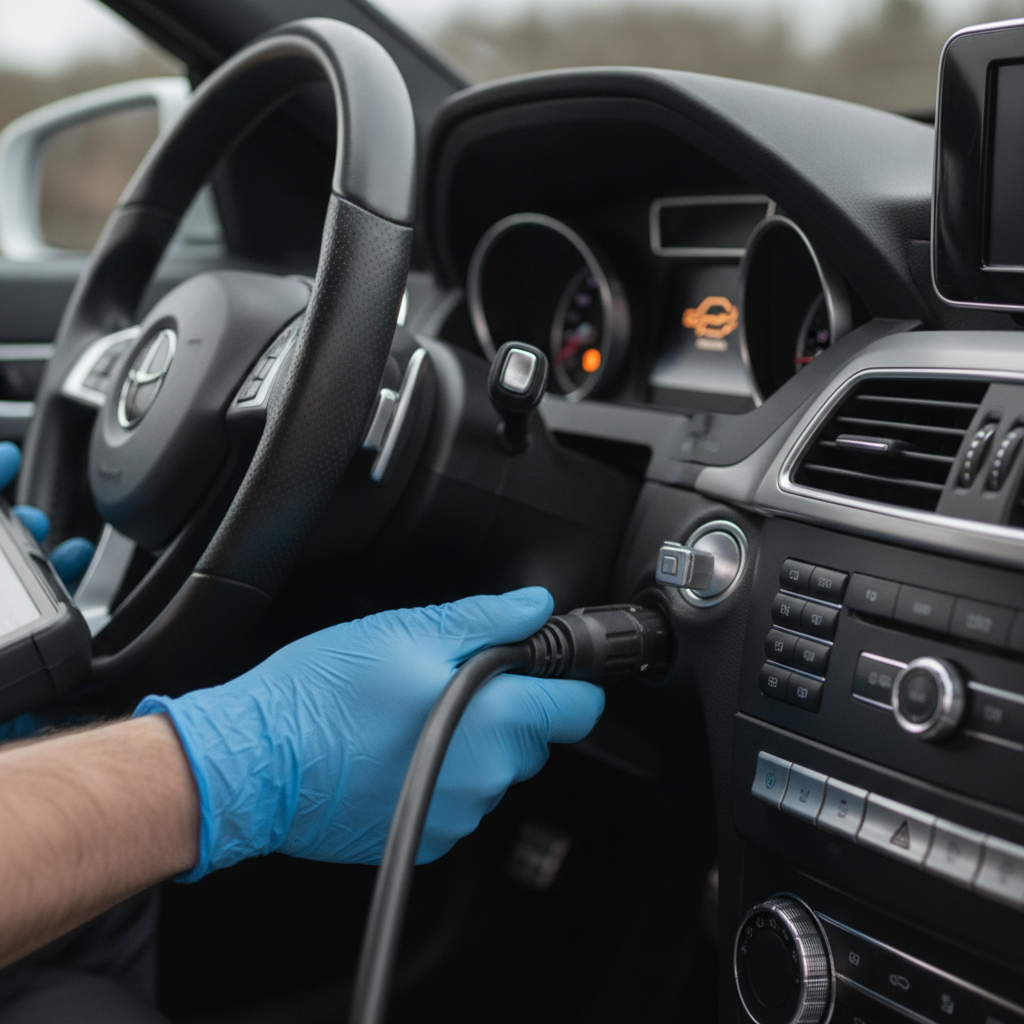
For a C-Class or E-Class showing an AdBlue fault, a mobile diagnosis session follows a consistent process. The diagnostic equipment connects to the OBD port and reads not just stored fault codes but also live data — pump pressure readings, NOx sensor values upstream and downstream, heater circuit resistance, and SCR efficiency percentages during a brief drive.
This live data is the key difference between guessing and knowing. A P20EE code alone tells you the SCR system isn’t performing — live data tells you whether the fault is the injector (low dosing volume), the NOx sensor (implausible upstream reading), the heater (circuit resistance out of range), or the pump (insufficient pressure).
Once the component is confirmed, the repair or replacement can typically be carried out on the same visit. The AdBlue system is then reset and the vehicle is checked through a short test cycle to confirm the fault code does not return before the engineer leaves. See how Mercedes heater faults present in cold weather and during diagnostics for more detail on the diagnostic approach.
Mercedes C-Class or E-Class AdBlue Fault? We Come to You
Mobile diagnosis across Staffordshire, Cheshire East, and Stoke-on-Trent. We read live SCR data, identify the specific failed component, and carry out the repair at your location — no dealer visit, no tow.
Written by James Carter, mobile AdBlue and emissions fault specialist. Published . Updated .
Frequently Asked Questions
Why does my Mercedes C-Class keep showing an AdBlue fault even after I’ve refilled the tank?
An AdBlue fault warning on a C-Class or E-Class is almost always triggered by a system component fault — the tank heater, a NOx sensor, the pump, or the injector — rather than simply low fluid. Topping up the tank addresses the fluid level, but the ECU continues running its own checks. If a component fails those checks, the countdown and warning light return. The fault code needs to be properly diagnosed and the failed component repaired or replaced before the system clears permanently.
How long can I drive with a Mercedes AdBlue countdown active?
The countdown gives you a defined mileage window — the number shown is how many miles remain before the engine will refuse to start. Each engine start reduces the counter. You should treat this as urgent and arrange diagnosis immediately. Continuing to drive without resolving the fault risks a no-start situation in an inconvenient location. The countdown does not pause or reset on its own.
What is the most common AdBlue fault on a Mercedes C-Class?
On the W205 C-Class and GLC with the OM651 engine, AdBlue tank heater failure is the most frequently diagnosed root cause. The heater is integrated into the tank assembly, and when it fails, the ECU cannot confirm proper system operation, triggering the countdown. On higher-mileage OM654-engined vehicles, NOx sensor drift is increasingly common as a second cause.
How much does it cost to fix an AdBlue fault on a Mercedes C-Class or E-Class?
Costs depend on which component has failed. An upstream NOx sensor replacement typically costs £250–£450 at an independent specialist. A full AdBlue tank and heater assembly replacement (required when the heater circuit fails) typically costs £800–£1,200 including Mercedes coding. Dealer prices are generally 30–50% higher. Proper diagnosis before any repair is essential — replacing the wrong component wastes money and leaves the fault unresolved.