
AdBlue Spill on Paintwork, Skin or Carpet: What It Damages and How to Clean It Up
Most advice about an AdBlue spill on paintwork starts by calling the fluid acidic. It isn’t. AdBlue is mildly alkaline, it is not classed as hazardous, and a fresh splash wipes off with water. The trouble starts when it is left to dry — and that is the part most drivers get wrong.
For an AdBlue spill on paintwork, wipe it off straight away with a damp cloth, then rinse the area with plenty of clean water and dry it. If it has already dried into white crystals, soften them with warm water rather than scraping. On skin, wash with water. On carpet or clothing, blot, rinse and wash before crystals form.
IN THIS GUIDE
What AdBlue Actually Is — and Why “Acidic” Is Wrong
AdBlue is 32.5 per cent high-purity urea dissolved in de-ionised water. That is the whole recipe. It is made to a tight standard so it can be sprayed into your exhaust without poisoning the SCR catalyst.
Plenty of guides describe it as an acid that eats paint. The chemistry says otherwise. BASF’s technical data sheet states that AdBlue has a faint alkaline reaction, with a pH of around 9.0 to 9.5 when fresh, rising towards 10 in storage. The same sheet notes that the dissolved urea slowly breaks down into ammonia and carbon dioxide, and faster when it is warm.
It is also not a hazardous substance. The safety data sheet from OCI, a major AdBlue producer, lists it as not classified under the CLP regulation — not for skin irritation, not for eye damage and not for toxicity. It is non-flammable too.
So why does it cause problems at all? Two reasons:
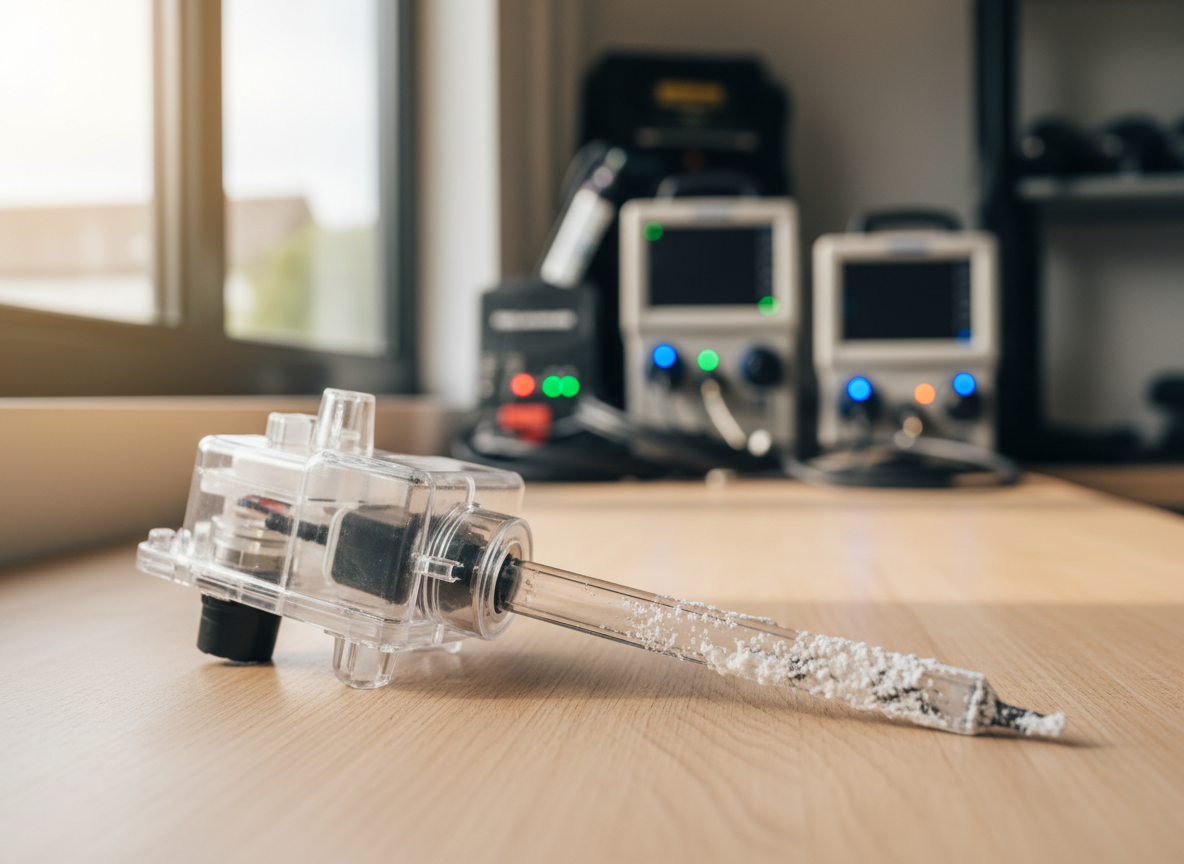
- It leaves crystals. When the water evaporates, the urea is left behind as a hard white crust. That crust is what marks paint, stiffens carpet and blocks things.
- It does not get on with some metals. BASF lists plain steel, zinc-coated steel, copper and copper alloys as unsuitable for contact with AdBlue, because of the urea and the ammonia dissolved in it.
AdBlue Spill on Paintwork: Fresh Splashes and Dried Crystals
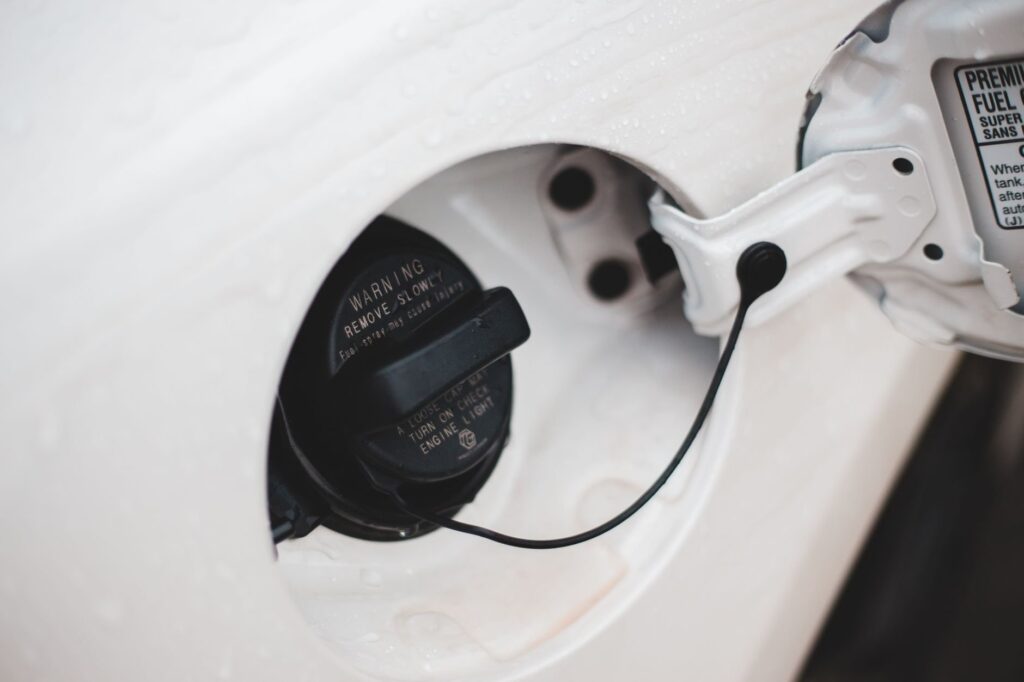
Most spills happen at the filler. Many vans and cars put the AdBlue cap right next to the diesel cap, and a glugging 10-litre container makes it easy to splash the panel below.
The equipment makers give the same simple instruction. Elaflex, which makes forecourt AdBlue nozzles, warns in its operating manual that urea solution can cause corrosion, and that accidental spills on car paint or clothes should be wiped off with a damp cloth and then cleaned with water.
If the spill is fresh
- Wipe, don’t smear. Use a damp cloth or wet kitchen roll and lift the fluid off the panel.
- Rinse with plenty of clean water. Run it down from above the spill so you are not leaving a tide mark further down the panel.
- Check the hidden places. Fluid runs into the filler flap recess, behind the flap hinge and along the sill. Rinse those too.
- Dry the area. A clean microfibre stops water spots and shows you whether anything is left.
If it has already dried
Dried AdBlue looks like white frost or salt crust, often in drips below the filler. Do not scrape it. The crystals are hard, and dragging them across lacquer will scratch it.
- Soak the crust with warm water for a minute or two to dissolve it.
- Wash the area with a normal car shampoo and rinse again.
- If a dull or stained patch remains once the panel is dry, a light polish followed by wax or sealant is usually enough to restore it.
Deep marking is uncommon and tends to mean the fluid sat there a long time, often in a hot spot by the exhaust or under the flap where nobody looks. If a mark will not polish out, that is a bodywork question rather than an AdBlue one.
On Your Skin, in Your Eyes or on Clothes
AdBlue is not classed as a skin or eye irritant, but nobody wants it splashed in the face. The first-aid advice on the OCI safety data sheet is plain:
| Where it went | What to do |
|---|---|
| Skin | Wash with plenty of water. Soap helps if it has dried on. |
| Eyes | Rinse with clean water. Get advice if they stay sore or red. |
| Breathed in | Move into fresh air and breathe normally. The sharp smell from an old container is ammonia from the urea breaking down. |
| Swallowed | Get medical advice, and take the container or its label with you. |
If irritation carries on after rinsing, speak to a pharmacist or call NHS 111. That advice applies to anyone, but especially to children, who should never be left near an open container.
Clothes: rinse the patch under the cold tap as soon as you can, then wash the item normally. Workwear that has been splashed and left can go stiff and smell of ammonia, which is the urea breaking down. It washes out.
Wearing a pair of nitrile gloves when you top up costs pennies and saves the hassle entirely.
On Carpets, Boot Liners and Upholstery
This is where spills cause the most annoyance, because AdBlue gets carried in the boot. A container that tips over on a sharp corner, or a cap that was not screwed down properly, can soak a boot carpet before you notice.
Fabric holds the fluid, the water evaporates slowly, and you are left with a crunchy white patch and a faint ammonia smell. Deal with it like this:
- Blot first. Press kitchen roll or an old towel into the wet patch to soak up as much as possible. Don’t rub it in.
- Rinse with clean water. Dampen the area, then blot again. Repeat two or three times to dilute what is left.
- For dried patches, warm water and a soft brush will dissolve the crystals. Follow with a fabric or upholstery cleaner if a mark remains.
- Dry it properly. Leave the boot open or lift out the liner. A damp carpet left closed up just swaps one smell for another.
- Check underneath. On many vans the boot or load floor has a spare wheel well or wiring beneath it. If fluid soaked through, look there too.
The simplest fix is prevention: carry AdBlue upright, in a box or crate, with the cap checked before you set off. Our guide to topping up AdBlue without spills covers the pouring side.
In the Engine Bay, on Wiring or on the Driveway
Engine bay and exhaust
On some cars the AdBlue filler is under the bonnet or in the boot rather than beside the diesel cap. A spill there can reach hot parts. Warmth speeds up the urea breaking down, which is why a splash on a hot component often produces a sharp ammonia smell. Let the engine cool, then rinse the area with water and let it dry.
Wiring and connectors
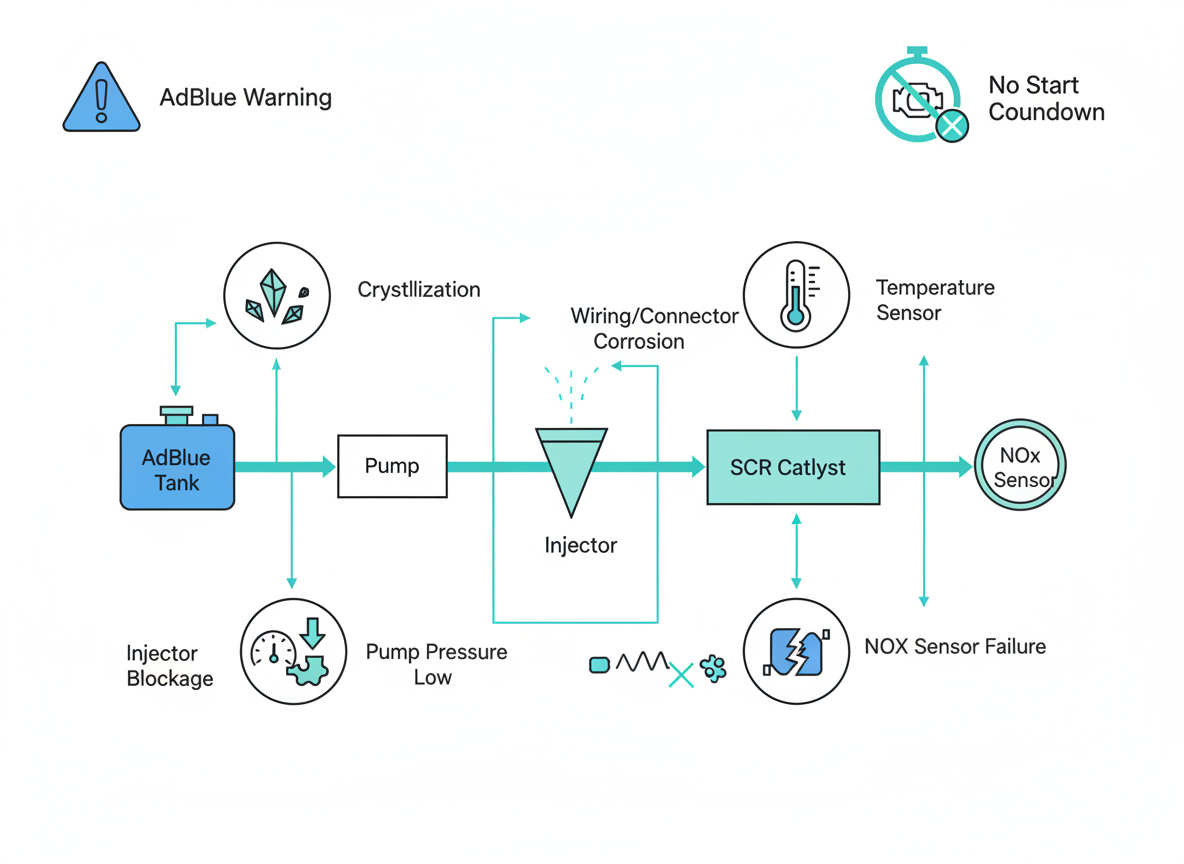
Because AdBlue does not agree with copper, a spill that runs into a wiring plug is worth taking seriously. Rinse it with clean water, let it dry fully and check the connector is sealed and clipped home. Corroded connectors are a genuine cause of AdBlue circuit fault codes, and they are far easier to prevent than to trace later.
Driveway, tarmac or garage floor
The safety data sheet’s clean-up instruction is to soak the spill up with absorbent material and avoid releasing it to the environment. For a domestic splash, that means kitchen roll, old towels or a handful of cat litter, then a rinse of the residue. Don’t hose a large quantity straight down a drain. If it dries first, you will see the same white crust as on paint; warm water shifts it.
In the diesel tank
This is the one spill that is an emergency. If AdBlue has gone into the fuel filler instead of the AdBlue filler, do not start the engine. Read our guide on what to do with AdBlue in the diesel tank before you touch the ignition.
When a “Spill” Is Really a Fault
Sometimes drivers ring us about a spill they don’t remember making. White crust appears around the AdBlue cap, under the tank or along a pipe, and nobody has been near it with a bottle.
That is not a spill. It is fluid getting out on its own, and it is worth a look. The usual sources are:
- A weeping pipe or union between the tank, pump and injector.
- A tank or pump seal that has started to leak, often leaving crust on the tank’s lower edge.
- A dosing injector crusting around its mounting on the exhaust.
- Overfilling, which pushes fluid out of the filler neck or breather as it warms up.
Crust in any of those places, especially with a warning light or a level that drops faster than it should, points to a leak rather than careless filling. Our guide to early AdBlue leak symptoms shows where to look.
Left alone, a small leak tends to get worse. Crystals build up around the joint, the pump works harder to hold pressure and, eventually, a pressure or dosing fault code appears. Catching it at the crust stage is far cheaper than catching it at the countdown stage.
If you are not sure what you are looking at, our AdBlue repair service can trace the source, replace the failed seal or component and clean up the crystal deposits properly.
Our mobile AdBlue service covers Stoke-on-Trent, Staffordshire and Cheshire East. We come to your home or workplace, check the tank, pump, pipes and injector, and tell you whether it is a spill, an overfill or a leak. Book a visit →
Frequently Asked Questions
Does AdBlue damage car paint?
A fresh spill wiped off and rinsed straight away very rarely leaves a mark. The risk comes from leaving it. As the water evaporates, hard urea crystals form that can dull or stain the lacquer, and equipment makers warn the solution can cause corrosion. Wipe, rinse with plenty of water and dry the panel.
Is AdBlue harmful to skin?
AdBlue is not classified as a skin irritant. Producer safety data says to wash it off with plenty of water. Wash promptly, wear gloves when you top up, and get advice if irritation continues.
How do you get dried AdBlue off a car?
Soak the white crystals with warm water until they dissolve, then wash with car shampoo and rinse. Don’t scrape them, as the crystals can scratch the lacquer. A light polish and wax will usually sort any dull patch left behind.
Is AdBlue flammable?
No. Safety data sheets list AdBlue as non-flammable. A spill near the exhaust is not a fire risk, but heat speeds up its breakdown into ammonia, so rinse it off once things have cooled.
Published: 12 November 2026 | Updated: 12 November 2026 | Author: AdBlue Specialist, mobile AdBlue and SCR repair technicians | Service area: Staffordshire, Cheshire East, Stoke-on-Trent
Featured image: Photo by Erik Mclean on Pexels