
The Ford Ranger is the UK’s best-selling pickup truck — and since Ford replaced the 3.2 Duratorq with the 2.0-litre EcoBlue engine in the 2019 facelift, every new Ranger on UK roads has an AdBlue system. That means a growing number of Ranger owners are encountering their first AdBlue warning lights, and many are searching for clear, specific information that actually applies to their vehicle — not to the Transit, the Focus, or some other diesel platform entirely.
The Ford Ranger’s EcoBlue engine shares its SCR (selective catalytic reduction) architecture with other Ford EcoBlue diesel vehicles, but its dosing system layout, heater routing, and ECU calibration produce a distinct set of fault patterns. This guide explains the most common AdBlue faults on the Ford Ranger, what each fault code means, what causes them, and what it actually takes to fix them properly.
Ford Rangers built from 2019 onwards with the 2.0-litre EcoBlue engine have a 20-litre AdBlue tank and a full SCR dosing system. The most common AdBlue fault is P20BA (reductant heater circuit), which is particularly frequent in colder months due to the Ranger’s exposed underside dosing pipework. P20EE (SCR efficiency) and P207F (AdBlue quality) also appear on Rangers, and all three typically require specialist diagnostic tools and a reset — topping up the tank alone will not clear them.
In this guide
- Which Ford Rangers have AdBlue?
- The most common Ford Ranger AdBlue fault codes
- P20BA explained: the Ranger’s most common fault
- P20EE and P207F on the Ford Ranger
- Warning stages and no-start countdown
- Why topping up AdBlue doesn’t fix most Ranger faults
- How a mobile specialist fixes Ford Ranger AdBlue faults
- Frequently asked questions
Which Ford Rangers have AdBlue?
Only Ford Rangers fitted with the 2.0-litre EcoBlue diesel engine have an AdBlue (diesel exhaust fluid) system. This engine was introduced in the UK with the Ranger T6 facelift in 2019. Rangers built before 2019 used the 3.2-litre five-cylinder Duratorq TDCi engine, which meets Euro 6 through a different emissions control approach and does not require AdBlue at all.
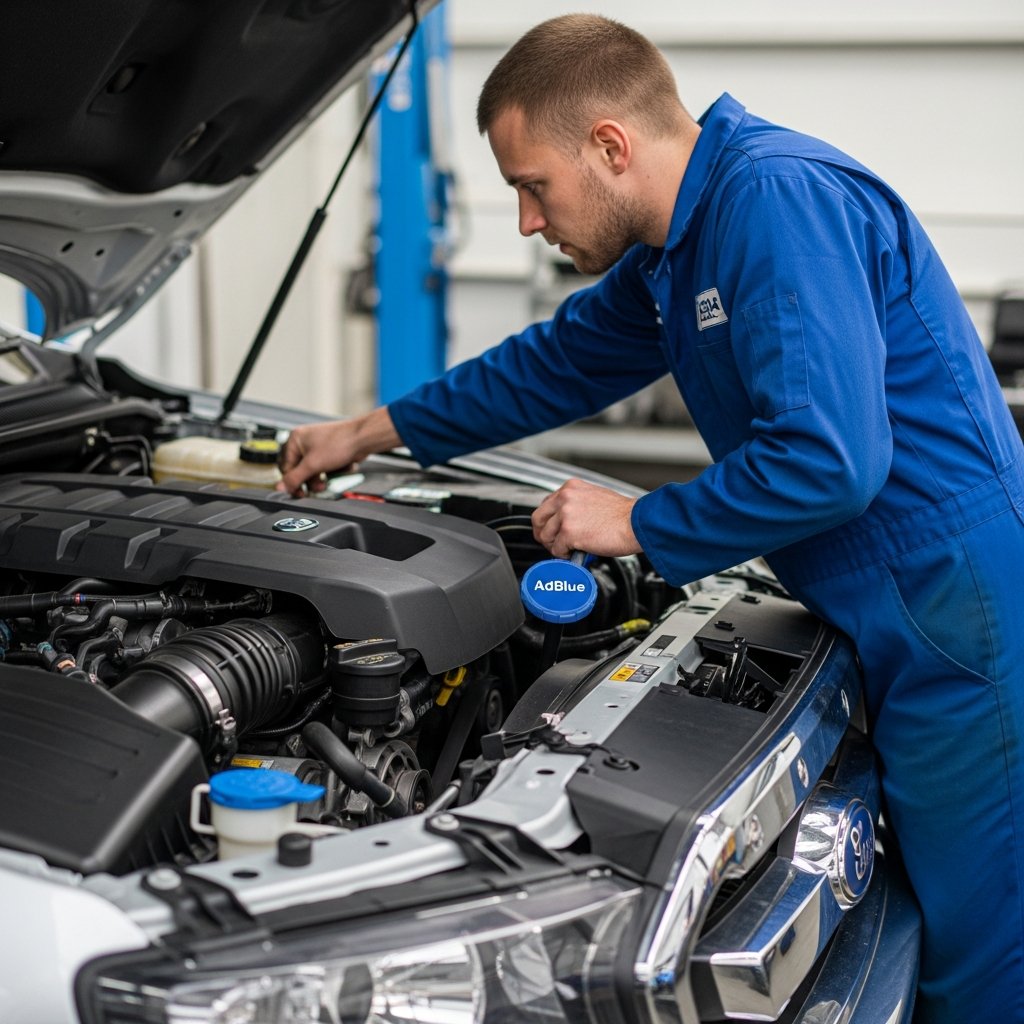
The 2.0 EcoBlue Ranger is available in 170 hp single-turbo and 213 hp bi-turbo forms. Both share the same SCR dosing system and carry an AdBlue tank capacity of 20 litres, according to Ford’s own service documentation for the GBR market. The AdBlue filler cap is a separate blue-capped port, usually located in the engine bay near the washer fluid reservoir. Newer Ranger T6.2 and T7 models (from 2022 onwards) retain the same EcoBlue platform and the same AdBlue requirements.
If you own a Ranger Wildtrak, Ranger Raptor (EcoBlue), or any Ranger XLT/Limited with the 2.0 diesel, AdBlue is part of your vehicle’s emissions system. Missing a refill, or having a fault in the dosing system, will trigger warnings and eventually prevent the engine from restarting.
The most common Ford Ranger AdBlue fault codes
The Ranger uses the same fault code framework as other EcoBlue diesel vehicles — SAE J2012 standardised DTC codes — but the specific codes that appear most frequently differ from the Transit or Focus, because the Ranger’s dosing system layout and underbody routing create different vulnerability points.
Ford Ranger AdBlue fault code reference
| Code | Description | Common cause on Ranger |
|---|---|---|
| P20BA | Reductant Heater — Circuit Malfunction | Heater element failure or wiring damage on exposed pipework; very common in winter |
| P20EE | SCR NOx Catalyst Efficiency Below Threshold | Degraded SCR catalyst, dosing injector crystallisation, or poor fluid quality |
| P207F | Reductant Quality Performance | Contaminated or diluted AdBlue; sensor drift; dosing injector restricting flow |
| P20E8 | Reductant Pressure Too Low | Dosing pump wear, blocked filter, frozen lines in cold weather |
| P2BAE | Reductant Injection — Control Circuit | Dosing injector electrical fault or damaged wiring connector |
P20BA explained: the Ford Ranger’s most common AdBlue fault
P20BA — Reductant Heater Circuit Malfunction — is the fault code most Ranger owners will encounter first, and it is particularly common in the UK during autumn and winter. The heater circuit keeps the AdBlue dosing lines warm enough to function in sub-zero temperatures. If the heater element or its wiring develops a fault, the ECU logs P20BA and, depending on how long the fault is present, may restrict performance or trigger a countdown.
Why is it more common on the Ranger than on a Transit or Focus? The Ranger’s chassis-mounted AdBlue dosing pipework runs along the underside of a pickup body, exposed to road debris, temperature extremes, and the significant mud and water splash that off-road or farm use brings. That exposure accelerates wear on wiring connectors and heater elements in ways that are less common on vans where the pipework is more sheltered.
A key warning sign of P20BA is an AdBlue fault appearing in cold weather that seems to clear or improve once the vehicle has warmed up, then returns the following morning. This is classic heater circuit behaviour: the heater is failing to bring the fluid to operating temperature on cold starts, the ECU sees a quality or pressure anomaly, and logs the fault.
Clearing P20BA requires more than a scan tool reset. The heater element or circuit needs to be diagnosed properly to confirm whether it is the element itself, a wiring fault, or a connector corrosion issue, and the underlying cause addressed before a reset will hold. A reset without the repair means the code will return within days.
P20EE and P207F on the Ford Ranger: what they actually mean
P20EE (SCR NOx Catalyst Efficiency Below Threshold) is the code that causes most Ranger owners the most concern, because it implies something is wrong with the SCR catalyst itself. On the Ranger, however, this fault code more often reflects a dosing problem than a failed catalyst. If the dosing injector has crystallised fluid restricting its spray pattern, or if P20BA has been present for some time and the heater has been dosing incorrectly, the ECU concludes that the SCR system is not reducing NOx as it should — and logs P20EE accordingly.
The practical implication: replacing the SCR catalyst is rarely the first step. A proper diagnostic sequence tests the dosing system, the injector spray pattern, and the NOx sensor readings before drawing any conclusion about catalyst condition. This is why dealer-style fault code reading without deeper investigation often leads to expensive parts being replaced unnecessarily.
P207F (Reductant Quality Performance) appears on the Ranger in two distinct scenarios. The first is genuine fluid contamination or degradation — AdBlue that has been stored incorrectly, used past its shelf life, or cross-contaminated with water or diesel. The second, and more common, is sensor drift or a dosing injector that has become partially blocked, causing the ECU to read the fluid characteristics as off-spec even when the fluid is perfectly good. Draining and refilling the tank sometimes resolves this temporarily, but the fault tends to return if the underlying sensor or injector issue is not addressed.
For further reading on how P20BA and P207F interact across Ford EcoBlue models, our P20BA Ford Ranger and Transit dosing fault guide covers the fault in more detail. Our general AdBlue fix service covers all makes and models if you want to understand the wider service offering.
Ford Ranger AdBlue warning stages and the no-start countdown
The Ford Ranger follows the same warning escalation as other Euro 6 diesel vehicles, but the specific triggers depend on the nature of the fault. There are two separate scenarios to understand:
Fluid level warnings
When the AdBlue tank level drops below a certain point — typically around 2,000 km of remaining range — the dashboard displays an amber warning with a range countdown. This is not a fault code; it is simply a reminder to refill. The Ranger’s 20-litre tank gives a reasonable operational range between fills, but high-mileage drivers can cover the tank quickly, especially in cold conditions where dosing rates may be higher as the system compensates for temperature. If the tank empties completely and the vehicle is restarted, the ECU may lock out engine restarts until the system is refilled and reset by a specialist.
System fault warnings
When an AdBlue system fault (P20BA, P20EE, P207F, or similar) is logged, the dashboard displays a fault warning — often accompanied by a countdown or a “Service Required” message. This countdown is not about fluid level; it is about an unresolved system fault. Once a system-fault countdown reaches zero and the ignition is cycled off, many Ranger models will not restart until the fault is cleared by a specialist with appropriate software. Refilling the tank will not resolve a system fault countdown.
Why topping up AdBlue does not fix most Ford Ranger faults
This is the most important practical point for Ranger owners: adding more AdBlue to the tank addresses a low level warning, but it does nothing for a fault code. The ECU logs P20BA, P20EE, or P207F because of a specific system anomaly — a heater circuit failure, catalyst efficiency reading, or fluid quality calculation — and it will only clear that log when a specialist connects diagnostic software and performs the appropriate reset after addressing the root cause.
Ranger owners who top up the tank hoping to clear a dashboard warning and find the warning persists (or returns within 50 miles) are experiencing exactly this: the fault was not a low fluid level, it was a system fault that happens to trigger a warning that looks similar. Without a diagnostic connection, there is no way to distinguish between the two from the dashboard alone.
Similarly, Ranger owners who have cleared the fault with a generic OBD reader and seen it return are finding out that a code clear is not a fix — it only resets the countdown. The underlying cause (heater element, sensor, injector) remains and the ECU will re-log the fault as soon as it completes its next self-test cycle, typically within 50 to 100 miles of driving.
How a mobile specialist fixes Ford Ranger AdBlue faults
A proper diagnostic session on a Ford Ranger with AdBlue faults involves connecting manufacturer-level software to read all stored and pending fault codes, testing the heater circuit resistance against specification, checking dosing injector function and spray pattern, reviewing NOx sensor data, and assessing whether the SCR catalyst is genuinely degraded or simply not receiving correctly dosed fluid.
In most cases, the fix is a combination of addressing the specific component failure (heater element, connector, injector cleaning or replacement, sensor replacement) and performing the manufacturer-specified diagnostic reset to clear the fault log and allow the ECU to verify the repair. This can be done at your location — home, workplace, or field — without recovering the vehicle.
AdBlue Specialist covers Staffordshire, Cheshire East, and Staffordshire Moorlands. We carry specialist tools for Ford EcoBlue diagnosis and can often attend on the same day. If your Ranger has an AdBlue warning or has already entered a countdown, early contact gives the most options for a same-location fix before the engine locks out entirely.
Ford Ranger AdBlue fault? We come to you.
Mobile EcoBlue diagnostics across Staffordshire and Cheshire East. P20BA, P20EE and P207F resolved on-site, without recovery or workshop delays.
Frequently asked questions
Do all Ford Rangers have AdBlue?
No. Only Ford Rangers fitted with the 2.0-litre EcoBlue diesel engine (introduced in the 2019 facelift) use AdBlue. Earlier Rangers with the 3.2-litre Duratorq TDCi do not have an AdBlue system.
How much AdBlue does a Ford Ranger hold?
The Ford Ranger 2.0 EcoBlue has a 20-litre AdBlue tank, according to Ford’s official service documentation for the UK market.
What is the most common AdBlue fault code on the Ford Ranger?
P20BA (Reductant Heater Circuit Malfunction) is the most frequently seen code on the Ranger, particularly in winter. It relates to the heating element that keeps the AdBlue dosing lines from freezing, and it requires a component repair and diagnostic reset — not just a fluid top-up.
Will my Ford Ranger not start because of an AdBlue fault?
Yes, if an AdBlue system fault countdown reaches zero and the ignition is cycled, many Ranger models will not restart until the fault is cleared by a specialist. Refilling the tank alone will not override a system fault countdown — a diagnostic reset with professional software is required.