
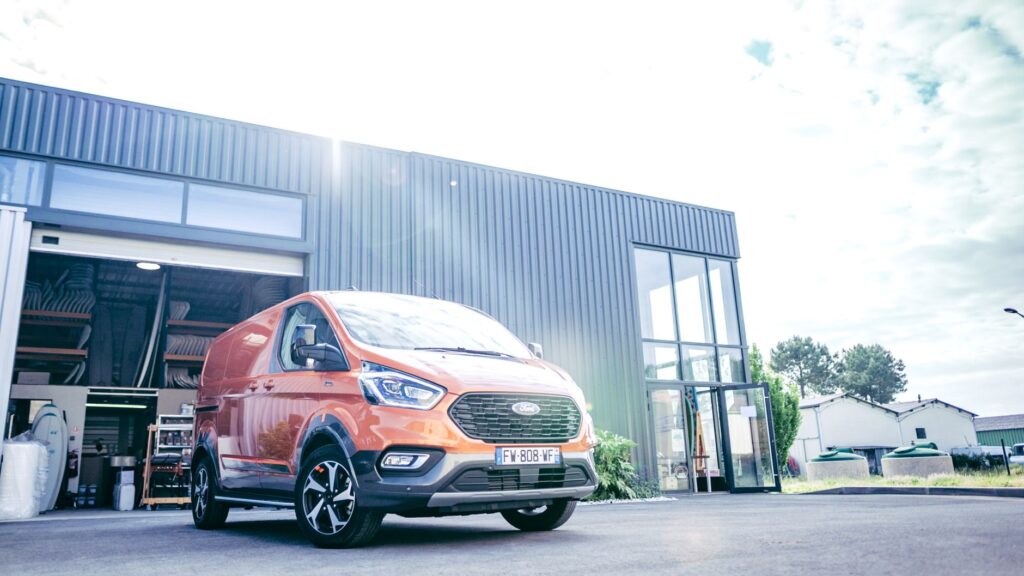
AdBlue Fault Guide — Ford Transit Custom
Ford Transit Custom AdBlue Fault Guide: Warning Lights, Codes & What to Do
The Ford Transit Custom’s 2.0 EcoBlue engine uses an SCR AdBlue system that is reliable in most conditions, but when it develops a fault the dashboard messages can be confusing and the countdown to no-start feels sudden. This guide covers the most common AdBlue warning messages, fault codes, causes, and repair options for Transit Custom owners across the UK.
Quick Answer
The most common AdBlue fault codes on the Ford Transit Custom 2.0 EcoBlue are P20EE (SCR catalyst efficiency below threshold), P20BA (reductant injector heater circuit), and P204F (SCR system performance). The most frequent dashboard messages are “AdBlue: Service Required” and “AdBlue System Fault.” The Transit Custom shows a kilometre countdown when AdBlue is low or when an SCR fault is detected — once it reaches zero, the van will not restart. Mobile diagnosis and same-day repair are available across Staffordshire and Cheshire East.
Contents
Ford Transit Custom AdBlue System Overview
The Ford Transit Custom received the 2.0 EcoBlue diesel engine as part of its Euro 6 compliance upgrade from 2016 onwards. This engine uses a Selective Catalytic Reduction (SCR) system to reduce nitrogen oxide (NOx) emissions. AdBlue — also known as Diesel Exhaust Fluid (DEF) — is stored in a separate tank and injected into the exhaust stream to react with NOx gases and convert them into harmless nitrogen and water vapour.
The Transit Custom’s SCR system includes an AdBlue pump and dosing module, a dosing injector fitted into the exhaust before the SCR catalyst, two NOx sensors (one upstream and one downstream of the catalyst), and an AdBlue tank with a level sensor. The PCM monitors all of these components continuously and stores diagnostic trouble codes when any part of the system operates outside expected parameters.
The AdBlue tank on the Transit Custom holds approximately 19 litres and typically covers between 5,000 and 10,000 miles on a refill depending on driving conditions and load. Vans driven in urban stop-start conditions tend to use more AdBlue than motorway vans because the SCR system works harder at lower exhaust temperatures.
Warning Messages on the Transit Custom Dashboard
The Ford Transit Custom uses the instrument cluster message centre to communicate AdBlue warnings. The following messages are the most commonly reported across all model years.
| Dashboard Message | What It Means | Urgency |
|---|---|---|
| “AdBlue: X miles remaining” | Tank is low — refill needed | Low — top up soon |
| “AdBlue: Service Required” | SCR fault detected — diagnostic needed | Medium — book soon |
| “AdBlue Fault Please Service Vehicle” | System fault stored in PCM | Medium-High |
| “Engine start not possible in X km” | Countdown to no-start condition | High — act before countdown expires |
| “Engine start not possible” | No-start condition active | Critical — immediate attention needed |
The countdown message is the most critical stage before immobilisation. On the Transit Custom, this countdown typically starts from around 2,400 km. The countdown is based on distance driven, not time elapsed, so a van parked overnight will not lose countdown kilometres.
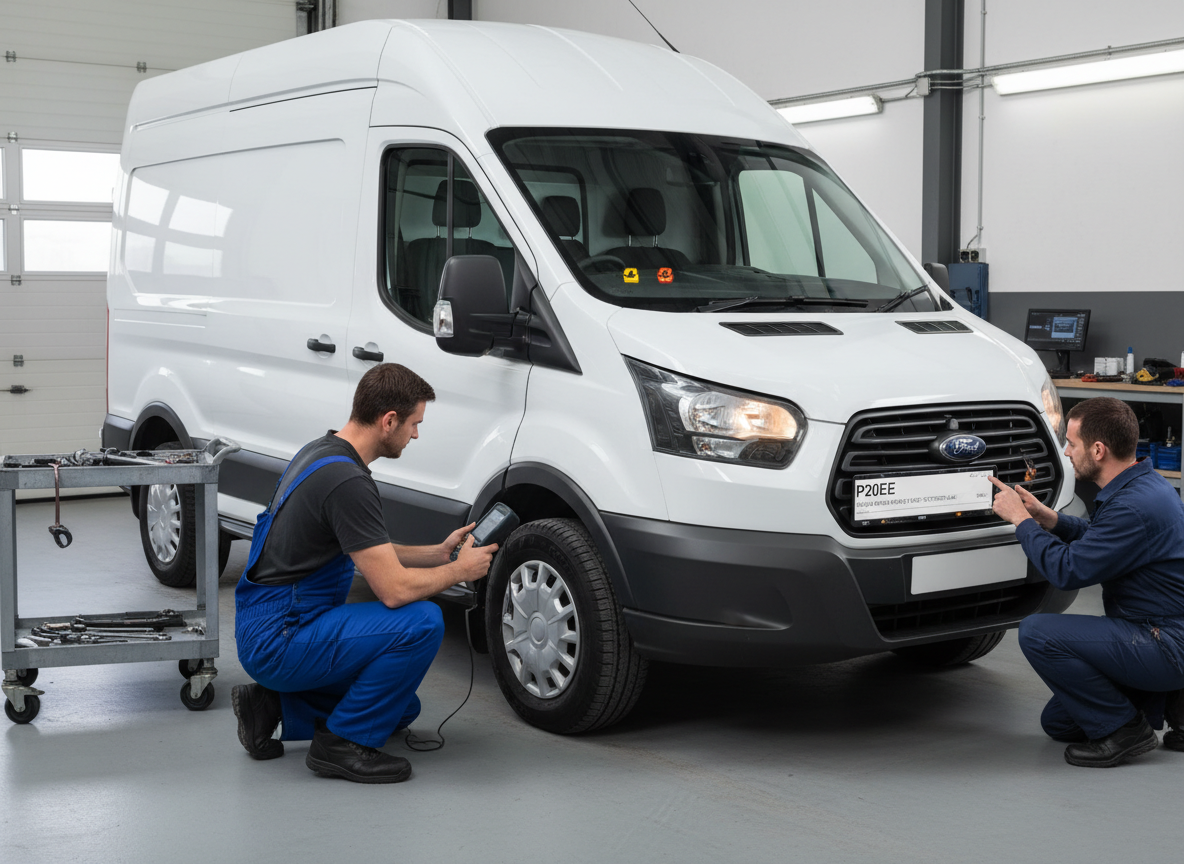
Common AdBlue Fault Codes on the Ford Transit Custom
P20EE — SCR NOx Catalyst Efficiency Below Threshold
This is the most frequently reported AdBlue fault code on the Transit Custom 2.0 EcoBlue. P20EE means the downstream NOx sensor is detecting more NOx after the SCR catalyst than the system expects. On the Transit Custom, P20EE is commonly caused by a dosing unit failure preventing correct AdBlue injection, rather than by the catalyst itself. A thorough SCR system test — including a live dosing check — is needed to determine the true root cause before replacing components.
P20BA — Reductant Injector Heater Circuit
P20BA indicates a fault in the heater circuit for the AdBlue dosing injector. The dosing injector is heated to prevent AdBlue from freezing in cold conditions. When the heater circuit fails, this code is stored. It is particularly common during winter months or after significant temperature fluctuations, and can cause the system to under-dose or fail to dose altogether when temperatures are low.
P204F — Reductant System Performance
P204F signals an overall SCR system performance problem. On the Transit Custom, this code often accompanies P20EE and typically points to the dosing module not operating within its expected pressure or flow parameters. It may appear alone or alongside other SCR codes.
P246B — Reductant Control Module Performance
P246B indicates that the reductant control module itself is not performing correctly. In some cases, a software update resolves P246B. In others, the dosing control unit requires replacement.
Most Common Causes of AdBlue Faults on the Transit Custom
Dosing unit failure
The AdBlue dosing unit is the most common single point of failure in the Transit Custom’s SCR system. The dosing unit contains a pump, a heater element, and a control circuit. Any of these sub-components can fail. When the dosing unit stops injecting AdBlue correctly, the downstream NOx sensor detects the absence of conversion and P20EE is triggered. In early-stage failure, the symptoms may be intermittent. As the failure progresses, the fault becomes permanent.
NOx sensor failure
NOx sensors on the Transit Custom have a finite lifespan and are susceptible to contamination from engine oil vapour and extreme exhaust temperatures. The downstream NOx sensor is more commonly affected than the upstream one. A failed downstream sensor produces inaccurate readings that make the ECU believe the system is underperforming, even when dosing is occurring correctly. Replacing the faulty sensor and clearing the code is often the complete resolution.
AdBlue crystallisation
AdBlue that evaporates from a leaking fitting or faulty dosing injector seal leaves behind white urea crystals. These crystals can block small passages within the dosing system and in severe cases cause mechanical damage to the dosing pump internals. Mild crystallisation can be cleaned. More extensive crystallisation usually requires dosing unit replacement.
Contaminated or low-quality AdBlue
Using substandard AdBlue, accidentally adding water to the tank, or using AdBlue past its shelf life can cause P20EE or P204F. In these cases, draining and refilling the tank with fresh, ISO 22241-grade AdBlue followed by an SCR reset often resolves the fault without component replacement.
SCR Dosing Unit Failure on the Transit Custom
A failing dosing unit on the Transit Custom typically follows a progression. Early on, the unit may operate correctly when the van is fully warmed up but struggle during cold starts — producing P20BA or intermittent P20EE codes. As the failure develops, the unit may stop priming correctly on startup. In later stages, it stops injecting AdBlue entirely, P20EE and P204F are stored permanently, and the countdown begins.
Proper diagnosis involves running a live data test using a Ford-compatible professional diagnostic system. This checks whether the unit is responding to dosing commands, whether it is achieving correct operating pressure, and whether the heater circuit is functioning. A visual inspection for crystallisation evidence is also important.
Replacement of the Transit Custom dosing unit is typically carried out as a complete assembly replacement and can be performed on-site by a mobile specialist. Costs for supply and fit typically range from £400 to £700 depending on the unit supplier and any ancillary work required.
Can I Still Drive My Transit Custom With an AdBlue Fault?
In most cases, the Transit Custom will continue to drive normally through Stage 1 (low fluid warning) and Stage 2 (countdown active). The engine produces full power and the van can be used for normal work. The critical point is when the countdown reaches zero — at that stage, the next time you switch the engine off, the van will not start again.
If the dashboard shows any variation of “AdBlue Fault: Service Required” without a countdown, you still have time to arrange a diagnostic visit before the countdown begins. Acting at this stage is significantly easier than arranging emergency assistance once the countdown has expired.
Repair Options: Mobile Specialist vs Dealer vs Workshop
Mobile AdBlue specialist
A mobile specialist who focuses specifically on AdBlue and SCR system faults brings professional diagnostic equipment and repair capability to your vehicle’s location. This avoids the need to transport an immobilised or countdown-warning van to a workshop. Costs are generally lower than a dealer visit, appointment turnaround is faster, and the diagnostic process is focused specifically on the SCR system.
AdBlue Specialist covers Stoke-on-Trent, Stafford, Newcastle-under-Lyme, Crewe, Nantwich, Congleton, Sandbach, and surrounding areas in Staffordshire and Cheshire East. Same-day and next-day visits are available for urgent cases.
Ford dealer
A Ford dealer has access to Ford-specific diagnostic tooling and genuine parts. For Transit Customs still within warranty, a dealer visit may be the most appropriate route. For out-of-warranty vans, dealer pricing for dosing unit replacement and labour tends to be higher than an independent specialist.
Independent workshop
Many independent workshops can scan and diagnose AdBlue faults on the Transit Custom. However, the ability to carry out a full SCR efficiency test — including live dosing system checks — varies by workshop. Confirm the workshop has the specialist tooling needed to properly test the system before committing to a repair.
Transit Custom AdBlue Fault? We Come to Your Location
AdBlue Specialist provides mobile SCR diagnosis and repair for Ford Transit Custom vans across Staffordshire, Cheshire East, and Staffordshire Moorlands. We use professional diagnostic tooling to test your dosing unit, NOx sensors, and SCR catalyst efficiency on-site. Most faults are diagnosed and resolved in a single visit.
Frequently Asked Questions
What is the most common AdBlue fault on the Ford Transit Custom?
The most common AdBlue fault on the Transit Custom 2.0 EcoBlue is P20EE (SCR catalyst efficiency below threshold), most frequently caused by a failing AdBlue dosing unit. The dosing unit stops injecting AdBlue correctly, the downstream NOx sensor detects the lack of conversion, and P20EE is stored. A dosing unit replacement resolves the fault in the majority of cases.
How long does the Transit Custom countdown last?
The Transit Custom typically starts its no-start countdown from around 2,400 km remaining. This is a distance-based countdown — parked time does not reduce it. A van covering 200 km daily would exhaust a 2,400 km countdown in around 12 days. Act well before the countdown expires to avoid being left unable to start the van.
Can I reset the AdBlue fault myself on a Transit Custom?
Using an OBD reader to clear the stored fault code will remove it from memory temporarily. However, if the underlying fault — such as a dosing unit failure — has not been repaired, the ECU will re-detect the same problem and store the code again within a short drive cycle. The countdown will also resume. A code clear is not a repair.
How much does it cost to fix an AdBlue fault on a Transit Custom?
Cost depends on the fault. If caused by low or contaminated AdBlue, a drain, refill, and system reset is relatively inexpensive. If the dosing unit has failed, supply and fit typically costs between £400 and £700. NOx sensor replacement is generally £200 to £450 depending on which sensor has failed. A diagnostic visit will confirm the exact fault before any repair is quoted.
Is there a software solution for Transit Custom AdBlue faults?
For Transit Custom vans used exclusively off-road, a software-based solution that removes the AdBlue system from the ECU is available. This eliminates all AdBlue fault codes, warning messages, and the no-start countdown. No physical components are cut or damaged. This option is for off-road use only. Contact AdBlue Specialist to discuss whether this is appropriate for your van.