
AdBlue Fault Code Guide — P2BAD
P2BAD Fault Code on Peugeot: NOx Concentration Too High and What It Really Means
P2BAD is not a component code. It is the SCR system reporting that too much NOx left the tailpipe — and on a Peugeot, that reading almost never tells you which part failed. This guide explains what actually triggers it, why the code it appears alongside matters more than the code itself, and how it is properly diagnosed on-site across Staffordshire and Cheshire East.
Quick Answer
P2BAD on a Peugeot means the engine management system has measured NOx leaving the exhaust above the level it is allowed to. It is an outcome code, not a fault location. The usual causes are poor AdBlue quality, an under-dosing or blocked injector, crystallisation in the SCR, a drifting downstream NOx sensor, or a genuinely degraded catalyst — in roughly that order of likelihood.
Contents
What P2BAD Actually Means
P2BAD belongs to the P2BA_ family of NOx exceedance codes. Every code in that group says the same underlying thing: the vehicle worked out that its tailpipe nitrogen oxide output went past the threshold it was type-approved to meet. What separates them is the qualifier the manufacturer attaches — one blames deactivated EGR, another blames reagent quality, another reports the cause as unknown.
Here is the part most code-lookup sites get wrong. The description printed against P2BAD is not consistent across manufacturers. Depending on whose software you read it with, you will see it rendered as a root-cause-unknown exceedance or as an SCR catalyst conversion efficiency exceedance. Those are meaningfully different sentences, and neither of them is a diagnosis.
So treat P2BAD the way the ECU intends it: as a result. The vehicle is not telling you what broke. It is telling you that whatever the SCR system did over the last drive cycle, it was not enough.
Why It Is Usually Not a Dead Catalyst
The default assumption — including from a lot of garages — is that a NOx exceedance means the SCR catalyst is spent and needs replacing. That is the most expensive possible conclusion and it is rarely the correct one on a BlueHDi Peugeot with reasonable mileage.
A catalyst converts NOx using ammonia released from AdBlue. If the fluid is weak, contaminated, or simply not arriving in the right quantity, the catalyst can be in perfect condition and still fail to convert enough. The measurement at the tailpipe looks identical either way. That is the whole trap.
The scale of the underlying problem is not in dispute. In the evidence supporting its current review of in-use emissions law, the Department for Transport cites a roadside remote-sensing study of more than 94,000 vehicles which found that fewer than 1 in 10 passenger cars met the official limits for nitrogen oxides, with around two-thirds of Euro 5 and Euro 6 diesel cars emitting more than three times the level allowed. Most of those cars do not have a failed catalytic converter. They have SCR systems that are degraded, poorly maintained, or not dosing properly.
The Code It Appears With Matters More Than P2BAD Itself
If you take one diagnostic habit from this page, take this one: read the whole fault memory, not the headline code.

P2BAD on its own is thin information. P2BAD stored alongside P20EE, the SCR efficiency-below-threshold code seen constantly on Peugeot and Citroën BlueHDi engines, is a much more specific picture. Where we see those two together, fluid quality and dosing are worth ruling out properly before anybody quotes for catalyst work.
The same logic applies to its near neighbour. P2BAE is a related NOx-limit code and gets confused with P2BAD constantly, but they are not interchangeable and the diagnostic routes differ — we have covered what P2BAE means and how it is worked through separately. If your scanner reported one and a forum post described the other, you are chasing the wrong fault.
What Triggers P2BAD on a Peugeot
These are the causes worth working through, ordered by how often they turn out to be the answer rather than by how dramatic they sound.
| Cause | What you would also expect to see |
|---|---|
| Poor or contaminated AdBlue | Quality or reagent codes stored alongside; often a recent top-up from an open or old container |
| Under-dosing injector | AdBlue consumption lower than it should be; crystalline deposits at the injector |
| Crystallisation in the SCR or dosing line | Restricted flow, pressure faults, a history of short low-temperature journeys |
| Downstream NOx sensor drift | Sensor circuit codes; implausible readings compared with the upstream sensor |
| Genuinely degraded SCR catalyst | Everything above verified as healthy first, and high mileage |
| EGR contribution | Separate EGR codes; raised engine-out NOx before the SCR gets a chance |
Crystallisation deserves a specific mention because it is quiet. It builds gradually, it produces no dramatic symptom until it produces a fault, and it is strongly associated with vehicles that do a lot of short, cool journeys. We have written about the symptoms of AdBlue crystallisation and the damage it does to an SCR system in detail.
How P2BAD Is Diagnosed Properly
A correct diagnosis for a NOx exceedance code is a process of elimination, and it has to be done in order. Skipping to the expensive component is how people end up paying twice.
- Read the full fault memory, including freeze-frame data. The conditions under which the exceedance was recorded — load, temperature, road speed — narrow the field immediately.
- Check the fluid itself. Concentration and contamination are cheap to test and expensive to ignore.
- Compare upstream and downstream NOx sensor live data. A sensor that disagrees with physics is a sensor, not a catalyst.
- Verify dosing quantity and injector condition. Under-dosing produces exactly this code with no component fault stored at all.
- Only then assess the catalyst. By this point you are testing a hypothesis rather than guessing.
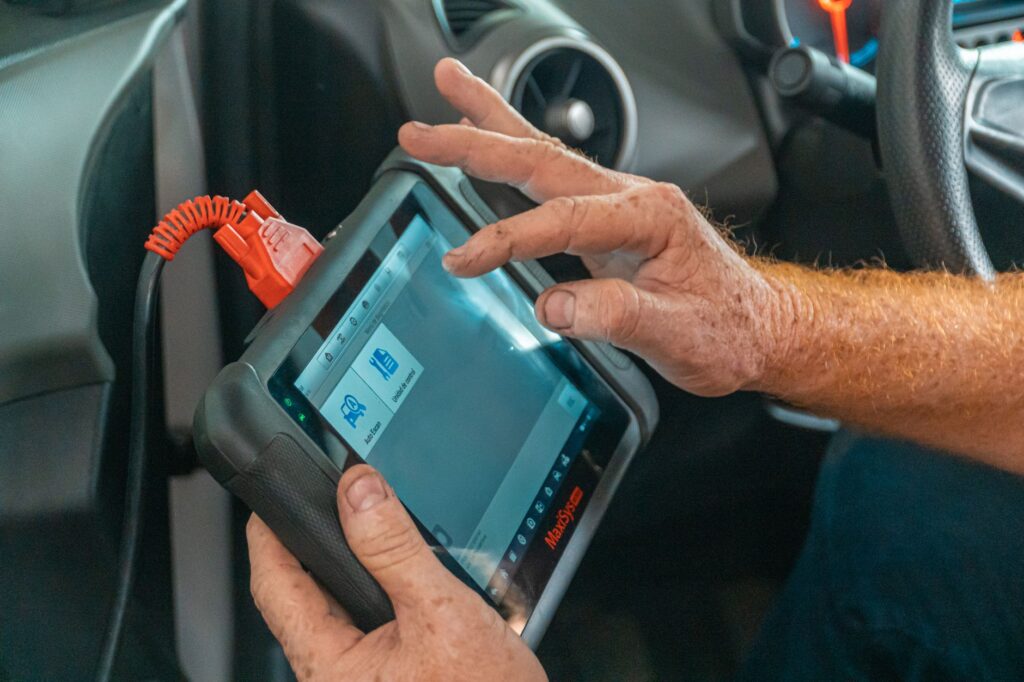
P2BAD is not a code you can meaningfully diagnose from a cheap generic reader in a car park. It needs live data and manufacturer-level access, which is precisely why it is worth having someone come to the vehicle with the right equipment rather than swapping parts hopefully. If you want the wider context on how these codes relate to each other, our guide to the most common AdBlue fault codes and what each one is actually reporting is a good place to start.
⚠ Clearing P2BAD Does Not Fix P2BAD
A NOx exceedance is recalculated on the next qualifying drive cycle. Clear the code without changing anything and it will return, usually within days. If it returned after a previous “fix”, that is useful diagnostic information in itself — it means the previous repair did not address the cause.
What P2BAD Means for Your MOT
Two things matter here, and drivers routinely get them the wrong way round.
First, the light. Under the DVSA inspection manual, an engine malfunction indicator lamp that is inoperative or indicating a malfunction is a Major defect — and a Major defect is a fail. Testers are also required to check visible, identifiable emissions components, including selective catalytic reduction valves, and to reject a vehicle where manufacturer-fitted emission control equipment is missing, obviously modified or obviously defective.
Second, and more surprisingly: an AdBlue leak on its own is not a failure item. The same manual states plainly that a leak of fluid required for selective catalytic reduction is not a reason for failure. So a damp AdBlue fitting will not fail your MOT — but the stored fault and the illuminated dash light that usually accompany it will.
Why Deleting It Is the Wrong Answer in 2026
We fix AdBlue systems and we also offer removal for off-road vehicles, so we have no reason to be squeamish about this. But the ground is moving, and anyone weighing up a delete on a road-going Peugeot should know where it is moving to.
The Department for Transport is currently consulting on making it a legal requirement that a vehicle’s emissions control system keeps working to the standard it was built to. Its proposal names manipulation of SCR systems and diesel exhaust fluid, “often referred to as AdBlue Delete”, among the modifications it would always consider illegal, with breaches of the relevant Road Traffic Act sections carrying fines from £1,000 up to an unlimited amount on conviction. The consultation closes on 6 September 2026 and new legislation is envisaged for summer 2027, with a proposed six-month lead-in.
That is a proposal, not law yet. But it is a clear direction of travel, and it changes the arithmetic on “just delete it” for a vehicle that will still be on the road in 2028. For most Peugeot owners with a P2BAD, a proper AdBlue repair is both the cheaper and the more durable answer — particularly when the cause turns out to be fluid or dosing rather than hardware.
Mobile P2BAD Diagnosis — On-Site Across Staffordshire & Cheshire East
AdBlue Specialist covers Stoke-on-Trent, Crewe, Newcastle-under-Lyme, Congleton, Nantwich, Kidsgrove, Sandbach and the surrounding areas. We bring the diagnostic equipment to your vehicle, test the fluid, the dosing and the sensors in one visit, and tell you honestly which one it is before anything gets replaced.
Frequently Asked Questions
Can I still drive with a P2BAD fault code?
Usually yes, at least initially — a NOx exceedance does not immediately immobilise the vehicle. However, on many Peugeot BlueHDi vehicles a persistent SCR fault will eventually escalate into a no-start countdown, and once that begins you are on a clock. Driving on also means the underlying cause continues, which on a crystallisation or dosing fault means the damage keeps progressing. Get it read sooner rather than later.
Does P2BAD mean my SCR catalyst needs replacing?
Not on its own. P2BAD reports that NOx output exceeded the permitted level; it does not identify which part of the system allowed that to happen. Fluid quality, dosing volume, injector condition, crystallisation and NOx sensor accuracy all produce the same tailpipe result as a worn catalyst. A catalyst should only be condemned after those have been checked and ruled out.
Is P2BAD the same as P2BAE?
No. Both are NOx-related codes and both point at the SCR system, but they are separate codes with separate trigger conditions, and the diagnostic path is not identical. Confusing the two is common because the code numbers are adjacent. Work from what your scanner actually reported, not from a forum thread about the other one.
Will P2BAD clear itself once the fault is repaired?
Often it needs a qualifying drive cycle before the system re-evaluates and the light goes out, so it may not disappear the instant the repair is finished. What it should not do is come back. If P2BAD returns after a repair, the repair addressed a symptom rather than the cause, and the diagnosis needs revisiting.
Can bad AdBlue really cause a NOx exceedance code?
Yes, and it is one of the more common causes. AdBlue is a precisely specified urea solution; if the concentration is wrong, if it has been contaminated by a dirty funnel or container, or if it has degraded through long storage in heat, the SCR system cannot generate enough ammonia to convert the NOx. The catalyst then fails to hit its target through no fault of its own.