

AdBlue Fault Guide — VW Transporter T6.1
VW Transporter T6.1 AdBlue Fault Codes: P204F, SCR Pump & NOx Sensor Explained
The T6.1 Transporter uses an updated SCR system that throws specific fault codes when something goes wrong. This guide explains what P204F, P20EE, P2202 and P20BA mean on the T6.1, how to identify whether the dosing pump or NOx sensor is at fault, and what your repair options are — including mobile diagnosis across Staffordshire and Cheshire East.
Quick Answer
The most common AdBlue fault codes on the VW Transporter T6.1 are P204F (SCR system efficiency — often the dosing pump), P20EE (SCR catalyst efficiency below threshold), P2202 (NOx sensor upstream circuit), and P20BA (reductant injector heater circuit). P204F is the most frequent on the T6.1 and often signals dosing unit failure rather than a fluid quality issue. Mobile diagnosis and software-based repair are available on-site, without towing or a workshop visit.
Contents
How the VW Transporter T6.1 SCR System Works
The Transporter T6.1, produced from 2019 onwards, uses Volkswagen’s updated 2.0 TDI engine paired with a Selective Catalytic Reduction (SCR) system. This system reduces harmful nitrogen oxide (NOx) emissions by injecting AdBlue — a solution of urea and deionised water — into the exhaust stream just before the SCR catalyst.
The system consists of several key components. The AdBlue tank stores the fluid and feeds it through a heated supply line to the dosing module. The dosing module pressurises and injects precise quantities via the dosing unit into the exhaust. Two NOx sensors — one upstream and one downstream of the SCR catalyst — monitor whether the chemical conversion process is working correctly. The ECU reads both sensors and uses the comparison to determine SCR system efficiency.
When any part of this chain fails, the ECU stores a fault code and triggers dashboard warnings. On the T6.1, fault code interpretation requires specific VW diagnostic tooling to pinpoint the exact failure rather than simply reset the warning.
T6.1 AdBlue Warning Stages
The VW Transporter T6.1 uses a structured warning system that escalates over time. Understanding which stage you are at helps you decide how urgently you need to act.
- Stage 1 — AdBlue Low: An amber AdBlue symbol appears. This is a top-up warning, not a fault. You can continue driving safely but should refill the tank soon.
- Stage 2 — Countdown begins: If the tank runs close to empty or a fault is detected, the display shows a countdown — typically starting at around 2,400 km. The vehicle still drives normally but the countdown is actively ticking down.
- Stage 3 — Restart warning: The dashboard shows that the next restart may not be possible. This requires immediate attention.
- Stage 4 — No-start: Once the countdown reaches zero, the vehicle may refuse to start on the next key cycle. EU emissions regulations require restart prevention when AdBlue is critically low or an SCR fault is unresolved.
If you are experiencing a fault code rather than simply a low fluid warning, the countdown may appear even with a full AdBlue tank. The ECU has detected an SCR efficiency problem and is enforcing the countdown regardless of fluid level.

Common Fault Codes on the VW Transporter T6.1
When you plug a diagnostic tool into a T6.1 Transporter showing AdBlue or SCR warnings, one or more of the following codes will typically appear.
| Fault Code | Description | Most Likely Cause on T6.1 |
|---|---|---|
| P204F | Reductant system performance — bank 1 | Dosing pump failure or restricted supply line |
| P20EE | SCR NOx catalyst efficiency below threshold | Failing downstream NOx sensor or catalyst contamination |
| P2202 | NOx sensor circuit — bank 1 sensor 1 | Upstream NOx sensor failure or wiring fault |
| P20BA | Reductant injector heater circuit | Dosing unit heater failure — common in winter |
| P246B | Reductant control module performance | Dosing control unit malfunction or supply voltage issue |
P204F on the T6.1 — What It Usually Means
P204F is the most frequently reported AdBlue fault code on the Transporter T6.1. While the generic description says “reductant system performance,” this code most often points to the dosing pump module rather than a fluid quality issue. Many workshops will clear P204F and recommend an AdBlue drain and refill. This fixes the problem temporarily in some cases, but if the dosing pump is failing the code will return within a few hundred kilometres.
A proper diagnosis involves checking dosing pump operation directly, including whether it is priming correctly on startup and delivering the correct pressure and flow rate during a test cycle. An experienced AdBlue specialist can complete this process in under an hour on-site using professional equipment.
P20EE — SCR Efficiency Below Threshold
P20EE indicates that the downstream NOx sensor is reading higher than expected after the SCR catalyst. On the T6.1, this can result from a failing downstream NOx sensor giving incorrect readings, contamination inside the SCR catalyst, or a dosing unit that is not injecting AdBlue correctly. A full SCR efficiency test should be done first to confirm the catalyst is not also compromised.
Diagnosing a Dosing Pump Failure on the T6.1
The dosing pump is the component most commonly responsible for P204F on the T6.1 Transporter. When it fails, it may do so partially or completely, and the symptoms vary depending on how far the failure has progressed.
Signs the dosing pump is failing
- P204F or P246B fault code stored even with a full, clean AdBlue tank
- No priming noise from the rear of the vehicle on startup (a brief pump sound is normal)
- AdBlue consumption appears lower than expected — the system may not be dosing at all
- Fault code returns within a short distance after being cleared
- Visible AdBlue crystallisation around the dosing unit fitting
Properly diagnosing a dosing pump failure requires a VW-compatible diagnostic system capable of running live data tests on the SCR system — checking the pump’s current draw and activation signal, running a dosing system self-test, and comparing upstream and downstream NOx sensor readings during a warm drive cycle.
If the dosing pump has failed, replacement costs typically range from £400 to £800 depending on the van’s age and whether additional components also need attention. For vans used heavily in cold conditions, the P20BA heater circuit code often appears alongside P204F — both can be addressed in the same visit.
NOx Sensor Failures on the T6.1 Transporter
The T6.1 uses two NOx sensors: an upstream sensor before the SCR catalyst and a downstream sensor after it. Both feed data to the ECU to calculate conversion efficiency. Either can fail independently, and the fault code stored will differ depending on which one has failed.
A failing upstream sensor (P2202) can cause the ECU to miscalculate dosing quantities, leading to over-dosing that can damage the SCR catalyst over time. A failing downstream sensor (typically P20EE) gives a false reading that makes the system appear to be performing below efficiency — even if the dosing pump is working correctly.
NOx sensor replacement on the T6.1 ranges from £200 to £500 depending on which sensor has failed and whether the fault extends into the wiring harness.
Repair, Replace or Delete?
Once you know which component has failed, you face a practical decision: repair the faulty component, replace it, or pursue a software-based AdBlue removal solution.
Repair or replace the faulty component
Replacing a dosing pump or NOx sensor restores the SCR system to full working order. This is the right choice for vans that need to remain compliant for fleet use, lease agreements, or manufacturer warranty purposes. Parts are generally available and a skilled AdBlue specialist can complete the work on-site at your location.
Software-based AdBlue removal
For vans used exclusively off-road where SCR compliance is not required, a software-based solution removes the AdBlue system from the ECU map entirely. This eliminates all AdBlue fault codes, warning lights, and the risk of no-start countdowns. No components need to be cut, drilled, or physically removed. This approach is intended for off-road use only.
Mobile T6.1 AdBlue Diagnosis — On-Site Across Staffordshire & Cheshire East
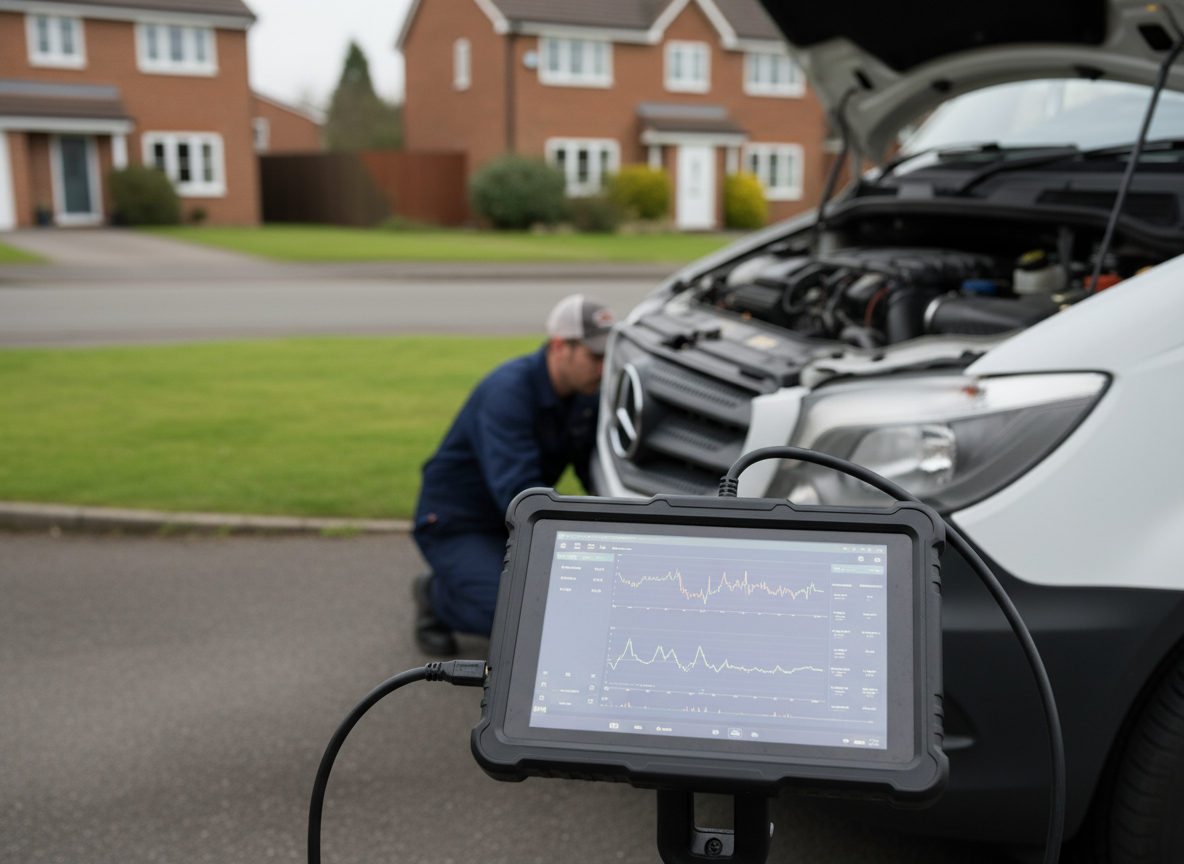
AdBlue Specialist covers Stoke-on-Trent, Crewe, Newcastle-under-Lyme, Congleton, Nantwich, Kidsgrove, Sandbach and the surrounding areas. We carry the diagnostic equipment to test your T6.1’s dosing pump, NOx sensors, and SCR efficiency in one visit — no towing, no workshop delay.
⚠ Do Not Ignore a P204F or Countdown on Your T6.1
If your T6.1 Transporter is displaying a no-start countdown, do not assume clearing the code will resolve it. The countdown is controlled by the ECU and will continue from where it left off after a reset unless the underlying fault is properly repaired. Once the countdown reaches zero, the van will refuse to start.
Frequently Asked Questions
What does P204F mean on a VW Transporter T6.1?
P204F means the SCR reductant system is not performing within expected efficiency thresholds. On the T6.1’s 2.0 TDI, this most commonly indicates a failing dosing pump module. It can also be triggered by low or contaminated AdBlue, a blocked supply line, or a dosing unit heater fault in cold weather. Proper diagnosis with VW-compatible tooling is needed to pinpoint the exact cause before replacing components.
Can I still drive my T6.1 with a P204F code?
In most cases, yes — initially. The vehicle will continue to run normally while the countdown is above zero. However, if P204F has triggered an SCR fault countdown, the van will refuse to start once the countdown expires. You should arrange diagnosis as soon as possible. Do not rely on simply clearing the code without addressing the underlying fault.
How much does a VW T6.1 AdBlue dosing pump replacement cost?
On-site replacement of the AdBlue dosing pump on a VW Transporter T6.1 typically costs between £400 and £800 depending on the supplier used and whether additional components also need attention. A mobile specialist can carry out this work at your vehicle’s location without the need for a workshop visit or towing.
Why does my T6.1 show a countdown even with a full AdBlue tank?
A countdown on a full tank indicates a system fault rather than a low fluid issue. The ECU has detected that the SCR system is not performing correctly — typically a dosing pump fault, a NOx sensor failure, or an SCR efficiency problem. Topping up the tank will not resolve this. The fault code stored needs to be diagnosed and the underlying component failure addressed.
Is there a software fix for T6.1 AdBlue faults?
Yes. For vehicles used exclusively off-road, a software-based AdBlue removal solution can be applied that eliminates all SCR-related fault codes, warning lights, and countdown behaviour from the ECU. No physical components are cut or removed. Contact AdBlue Specialist to discuss whether this option is appropriate for your vehicle.