
AdBlue Guide — Warning Light Consequences
What Happens If You Ignore Your AdBlue Warning Light?
Ignoring an AdBlue warning light might seem harmless at first — the van still drives, the warning is just a light. But the consequences escalate quickly through four stages, ending with a van that will not start. This guide explains exactly what happens at each stage, what damage is possible, and what you should do instead of leaving it.
Quick Answer
Ignoring your AdBlue warning light leads to a staged escalation: first a low-fluid warning, then a kilometre countdown, then a message that the next restart will not be possible, and finally a no-start condition where the vehicle refuses to start on the next key cycle. If the fault is system-related rather than just low fluid, ignoring it can also cause SCR catalyst damage, dosing pump crystallisation, and expensive secondary failures. Acting early is always cheaper than acting after the countdown reaches zero.
Contents
What the AdBlue Warning Light Actually Means
Not all AdBlue warnings mean the same thing, and the appropriate response depends on which type you are seeing. There are two distinct categories. The first is a low fluid warning — the tank level has dropped below a threshold and needs to be topped up. The second is a system fault warning — the SCR emissions system has detected a problem with a component, such as the dosing pump, a NOx sensor, or the catalyst itself. A system fault warning cannot be resolved by simply topping up the tank.
Low-fluid warnings typically say something like “AdBlue: 500 miles remaining” or “Refill AdBlue.” Fault warnings often say “AdBlue Fault” or “AdBlue System Fault: Workshop Required” — these require diagnosis rather than a top-up.
Stage 1: The First Warning
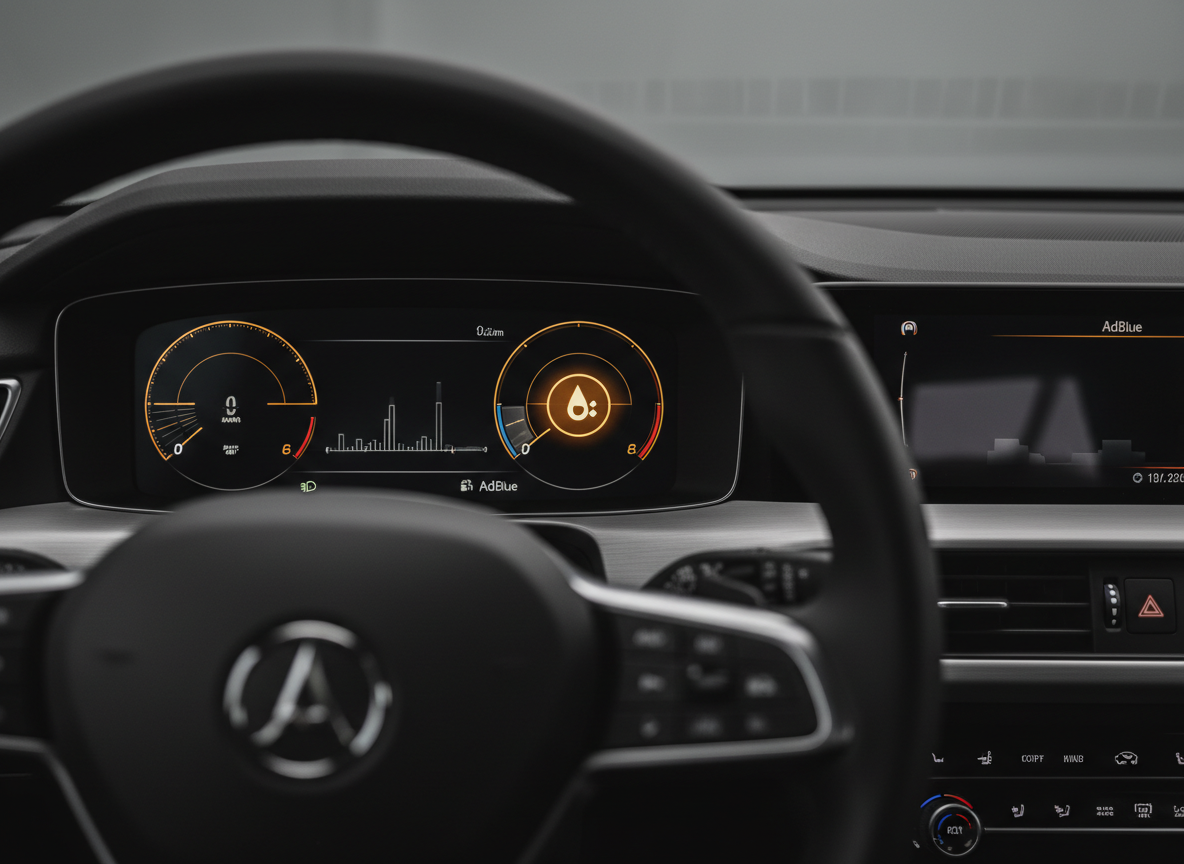
The first stage of an AdBlue warning appears when the fluid level in the tank drops to around 15–20% of its total capacity. At this point, a warning light or message illuminates on the dashboard. The vehicle runs completely normally. There is no power loss, no limp mode, and no restriction on starting.
This stage is intentionally gentle — it gives the driver time to find an AdBlue top-up before the situation becomes critical. Most vans can still cover several hundred miles at this point. If you address the warning here, the problem ends at Stage 1 and no further escalation occurs.
The mistake many drivers make at Stage 1 is deciding to wait. The van drives fine, the light is easy to ignore during a busy working week. This is where the problem begins.
Stage 2: The Countdown Begins
If the AdBlue level continues to drop without being addressed, the system moves to Stage 2. The dashboard display begins showing a countdown — typically expressed in kilometres remaining before the next engine start is prevented. On most modern diesel vans and cars, this countdown starts somewhere between 1,500 and 2,400 km depending on the manufacturer and model.
Stage 2 still allows completely normal driving. The only difference is that the countdown clock is now running, and it reduces every time you drive. If a fault is also present in the SCR system rather than just low fluid, the countdown may run faster or may have already started from a lower initial value.
At Stage 2, the situation is still easy to resolve. A top-up with AdBlue (for a low-fluid countdown) or a diagnostic visit (for a fault-based countdown) will address the problem before any restrictions kick in.
Stage 3: The Next Restart Warning
Stage 3 is when the situation becomes genuinely urgent. As the countdown approaches zero, the dashboard message changes to a direct warning: something along the lines of “Next engine start not possible” or “AdBlue: Restart will not be possible.” If you turn the engine off, the vehicle may not start again.
If you are at Stage 3, keep the engine running if at all possible and arrange immediate assistance. A mobile AdBlue specialist can come to your location and carry out a diagnosis or top-up on-site, without needing to transport the vehicle to a workshop. Do not assume you can sort it tomorrow — once the engine is switched off at Stage 3, there is no guarantee it will start again.
Stage 4: The Engine Won’t Start
If the countdown reaches zero and the engine is switched off, Stage 4 begins. The vehicle refuses to start. This is not a breakdown in the traditional sense — the battery is fine, the fuel is fine, and the engine itself is in working order. The ECU is actively preventing the start cycle from completing because the AdBlue system is in a fault or empty state.
Getting out of Stage 4 requires either a proper AdBlue top-up (if the cause was low fluid) or a diagnostic visit and repair if the cause was a system fault. Simply adding AdBlue may not be enough if a fault code is also present — the ECU may need to see a complete top-up, a successful self-test of the SCR system, and potentially a diagnostic reset before it allows the engine to start again.
⚠ Resetting Without Fixing Does Not Work Long-Term
Some drivers attempt to bypass the no-start condition by disconnecting the battery or resetting the ECU. In most cases, this temporarily clears the warning but the fault code returns quickly and the countdown resumes from where it left off. The underlying fault is still present, and the countdown will reach zero again.

Long-Term Damage from Ignoring AdBlue Warnings
Beyond the immediate risk of a no-start situation, ignoring AdBlue warnings can lead to secondary damage that is significantly more expensive to repair than the original fault.
SCR catalyst contamination
If the dosing pump is intermittently injecting AdBlue but not doing so correctly, the SCR catalyst can become contaminated over time. Catalyst contamination is difficult to reverse and often requires full catalyst replacement — substantially more expensive than fixing the original dosing fault.
AdBlue crystallisation
AdBlue that evaporates from a leaking fitting leaves behind white urea crystals that can block dosing lines, injector nozzles, and the dosing pump itself. A light crystallisation around a fitting can be cleaned. Heavy crystallisation inside the dosing unit usually requires full component replacement.
Dosing pump wear
A dosing pump that is failing but still partially operating puts additional strain on its own internal components. What might begin as a seal failure or pressure issue can progress to a complete pump failure if not addressed. Early repair costs considerably less than replacing a pump that has been allowed to fail completely.
Common Myths About AdBlue Warnings
“I can just top it up and it will be fine.” True if the warning is purely about low fluid level. Not true if a system fault has been detected. A top-up cannot fix a broken dosing pump or a failed NOx sensor.
“I’ll just reset the fault code.” Clearing a fault code removes the stored code from the ECU’s memory but does not fix the underlying component fault. The ECU will re-detect the same problem and store the code again — usually within a short drive cycle.
“My van doesn’t use AdBlue on long runs, so it’s fine.” A van that appears to use little AdBlue may actually have a non-dosing dosing pump — meaning the system is not injecting AdBlue at all. This will still trigger an SCR efficiency fault over time.
“It’s just an emissions thing, not a real problem.” The consequences of ignoring AdBlue warnings are very real — specifically the no-start condition and the potential for secondary component damage. Emissions-related immobilisation is legally required and cannot be bypassed indefinitely.
What to Do Instead of Ignoring It
If your dashboard shows an AdBlue low-fluid message with a mileage countdown, top up the tank with ISO 22241-grade AdBlue. Most fuel stations carry AdBlue in five-litre containers. After topping up, the warning should clear within a short drive.
If your dashboard shows “AdBlue Fault,” “AdBlue System Fault,” or “Workshop Required,” a top-up will not resolve the issue. You need a diagnostic scan. A mobile AdBlue specialist can come to your vehicle, carry out a full SCR diagnostic on-site, and advise on the repair options available — including no-start countdown bypass where appropriate.
If you are already at Stage 3 or Stage 4, keep the engine running and arrange a mobile visit. A specialist with the right equipment can resolve most AdBlue faults without any need to move the vehicle.
Stuck on an AdBlue Warning? We Come to You
AdBlue Specialist covers Staffordshire, Cheshire East, and Staffordshire Moorlands. Whether your van is stuck in a countdown, showing a fault code, or already refusing to start — we carry the diagnostic tools and repair equipment to resolve AdBlue faults on-site. Same-day response available for urgent cases.
Frequently Asked Questions
How long can I drive with an AdBlue warning light on?
This depends on which stage the warning is at. A Stage 1 low-fluid warning typically gives you several hundred miles before the countdown starts. Once the countdown has begun, you have whatever distance remains on the counter before the no-start condition kicks in. In all cases, it is best to act before Stage 3 begins.
Will adding AdBlue clear the warning light?
Only if the warning is caused by low fluid. If a system fault code is also present, adding AdBlue will top up the tank but will not clear the fault. The warning may persist, or it may clear temporarily before returning. If the light comes back after a top-up, a diagnostic scan is needed.
Can my van be fixed if it already won’t start due to AdBlue?
Yes. If the cause is low fluid, topping up the tank and carrying out a diagnostic reset will usually allow the vehicle to start again. If the cause is a system fault such as a dosing pump failure, the faulty component needs to be repaired or a software-based solution applied. A mobile specialist can attend on-site without needing the vehicle to be moved.
Does the AdBlue system affect engine performance?
In normal operation, the AdBlue system runs in the background and has no effect on power, fuel economy, or drivability. Once the fault is resolved, normal performance is fully restored.
Is it possible to bypass the AdBlue system entirely?
A software-based AdBlue removal solution can be applied to vehicles used exclusively off-road, eliminating all AdBlue warnings, fault codes, and countdown behaviour. This is intended for off-road use only. Contact AdBlue Specialist to discuss whether this option is applicable to your situation.