
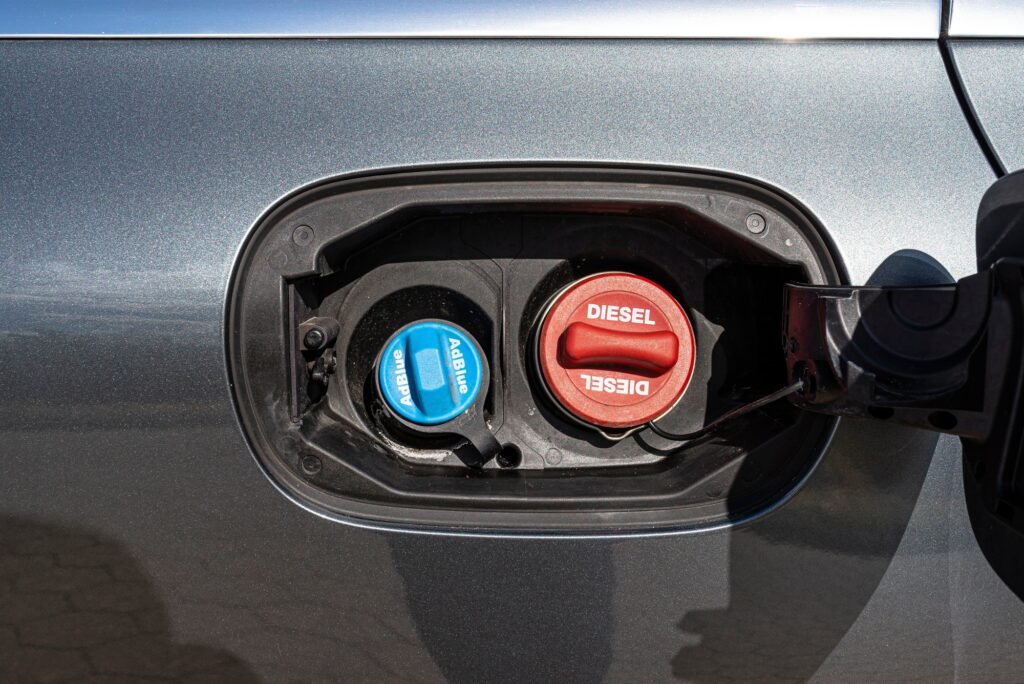
Rumours keep popping up every winter: AdBlue turns to a solid brick at –11 °C, heaters take twenty minutes to melt it, and the only “hack” is mixing in hot water.
Fleet managers around Stoke hear these stories from drivers stuck on the A53 and wonder if they should drain tanks before each cold snap.
The truth is less scary.
AdBlue starts to crystallise at –11.5 °C, but the ISO-22241 spec means it thaws cleanly and the NOx system still doses fine once the heater clicks on.
The Met Office’s 2025 Midlands cold report shows only three nights below –10 °C in the past five winters.
Instead of panic-draining, follow the storage and heater tips below and your SCR system will sail through February without a fault code—or worse, the dreaded P13DF heater error explained in our winter AdBlue heater fault guide.
The real freezing point of AdBlue
AdBlue is 32.5 % high-grade urea in de-ionised water.
At –11.5 °C, water begins to form ice crystals, forcing urea into a slush: a white, grainy mix nicknamed “polar porridge.”
Unlike diesel wax, the frozen urea doesn’t expand enough to crack the tank.
As temperature rises above –10 °C, the slush melts back to liquid with no loss of purity.
The SCR control unit refuses to dose until it senses fluid temperature over –5 °C; that prevents injector blockages while you get back on the road.
Four winter myths busted
Myth 1 “Add antifreeze.”
Propylene glycol or methanol kills the catalyst. ISO-22241 bans any additive—stick to sealed AdBlue cans.
Myth 2 “Drain the tank overnight.”
Draining exposes the pump diaphragm to air and dries the seal; it then sticks on first use. Leave the fluid in place—the heater is designed for it.
Myth 3 “Hot water thaws faster.”
Water wrecks the 32.5 % concentration. Even a half-litre top-up drags urea below spec and triggers P20EE efficiency codes.
Myth 4 “Block the return hose.”
Some forums suggest clamping the return to stop fluid circulating and cooling. That spikes pressure and brings on P20E9.
The correct fix is a healthy tank heater, not hose surgery.
How to store AdBlue the right way
Keep sealed 10 L cans upright in a warehouse that never drops below –5 °C.
Pallet stacks should sit at least 100 mm off the concrete to dodge frost pockets.
If you run IBCs, fit a 240 V immersion wrap; a 200 L container warms to +5 °C in three hours.
When filling vans outside, park them leeward of wind chill and use a screw-neck funnel so crystals don’t hit the filler neck.
Wipe spouts with lint-free cloths—tissue fragments seed crystals inside the dosing line.
Always reseal partial cans; open lids suck in humid air, which dilutes the urea blend even if temperature never reaches freezing.
Prevent heater faults before they log P13DF
The tank heater draws 180 W at 12 V.
A weak battery drops voltage, heater current falls, and the ECU logs P13DF heater circuit open.
Before frost hits, run a battery health check: anything under 12.4 V resting voltage means a charger overnight.
If the van sleeps outside and forecasts show –10 °C, idle it for three minutes; coolant warms the tank faster and the heater cycle finishes before you reach the junction.
More winter-specific tips live in the Euro-7 SCR compliance roundup.
Stuck with a frozen tank now?
Call 07503 134 362 and book a heated flush before the countdown starts.
Frequently asked questions
Will AdBlue in the injector freeze first?
No, the injector sits close to the exhaust and stays above 100 °C even at idle.
Can I dilute AdBlue with warm water to stop freezing?
No—any dilution changes concentration and the ECU logs efficiency faults.
At what temp does DEF in the UK normally freeze?
ISO-grade AdBlue reaches slush at –11.5 °C; UK winter lows rarely fall that far.