
AdBlue Specialist — Mobile Emissions Fault Solutions, Staffordshire
Peugeot Expert and Citroën Dispatch AdBlue Faults: Warning Lights, Fault Codes and What to Do
Peugeot Expert or Citroën Dispatch showing an AdBlue warning, P20E8, P20EE or a mileage countdown? The 2.0 BlueHDi platform has two specific failure patterns that dealers often diagnose incorrectly — here’s what’s actually failing, what it costs to fix, and how mobile diagnosis gets you back on the road without unnecessary parts replacements.
Quick Answer
AdBlue faults on the Peugeot Expert and Citroën Dispatch are overwhelmingly caused by two components: the AdBlue pump (built into the tank), which fails due to PCB contamination from fluid ingress, or the AdBlue injector, which becomes blocked through urea crystallisation. Both trigger P20E8 (low pressure) or P20EE (SCR efficiency below threshold) and eventually cause a no-start countdown. The pattern on these vans is distinctive — the fault often starts intermittently and becomes permanent. Mobile diagnosis confirms which component has failed and avoids replacing both unnecessarily.
Contents
The Expert/Dispatch Platform and AdBlue System
The Peugeot Expert (third generation, 2016–present) and Citroën Dispatch (third generation, also 2016–present) share the same Stellantis K9 platform and the same 2.0 BlueHDi diesel engine family. Both vans are used extensively by UK tradespeople, courier fleets, and small businesses — and both share the same AdBlue system architecture and the same failure patterns.
The AdBlue system on these vans uses a Selective Catalytic Reduction (SCR) catalyst to reduce NOx emissions to Euro 6 standards. AdBlue (a 32.5% urea-water solution) is injected into the exhaust stream upstream of the catalyst, where it reacts with NOx to produce nitrogen and water. The system uses:
- An AdBlue tank (typically 13–18 litres on Expert/Dispatch) with an integrated pump and level sensor
- An AdBlue injector mounted in the exhaust pipe upstream of the SCR catalyst
- An upstream and downstream NOx sensor to monitor SCR efficiency
- An ECU that controls dosing and monitors the entire system
The Expert and Dispatch are not the same vehicle as the Peugeot Boxer — the Boxer is a larger van on a different platform with a different engine. The Expert/Dispatch system is more compact, which means the pump and injector are more tightly packaged and have less cooling airflow, contributing to their specific failure profile.
Warning Stages and Countdown Behaviour
Both Expert and Dispatch implement a two-stage warning system that escalates to a start-prevention countdown if the fault is not addressed:
| Stage | Dashboard Message | Action Required |
|---|---|---|
| Low fluid | “Top up AdBlue” with remaining range | Add AdBlue — fault not present, just low fluid |
| Fault detected | Engine management light + AdBlue warning | Diagnosis needed — fault code stored |
| Countdown active | “Start not possible in X miles” or “Emissions fault” with countdown | Urgent — arrange repair before countdown reaches zero |
| Lockout | Engine will not start | Cannot be driven — mobile repair or recovery required |
A detail specific to this platform: the countdown on Expert/Dispatch does not always start from the same mileage. Depending on the fault severity and which code is stored, some owners see a 700-mile countdown; others see as few as 150 miles. This is ECU-controlled and varies by fault type. Do not assume you have the full 700 miles just because a forum post suggests that is the standard window.
Common Fault Codes on Peugeot Expert and Citroën Dispatch
These are the codes most frequently diagnosed on Expert and Dispatch AdBlue faults:
P20E8 — Reductant Pressure Too Low
The most common first fault on these vans. When the AdBlue pump fails to generate the required injection pressure (typically around 5 bar), the ECU logs P20E8 and starts the countdown. This code almost always points to the pump — either the PCB has failed due to fluid ingress, or the pump motor has degraded. P20E8 is the code that tells you the fault is upstream of the injector.
P20EE — SCR NOx Catalyst Efficiency Below Threshold
The ECU has measured NOx reduction across the catalyst and found it below threshold. On these vans, P20EE is commonly caused by an injector blockage (the system cannot dose correctly so the catalyst cannot reduce NOx) rather than the catalyst itself failing. Check the full breakdown of common AdBlue fault codes for a comparison across platforms.
P2200 / P2201 — NOx Sensor Circuit Malfunction
The upstream or downstream NOx sensor is reporting an implausible value or has lost communication. On the Expert/Dispatch platform, P2200 often appears after the pump or injector has failed — the ECU cannot get a valid reading because the system is not dosing correctly. Fix the dosing fault first; P2200 may resolve without a sensor replacement.
P2048 — Reductant Injector Circuit Short to Ground
The injector circuit has shorted. This code specifically points to the injector wiring or the injector itself rather than the pump. It often appears in combination with P20EE when the injector has failed electrically rather than through crystallisation.
U029D — No Communication with Deox System
A communication fault between the ECU and the AdBlue control module. This is less common but appears on some Expert/Dispatch variants when the pump module PCB has completely failed rather than degraded gradually.
The Two Failure Patterns You Need to Know
The Expert/Dispatch AdBlue system fails in two distinct ways, and knowing which pattern you have determines the repair. Getting this right avoids replacing a pump when the injector is the problem — or vice versa.
Pattern 1: Pump PCB Failure (P20E8, gradual onset)
The AdBlue pump on Expert/Dispatch is integrated into the tank assembly. The pump PCB (circuit board) sits exposed to the tank interior. Over time, AdBlue fluid can contaminate the PCB, corroding solder joints and causing intermittent failures that become permanent. The characteristic pattern is: fault appears and self-clears for a few weeks, then becomes permanent. P20E8 is the primary code. Live data shows pump pressure consistently below specification even with a full tank.
Pattern 2: Injector Crystallisation (P20EE, insidious onset)
The AdBlue injector sits in the exhaust stream. Between drive cycles, residual AdBlue fluid dries and forms urea crystals at the injector tip. Initially this reduces spray pattern accuracy; eventually it blocks the injector entirely. The pattern here is: fault appears after longer periods of non-use, or after cold weather. P20EE appears with otherwise normal pump pressure readings. Live data shows commanded dosing but insufficient NOx reduction across the catalyst. According to specialist repair data on Peugeot/Citroën AdBlue faults, injector crystallisation accounts for a significant proportion of Expert/Dispatch P20EE codes.
Why These Vans Fail More Than Others
The Expert/Dispatch AdBlue system has a worse reliability record than equivalent vans from Ford or Mercedes. Three factors drive this:
The pump PCB design. Other manufacturers house the pump electronics outside the fluid-contact area. On the Expert/Dispatch (and other Stellantis K9 vans), the PCB sits within the tank module, exposed to AdBlue vapour. Over time this causes corrosion.
The injector mounting position. The injector on these vans is mounted at an angle that increases the risk of residual fluid pooling at the tip between drive cycles. Vans that do a lot of short urban runs — common on Expert/Dispatch used for deliveries — are at higher risk of crystallisation than motorway-heavy vehicles where exhaust temperatures remain high for longer.
The SCR catalyst is relatively unforgiving. Because the Expert/Dispatch uses a compact catalyst layout, even a brief period of under-dosing (from a partially blocked injector) pushes the NOx reduction ratio below the P20EE threshold. Larger catalyst volumes on longer vehicles are more tolerant of temporary dosing interruptions.
Repair Costs
These are typical independent specialist costs for Expert and Dispatch AdBlue repairs, including parts and labour:
| Component | Typical Cost | Notes |
|---|---|---|
| NOx sensor replacement | £200–£380 | Worth confirming sensor is actually failed before replacing |
| AdBlue injector clean | £100–£200 | Effective for early-stage crystallisation |
| AdBlue injector replacement | £250–£450 | Required when tip is damaged or electrical fault confirmed |
| AdBlue pump replacement | £400–£600 | Pump is part of the tank on Expert/Dispatch — some suppliers sell the module separately |
| Full tank and pump assembly | £650–£1,000 | When pump cannot be sourced separately |
| Full system repair (pump + injector) | £900–£1,500 | When both are confirmed failed — rare but does occur on high-mileage vehicles |
Peugeot dealer pricing adds typically 30–50% to these figures. For a van used commercially, the cost of downtime while waiting for a dealer appointment often exceeds the difference in parts cost. Mobile repair gets the van back on the road the same day in most cases.
Mobile Diagnosis: What Happens on the Day
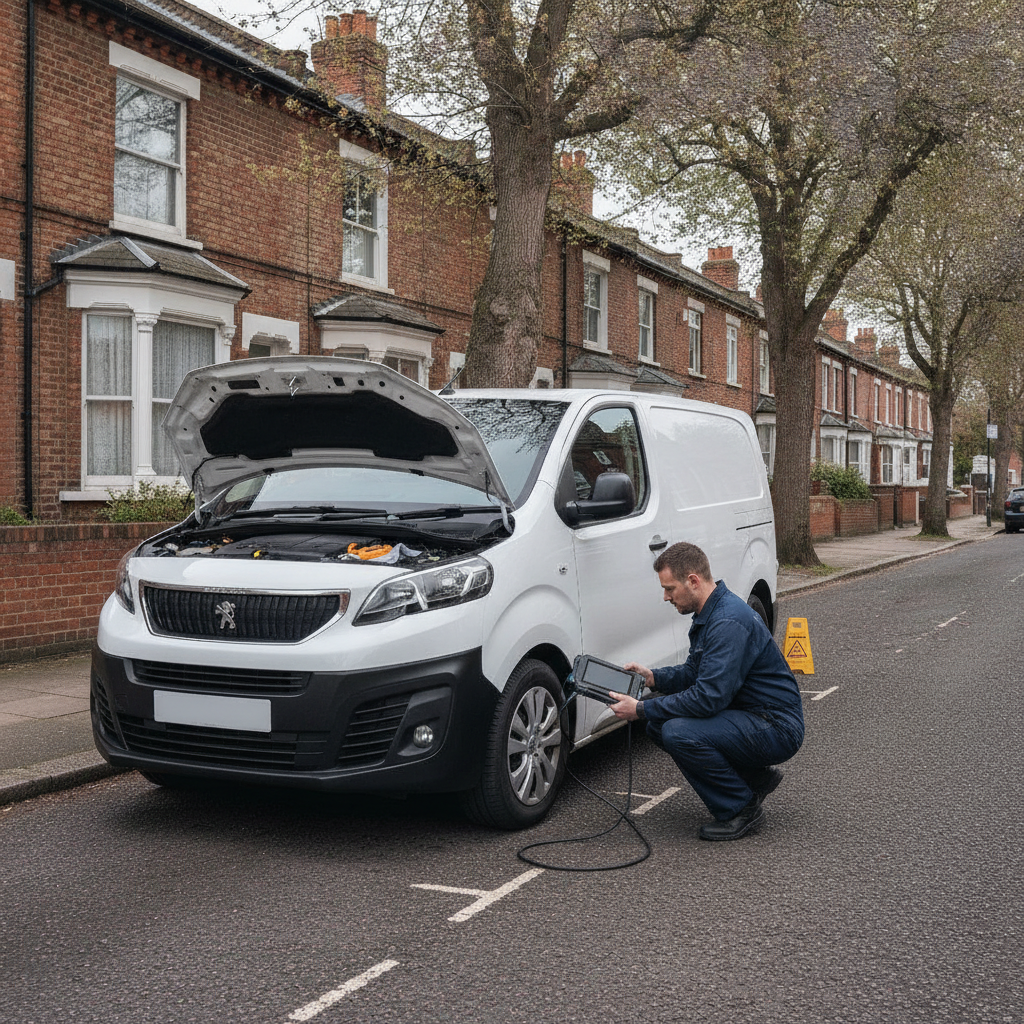
For a Peugeot Expert or Citroën Dispatch with an active AdBlue fault, mobile diagnosis follows a structured process. The diagnostic tool reads stored codes and then runs live data — checking pump pressure under commanded injection, NOx values upstream and downstream of the catalyst, and injector duty cycle. This identifies within 20–30 minutes whether the fault is the pump, the injector, the NOx sensor, or a combination.
Once confirmed, the repair is carried out at the same visit where possible. For a full AdBlue repair service, the system is reset and verified through a short test run before the engineer leaves. You do not need to tow the van to a workshop.
For Expert/Dispatch owners with the countdown already active: if the countdown has reached zero and the van will not start, mobile repair is still possible. The van needs to be accessible rather than towed — the repair is carried out where it sits, and once the fault is cleared and the system reset, the van starts and can be driven.
See the wider guide to Citroën AdBlue warning lights across the model range for context on how different Citroën platforms compare.
Peugeot Expert or Citroën Dispatch AdBlue Fault? Mobile Repair Available
We diagnose and repair Expert and Dispatch AdBlue faults across Staffordshire, Cheshire East, and Stoke-on-Trent. Live data diagnosis, no guesswork, no unnecessary parts — and we come to you.
Written by James Carter, mobile AdBlue and emissions fault specialist. Published . Updated .
Frequently Asked Questions
Why does my Peugeot Expert keep showing an AdBlue fault after I’ve topped up the tank?
Topping up the AdBlue tank resolves a low-fluid warning but does not fix a system fault. On the Expert and Dispatch, the fault is almost always the pump (failing to generate enough pressure) or the injector (blocked by urea crystals). Both components have their own fault codes, and until the failed component is repaired or replaced, the ECU will continue logging the fault and displaying the warning regardless of fluid level.
What fault codes come up with AdBlue problems on the Peugeot Expert?
The most common are P20E8 (reductant pressure too low — pump fault), P20EE (SCR efficiency below threshold — usually injector or NOx sensor), P2200 (NOx sensor circuit malfunction), and P2048 (injector circuit short to ground). P20E8 and P20EE are the most frequent and point directly at the two main failure components: the pump and the injector respectively.
How much does it cost to fix the AdBlue system on a Peugeot Expert?
Costs depend on which component has failed. An AdBlue injector clean costs £100–£200 and resolves early-stage crystallisation. Injector replacement costs £250–£450. Pump replacement costs £400–£600. A full tank and pump assembly costs £650–£1,000. Getting a proper diagnosis first is essential — replacing both pump and injector without confirming which has failed costs £900–£1,500 and is often unnecessary.
Can I still drive my Citroën Dispatch with an AdBlue fault countdown active?
You can drive until the countdown reaches zero — once it does, the engine will not start. The countdown is shown in miles and reduces with each engine start. Treat it as urgent: arrange diagnosis before the counter runs out. Continuing to drive without resolving the fault does not stop the countdown, and reaching zero in an inconvenient location means recovery as well as repair.