
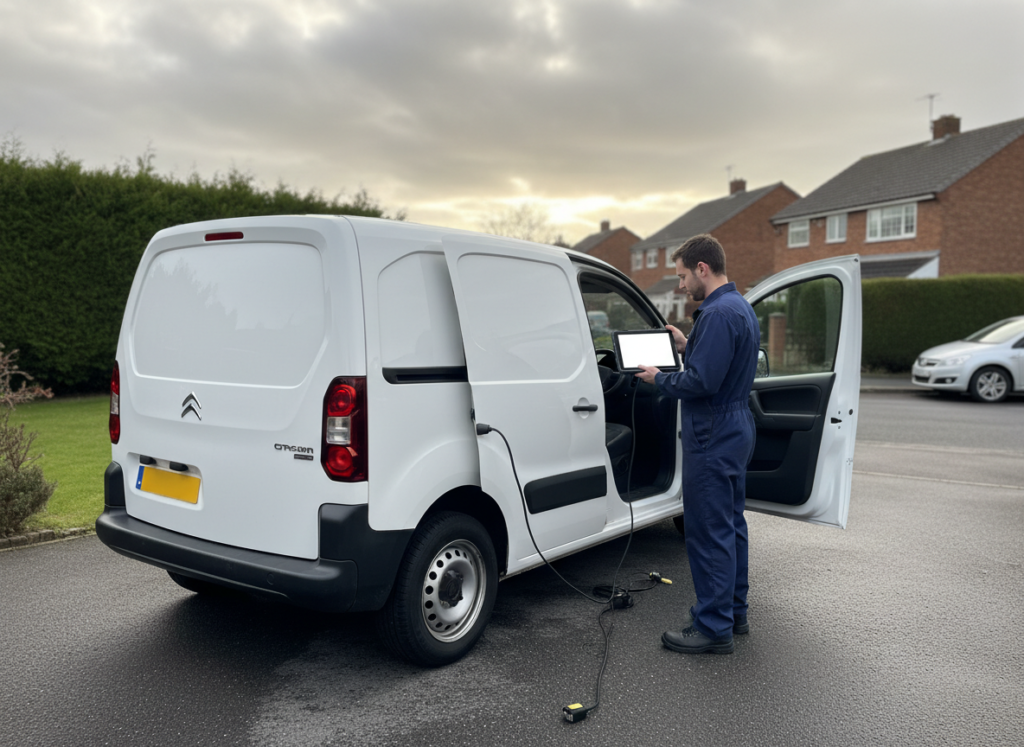
AdBlue Specialist — Mobile Citroen Emissions Fault Repair
Citroen AdBlue Fault: Warning Lights, Fault Codes and What to Do
Citroen BlueHDi diesels share the PSA SCR platform with Peugeot, and AdBlue faults are one of the most common reasons Citroen owners end up stranded or facing a no-start warning. This guide covers how the Citroen AdBlue system works, what each warning stage means, the most common fault codes, and how mobile diagnosis resolves these faults without a Citroen dealer visit.
Quick Answer
Citroen AdBlue faults follow a four-stage warning system, starting with a mileage countdown and ending in a no-start lockout. The most common fault codes on Citroen BlueHDi vehicles are P20EE:92 (SCR efficiency), P207F (reductant quality), and P20E8 (low pressure). These are rarely caused by the catalyst or the fluid alone — they usually point to a sensor failure, heater fault, or dosing issue that requires specialist diagnosis to confirm and clear. Call 07503 134362 for mobile diagnosis across Staffordshire and Cheshire.
Contents
How the Citroen BlueHDi AdBlue System Works
Citroen introduced its BlueHDi engine range to meet Euro 6 emissions legislation, which requires diesel vehicles to reduce NOx (nitrogen oxide) output to levels that cannot be achieved through combustion control alone. The solution is Selective Catalytic Reduction (SCR) — a system that injects AdBlue (a 32.5% urea solution) into the exhaust stream, where it converts NOx into harmless nitrogen and water vapour.
The Citroen SCR system consists of several key components: an AdBlue tank (typically located near the spare wheel or in the boot area), a quality sensor inside the tank that monitors urea concentration, a heated supply line that prevents freezing in cold conditions, a dosing pump, a dosing injector positioned upstream of the SCR catalyst, and NOx sensors positioned before and after the catalyst to measure conversion efficiency.
All of these components are monitored continuously by the SCR control module. When any reading falls outside the expected range — whether that is low fluid, poor fluid quality, insufficient pump pressure, heater failure, or an NOx sensor returning unexpected values — the system logs a fault code and begins escalating warnings to the driver.
The critical point for Citroen owners to understand is that the AdBlue warning system on Citroen does not simply tell you the fluid is low. It responds to component faults too. A full AdBlue tank can still trigger a countdown warning if the quality sensor has failed or the heater circuit is open. Filling up without diagnosing the root cause will not clear a fault-code-driven warning.
Citroen AdBlue Warning Stages Explained
Citroen’s AdBlue warning system follows the PSA platform’s staged approach. Each stage increases in urgency, and the transition from Stage 2 to Stage 4 can happen faster than many drivers expect.
Stage 1 — Mileage Warning Appears
An amber AdBlue warning icon appears on the dashboard, typically showing a mileage countdown. Messages such as “Please top up AdBlue: 2400 km remaining” indicate the fluid level is dropping toward the minimum threshold. The vehicle drives and starts normally. This is the ideal time to investigate — you still have flexibility.
Stage 2 — Countdown Becomes More Prominent
As the remaining range drops further — typically below 1,000 km — the warning becomes more prominent and appears more frequently on start-up and during driving. If the underlying cause is a fault rather than low fluid, the countdown will continue even if AdBlue is added. At this stage, a specialist scan is needed to confirm whether the warning is fluid-level driven or fault-driven.
Stage 3 — Engine Start Warning
Citroen now warns that engine starts are limited. Messages such as “Engine start prevented in 200 km” or “Last engine start possible: X starts remaining” indicate the system is about to enforce a no-start lockout. The vehicle may also enter a speed-limited mode on some models. This is the point at which arranging immediate diagnosis becomes critical.
If your Citroen is showing a Stage 3 no-start warning, avoid switching the engine off in a location where recovery would be difficult. Call a mobile specialist while the vehicle is still running.
Stage 4 — No-Start Lockout
The engine will not restart after being switched off. This is a legal compliance measure — the SCR system must function for the vehicle to meet its type-approval emissions standards. Once locked out, the vehicle requires specialist diagnostic equipment to reinitialise the SCR system. Simply adding AdBlue at this stage will not unlock the vehicle. The control module must be reset and the system verified by a qualified specialist.
Common Citroen AdBlue Fault Codes
Citroen uses PSA-platform fault codes that follow the OBD standard with manufacturer-specific sub-codes. The three most frequently encountered codes on Citroen BlueHDi vehicles are:
P20EE:92 — SCR NOx Catalyst Efficiency Below Threshold
This is the most common Citroen AdBlue fault code.
The “:92” sub-code is PSA-specific and indicates the efficiency fault is related to the SCR system’s conversion performance rather than a purely electrical fault. Despite the code referring to the catalyst, the catalyst is very rarely the actual problem. The most common root causes confirmed through specialist diagnosis are a failed upstream or downstream NOx sensor providing inaccurate comparative readings, poor or degraded AdBlue fluid quality, a partially blocked dosing injector reducing fluid delivery, or a pump that is operating at reduced pressure. Replacing the catalyst without first verifying these components wastes significant money and will not resolve the fault.
P207F — Reductant Quality Performance
P207F indicates that the AdBlue quality sensor in the tank has detected a urea concentration outside the 31.8–33.2% range required for correct SCR operation. This can be caused by genuinely poor or contaminated AdBlue fluid — sometimes supplied at petrol stations where tanks are exposed to direct heat — but it is also commonly caused by a faulty quality sensor that has degraded and is sending false readings. On Citroen BlueHDi vehicles, quality sensor failure is more common than actual fluid contamination in most real-world cases. Replacing the fluid without testing the sensor is a common misdirection.
P20E8 — Reductant Pressure Too Low
P20E8 indicates the AdBlue dosing pump is not generating sufficient pressure to deliver fluid to the injector at the required rate. This can result from a worn pump, a blockage in the supply line or injector from crystallised urea deposits, or an electrical fault in the pump motor circuit. P20E8 on Citroen is often preceded by P20EE because inconsistent dosing naturally leads to efficiency readings dropping below threshold.
Additional Codes to Be Aware Of
Citroen BlueHDi vehicles may also log P207F-00, P20EE-00, P20EE-92 as separate entries depending on the scan tool used. Some Citroen models also produce manufacturer-specific codes such as D50B17 or D50CB7, which relate to SCR heater circuit faults and require PSA-compatible scan tools to read correctly. Generic OBD readers may not capture the sub-codes, which means the diagnosis can appear incomplete.
Citroen Models Affected by AdBlue Faults
Any Citroen with a BlueHDi diesel engine and Euro 6 compliance uses the SCR AdBlue system. The models most frequently seen with AdBlue faults are:
| Model | Engine | Common Fault |
|---|---|---|
| Citroen Berlingo (Van / MPV) | 1.5 BlueHDi | P20EE:92, P207F, quality sensor |
| Citroen Dispatch (Van) | 2.0 BlueHDi | P20EE, P20E8, pump pressure |
| Citroen Relay (Van) | 2.2 BlueHDi | P20EE, heater fault, P20E8 |
| Citroen C5 Aircross | 1.5 / 2.0 BlueHDi | P207F, NOx sensor, P20EE:92 |
| Citroen C4 / C4 Cactus | 1.5 BlueHDi | P20EE, quality sensor fault |
| Citroen SpaceTourer | 2.0 BlueHDi | P20EE, P207F, pump fault |
| Citroen C3 Aircross | 1.5 BlueHDi | P207F, countdown issues |
Van operators using Citroen Berlingo, Dispatch, and Relay vehicles should be particularly aware that high-mileage use accelerates dosing injector wear and increases the likelihood of crystallisation in the AdBlue supply line during colder months. Fleet vehicles covering high weekly mileage can develop SCR heater and pump faults earlier than lower-mileage private vehicles.
Common Causes of Citroen AdBlue Faults
The root causes of Citroen AdBlue faults fall into a small number of categories that account for the majority of real-world cases:
- Failed or degraded AdBlue quality sensor: One of the most frequent Citroen-specific failure points. The tank sensor degrades over time and begins returning inaccurate concentration readings, triggering P207F without any actual fluid quality issue.
- SCR heater element failure: The heated supply line prevents AdBlue from freezing and crystallising. When the heater burns out or the connector corrodes, cold-weather crystallisation blocks the dosing system and causes P20E8 pressure faults.
- Dosing injector blockage: AdBlue crystallisation — urea deposits that form when residual fluid dries in the injector — is a known cause of dosing inefficiency on the PSA platform. The injector can appear functional but delivers insufficient fluid volume.
- NOx sensor failure: Upstream or downstream NOx sensors degrade over time. When a sensor fails, the SCR module receives false efficiency readings and logs P20EE:92 even if the catalyst and dosing system are working correctly.
- Substandard or contaminated AdBlue: AdBlue stored outdoors in direct sunlight, or fluid past its shelf life, loses its urea concentration. Using degraded fluid triggers quality faults and can also damage the quality sensor.
- Dosing pump wear: The pump delivers AdBlue at precise pressure. Wear over time — particularly on high-mileage vans — reduces pump output and causes P20E8 pressure fault codes.
Citroen vs Peugeot AdBlue Faults: Same Platform, Same Problems
Citroen and Peugeot share the PSA engine and SCR platform — which means the fault codes, warning behaviours, and failure modes are essentially identical across both brands. P20EE:92 on a Citroen Berlingo and P20EE:92 on a Peugeot Partner are the same code on the same underlying system.
This matters for two reasons. First, it means that diagnosis and repair techniques developed through experience with one brand apply directly to the other. Second, it means that generic advice or parts recommendations for “Peugeot AdBlue faults” will apply equally to Citroen and vice versa — so comparing repair options across both brands is valid.
The key difference between individual models is access point and component location. On some Citroen vans the AdBlue tank quality sensor is harder to access than the equivalent component on a Peugeot of the same generation. This affects labour time but not the diagnosis or repair approach.
Mobile Citroen AdBlue Diagnosis vs a Dealer Visit
A Citroen dealer visit for an AdBlue fault typically follows a predictable path: a booking wait, an initial diagnostic fee, and then a parts quote that often starts with the most expensive component — the catalyst — rather than methodically working through the likely causes from the most common to the least common.
Mobile diagnosis works from the other direction. The specialist arrives with PSA-compatible scan equipment, reads the full fault code data including sub-codes, performs live NOx sensor comparison, checks pump pressure, tests the heater circuit, and assesses AdBlue fluid quality before any repair recommendation is made. The root cause is confirmed before any part is ordered.
Most Citroen AdBlue faults — including quality sensor replacement, heater element repair, NOx sensor swap, dosing injector cleaning, pump assessment, and SCR reinitialisation after a no-start — can be completed in a single mobile visit at your home, workplace, or roadside location.
AdBlue Specialist covers Staffordshire, Cheshire East, and Staffordshire Moorlands with seven-days-a-week availability. Call 07503 134362 to book a mobile diagnosis, or visit the AdBlue repair page for more information on the repair process. If your Citroen is already at Stage 3, call directly rather than waiting for a callback.
Citroen AdBlue Warning? Mobile Diagnosis Comes to You
Same-day support across Staffordshire and Cheshire East. No recovery fees, no dealer booking, no guesswork on parts.
Frequently Asked Questions
Why is my Citroen AdBlue warning on even though I just filled it up?
A warning that persists after filling typically means the fault is code-driven rather than fluid-level driven. The SCR system has logged a fault code — most likely P20EE:92, P207F, or P20E8 — which will not clear by adding fluid. The root cause needs to be diagnosed and the fault cleared with specialist scan equipment.
How long do I have before my Citroen won’t start?
Once the countdown warning begins (Stage 2), most Citroen BlueHDi vehicles give roughly 1,000–2,400 km before the no-start lockout. However, the countdown can progress faster if a fault has been logged rather than simply low fluid. Do not rely on reaching the mileage shown — arrange diagnosis as soon as Stage 2 appears.
Is P20EE:92 on a Citroen always a catalyst problem?
No. P20EE:92 refers to SCR catalyst efficiency below threshold, but the catalyst itself is rarely faulty. In most cases the root cause is a failed NOx sensor, degraded AdBlue quality, a blocked dosing injector, or low pump pressure. A proper diagnostic process eliminates these cheaper causes before any catalyst work is recommended.
Can a Citroen AdBlue fault be fixed without going to a Citroen dealer?
Yes. A mobile specialist with PSA-compatible diagnostic equipment can diagnose and repair the full range of Citroen AdBlue faults on your driveway or at your workplace. Dealer visits add booking delays and diagnostic fees without offering faster diagnosis for these specific faults. Most repairs are completed in a single mobile visit.
Related reading: Mercedes Vito AdBlue Faults: Warning Lights, Fault Codes and What to Do.