
Mazda CX-5 and CX-60 AdBlue Faults: Skyactiv-D Warnings, Power Loss and Fixes
For six years Mazda sold the Skyactiv-D as the diesel that did not need AdBlue. Then, in 2018, the 2.2 gained an SCR system to pass on-road emissions tests — and a Mazda CX-5 AdBlue warning became something owners of a car they thought was “AdBlue-free” suddenly had to understand.
A Mazda CX-5 AdBlue warning on a 2.2 Skyactiv-D built after the 2018 Euro 6d-TEMP update means the SCR system needs fluid or has a fault. Mazda says to add at least 4 litres, never overfill, and check the level percentage rises. If the warning stays, or a speed restriction will not cancel, the usual culprits are a blocked dosing injector, an overfilled tank or a sensor fault.
IN THIS GUIDE
Which Mazdas Have AdBlue — and Which Do Not
This is the first thing to settle, because Mazda’s diesel range is split down the middle.
When Mazda moved its line-up to Euro 6d-TEMP in 2018, it announced that the Skyactiv-D 2.2 would add an SCR system to meet on-road NOx limits, while the new Skyactiv-D 1.8 would use a NOx storage catalyst instead. The same announcement makes the point directly: the 1.8 needs no AdBlue.
So the dividing line is the engine size, not the model name.
| Model | Diesel engine | AdBlue? |
|---|---|---|
| CX-5 (2nd gen) | 2.2 Skyactiv-D 150 / 184, from the 2018 Euro 6d-TEMP update | Yes |
| Mazda6 | 2.2 Skyactiv-D, from the same 2018 update | Yes |
| CX-5 / Mazda6 before the update | 2.2 Skyactiv-D (original Euro 6) | No |
| Mazda3, CX-3, CX-30 | 1.8 Skyactiv-D | No — NOx storage catalyst |
| CX-60 | 3.3 e-Skyactiv D inline six | Yes — 13.3 litre tank |
| CX-80 | 3.3 e-Skyactiv D inline six | Yes |
If your CX-5 is a 2017 or early 2018 car, check the filler flap. A separate AdBlue filler cap beside the diesel filler means SCR. No AdBlue cap means the warning on your dash is something else entirely, and no amount of AdBlue will fix it.
That split also explains why forum advice is so contradictory. Many of the owners in any thread are driving a car without AdBlue, and their experience does not apply to yours.
The Four-Litre Rule and the Overfill Trap
Mazda is unusually specific about refilling, and two of its instructions account for a large share of the “I added AdBlue and it did not work” calls on these cars.
Add at least 4 litres
The CX-5 owner’s manual says 4.0 litres of AdBlue or more needs to be added. It gives a table of reference amounts by the percentage shown on the multi-information display, from about 4 litres at 80–70 per cent up to about 10 litres at 10–0 per cent.
A 1.5 litre “emergency” bottle poured in at the roadside is below that minimum. The car may not register it at all.
Then check the percentage rises
After filling, Mazda says to check with the car stationary that the level warning has gone and the percentage has increased. If nothing changes after a minute, and you have only added the minimum, the manual says to add another 4 litres or more.
It also notes that the display may not show 100 per cent even after the recommended amount. That is normal. A rising number is what you are looking for.
Do not overfill
This is the Skyactiv-D quirk most owners never hear about. The same manual warns that adding AdBlue unnecessarily can cause a problem with the urea tank or damage it, and that too much AdBlue may make the SCR system display a warning. If that warning remains, Mazda says the tank may have a problem or be damaged.
Power Loss and the Speed Restriction
Owners describe this fault as “the car went into limp mode”. On a Mazda it is more accurately a speed restriction applied by the SCR system.
The manual refers to it directly: if the level percentage does not increase, or the speed restriction does not cancel while driving after a correct refill, Mazda tells owners to consult a repairer. In other words, Mazda itself treats a restriction that survives a proper top-up as a fault, not a fluid issue.
That gives you a clean decision point:
- Restriction clears after a correct refill and a drive — it was a genuine low level. Nothing more to do.
- Restriction stays, level rises normally — the fluid is fine; something in the dosing or monitoring side is not.
- Restriction stays, level does not rise — the tank, its sender or an overfill problem is the likelier cause.
Power loss on a Skyactiv-D is not always AdBlue, though. A blocked DPF, a boost leak or an EGR fault can feel identical from the driver’s seat. Our comparison of DPF pressure sensor faults versus NOx sensor faults explains how the two are told apart.
Blocked Injectors and the DPF Connection
The fault pattern we associate most with the 2.2 is a dosing injector that has crusted up, often on a car that also has a history of DPF complaints.
The reason is the way these cars get used. A CX-5 is a family SUV. It does school runs, supermarket trips and short commutes. Both the DPF and the AdBlue system depend on a hot exhaust: the DPF to burn off soot, the SCR system to dose and vaporise AdBlue cleanly. Short, cool journeys starve both.
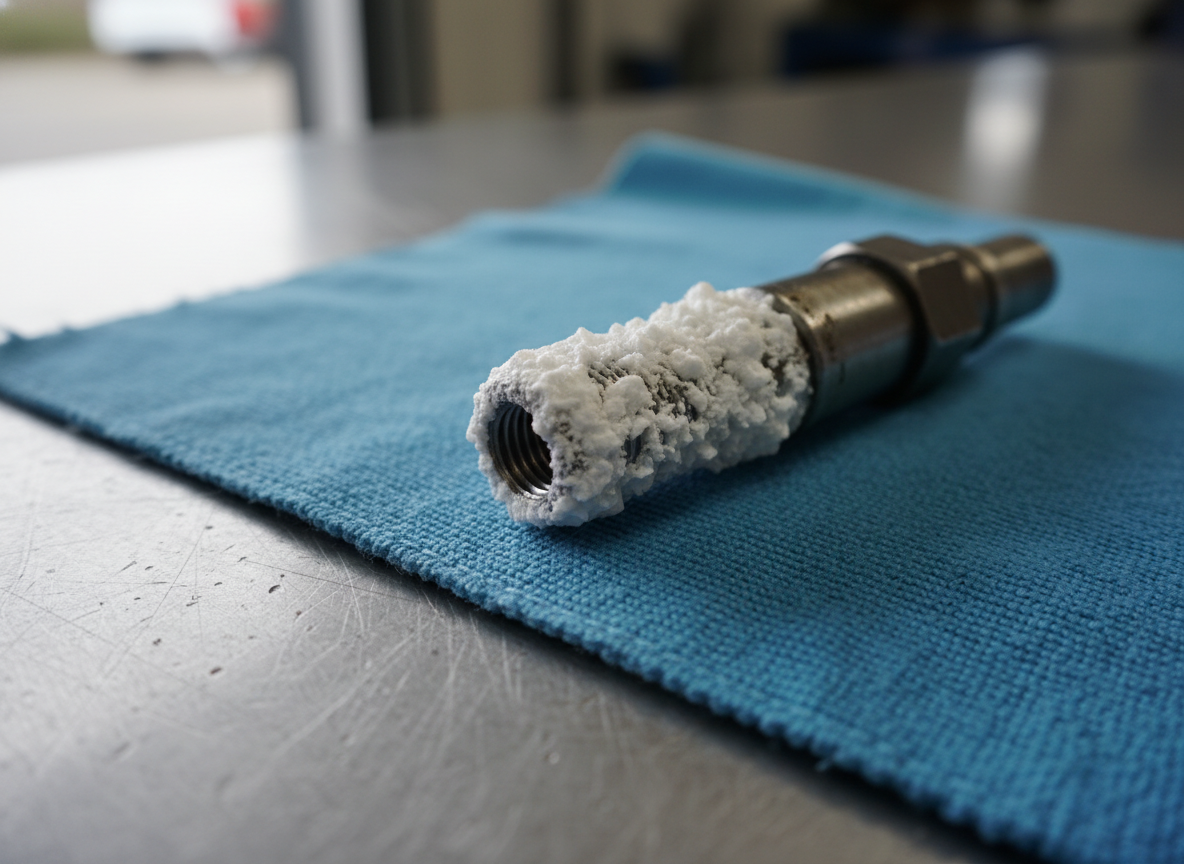
When AdBlue is injected into an exhaust that is not hot enough, it is more likely to leave urea deposits around the injector tip and in the mixing section. Over time, those deposits restrict the spray. The ECU sees NOx conversion falling below target and flags an efficiency or dosing fault.
That is why the two problems so often turn up together on one car, and why fixing only one of them tends to buy a few weeks rather than a cure. Our detailed guide to AdBlue injector faults covers the symptoms and the clean-or-replace decision, and how crystallisation damages the SCR system explains the deposit mechanism in more depth.
CX-60 and CX-80: the 3.3 Six-Cylinder
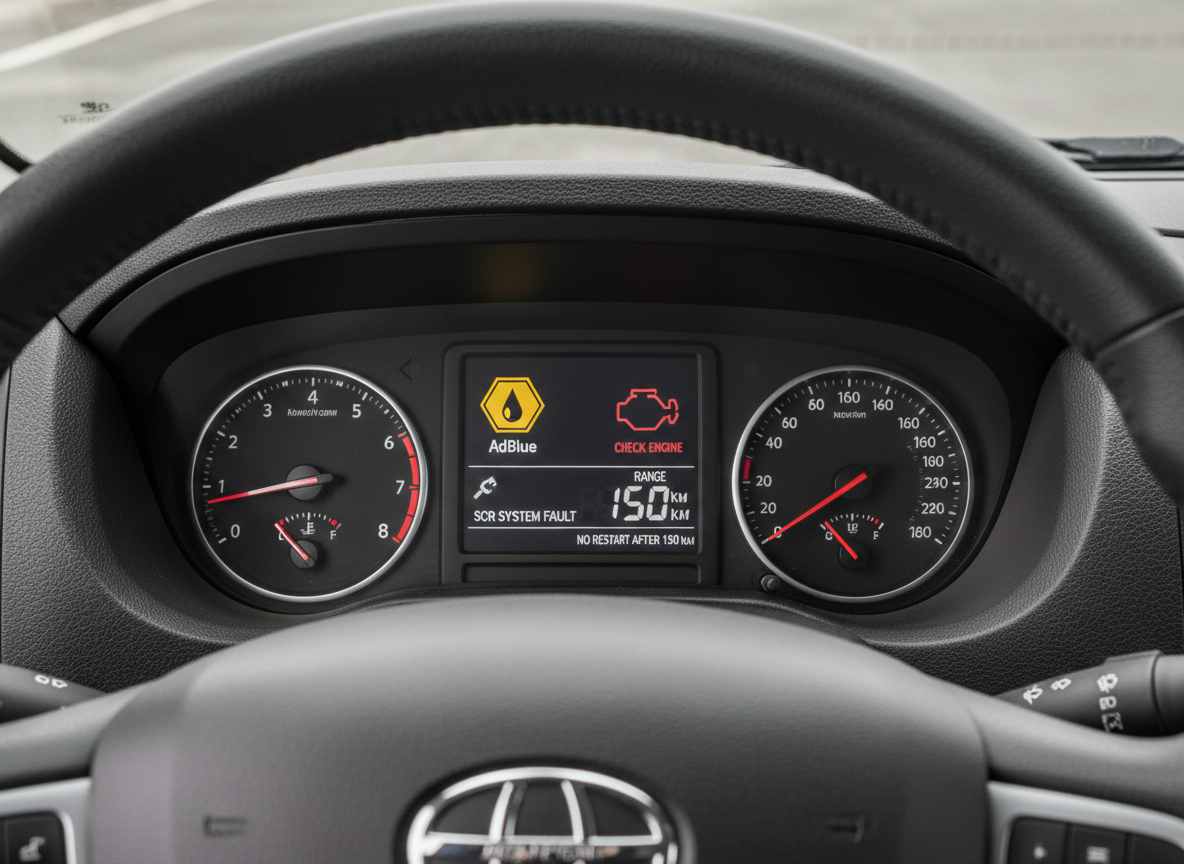
Mazda’s larger SUVs use a very different diesel: the 3.3-litre e-Skyactiv D inline six with mild-hybrid assistance. Mazda’s CX-60 press material confirms the six-cylinder uses high- and low-pressure EGR plus an SCR system. Mazda’s UK price and specification guide lists a 13.3 litre AdBlue tank alongside a 58 litre fuel tank. The CX-80 uses the same engine and is also listed with an AdBlue tank.
These are newer cars, many still under manufacturer warranty, so a warning on a CX-60 or CX-80 is often a dealer matter first. Where we see them is after the warranty has ended, or where the owner wants a second opinion before agreeing to a large bill.
The refill principles are the same as the 2.2: the right fluid to ISO 22241, a sensible quantity and no overfilling. The diagnosis is more involved because the six-cylinder has a more complex aftertreatment layout, so reading live data rather than guessing from the dashboard matters even more.
How We Diagnose a Mazda CX-5 AdBlue Warning
We work through Mazda AdBlue faults in the same order every time, because the cheap causes are also the common ones.
- Confirm the car has SCR. Engine size, build date and a look at the filler flap.
- Ask how and when it was last filled. Quantity, container and whether the warning started immediately after. This is where overfills get spotted.
- Read the stored codes and the freeze-frame data. The code tells us whether the ECU is unhappy with level, quality, pressure, dosing or NOx conversion.
- Check live values. Tank level percentage, AdBlue temperature, pump pressure and upstream and downstream NOx readings.
- Inspect the injector and mixing area for urea deposits where the codes point that way.
- Check DPF soot load and regeneration history, because on these cars the two systems so often fail together.
Only then do we talk about parts. When a component has failed, we explain the options before any work starts. The AdBlue repair service covers the pump, heater, injector and tank side, and the car and van AdBlue repair page covers the other makes and models we see.
CX-5 in speed restriction after a refill, or a CX-60 warning you want checked before paying a dealer bill? We come to you, read the live SCR data and tell you exactly what has failed. Arrange a visit →
Frequently Asked Questions
Does the Mazda CX-5 need AdBlue?
Only the 2.2 Skyactiv-D diesels built after Mazda’s 2018 Euro 6d-TEMP update, which added an SCR system. Earlier 2.2 diesels and all petrol CX-5s have no AdBlue tank. An AdBlue filler cap next to the diesel filler, under the same flap, confirms it.
How much AdBlue does a Mazda CX-5 take?
Mazda’s manual says to add at least 4 litres each time. Its reference table suggests about 10 litres when the display shows 10 to 0 per cent remaining. For comparison, Mazda lists the CX-60 diesel’s AdBlue tank at 13.3 litres.
Does the Mazda3 or CX-30 diesel use AdBlue?
No. Those models use the 1.8 Skyactiv-D, which Mazda equipped with a NOx storage catalyst instead of SCR, so there is no AdBlue to add.
Why is my Mazda still restricted after adding AdBlue?
Either too little was added for the system to register it, the tank was overfilled, or there is a genuine fault. Mazda’s own advice is that if the level percentage does not rise, or the speed restriction does not cancel after driving, the car should be checked by a repairer.
Published: 10 November 2026 | Updated: 10 November 2026 | Author: AdBlue Specialist | Service area: Staffordshire, Cheshire East, Stoke-on-Trent
Featured image: Photo by Srattha Nualsate on Pexels