

AdBlue Diagnostics — Leisure Vehicles
Motorhome and Campervan AdBlue Problems: Why Standing Still Causes Faults
Most motorhome AdBlue problems are not caused by driving. They are caused by the eight months a year the vehicle spends parked up. The SCR system on a leisure vehicle is doing the same job as the one on a courier van — but it is being asked to do it after a winter of doing nothing at all, and that changes everything about how it fails.
Quick Answer
Motorhome AdBlue problems usually come from a use pattern, not a weak part. Long lay-ups leave fluid sitting in a warm tank and dosing line, and the short, slow trips either side of storage never get the exhaust hot enough for the SCR system to work properly or to complete its self-checks. The result is a warning light that appears on the first proper trip of the season.
In This Guide
Motorhome AdBlue Problems Follow a Pattern You Only See in Vehicles That Sit
There is a version of this story we hear every spring. The motorhome came out of storage in March, went for its habitation check, did a couple of short runs, and then threw an emissions warning somewhere on the M6 on the first real trip of the year.
The owner assumes the drive caused it. It did not. The drive simply gave the system its first opportunity in months to run a full set of checks and report what it found.
That is the single most useful thing to understand about motorhome AdBlue problems. A courier van covering 30,000 miles a year exercises its SCR system constantly — hot exhaust, regular dosing, tank emptied and refilled several times a season. A leisure vehicle might cover 3,000 miles, in bursts, with months of nothing in between. Same hardware, completely different working life.
Most of the technical AdBlue content online is written for the courier van. It is not wrong, it is just answering a different question.
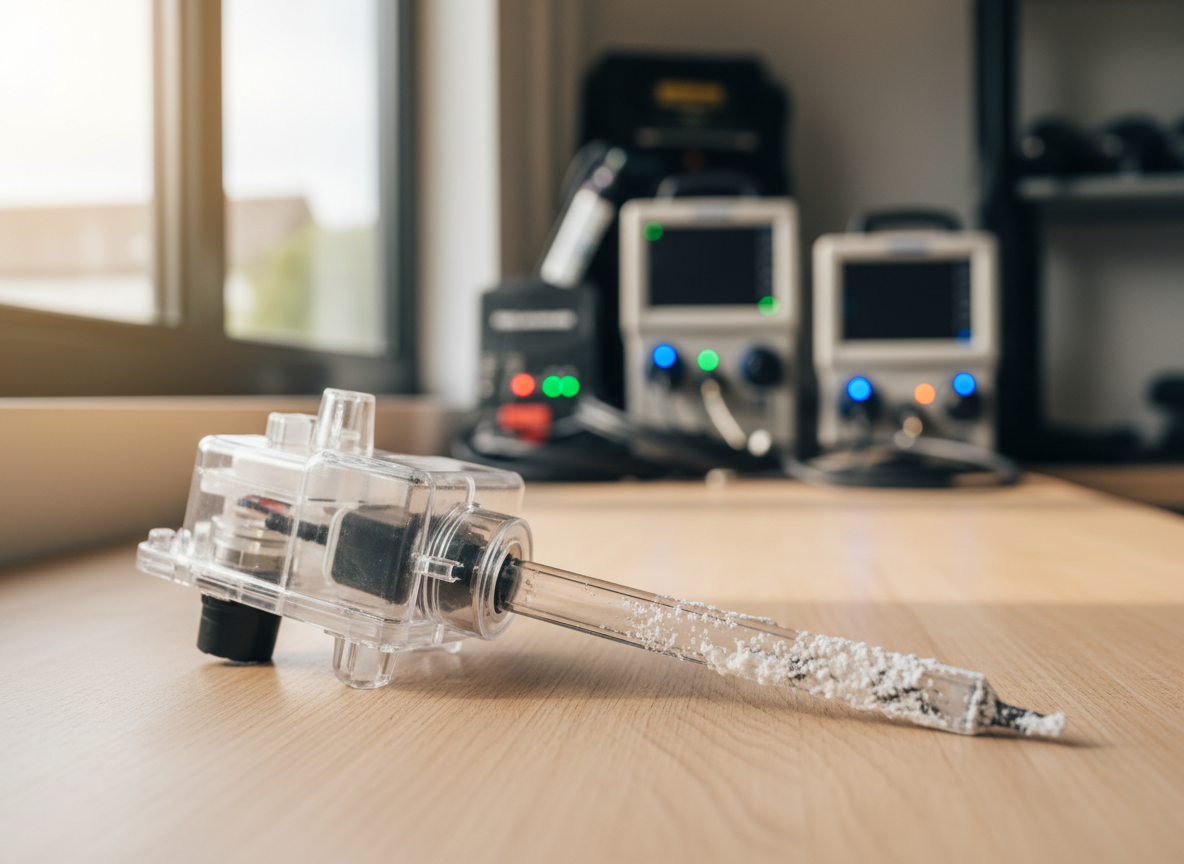
What Actually Happens Over a Long Lay-Up
Three things change while the vehicle is parked, and they compound.
The fluid in the tank gets older than the vehicle expects
AdBlue is a consumable with a finite life, and warm storage shortens it. On a van that gets through a tank every few months this never matters. On a motorhome that took a half tank in September and has not moved since, the fluid can easily be a year or more old by the time it is next dosed — and it has spent a summer sitting in a plastic tank under a vehicle parked in the open.
Degraded fluid is a common trigger for quality-related faults, and it is the one owners find hardest to accept because the tank still looks full. We cover what actually happens to ageing fluid in our guide to whether AdBlue can go off in storage.
Deposits form where the fluid stopped moving
When a system shuts down with fluid in the lines and then stays cold for months, solids can build up at the points where the fluid was last held. That includes the pump strainer, the level sensor float and, most awkwardly, the dosing injector tip.
None of that is unique to leisure vehicles — it is the same chemistry described in our article on how AdBlue deposits damage the SCR system. What is unique is the opportunity. A vehicle that runs weekly rarely gives deposits the undisturbed months they need.
The battery goes flat, and the system loses its memory of normal
Motorhomes get disconnected, isolated or simply run their leisure batteries down over winter. Every time the engine ECU loses power it restarts its monitoring from zero. That is why a system which was quietly tolerating a marginal sensor in October can decide it has a hard fault in April — it is not comparing against months of history any more.
Short, Slow Trips Are the Other Half of the Problem
The SCR catalyst needs heat. Below roughly 200°C the reaction that converts NOx does not happen efficiently, so the ECU either doses very little or does not dose at all.
Now look at how a motorhome typically moves outside of holidays. Off the storage compound. Ten minutes to the service point. Twenty minutes home. On and off the drive. Round to the dealer for a habitation check. None of that gets the exhaust properly hot, and none of it lets the system finish the drive cycles it needs to confirm everything is healthy.
So the vehicle accumulates months of incomplete checks and part-completed monitors. Then the owner does 200 miles to Cornwall, the system finally gets to run everything it has been unable to run since last summer, and the dashboard delivers the news all at once.
This is also why “I took it for a good long run and it cleared” is such a misleading result. A long run can genuinely resolve a marginal condition. It can equally just mask one that is still logged.

The Faults We Actually See on Leisure Vehicles
Across the motorhomes, campervans and converted panel vans we get called out to in Staffordshire and Cheshire, three faults dominate after a lay-up.
A level sensor reading something impossible
The gauge says empty on a tank you know is half full, or it sticks at one reading no matter what you add. Deposits around the float are the usual reason, and topping up makes it worse rather than better. Our guide to AdBlue level sensor faults covers how these are separated from a genuinely empty tank.
A dosing injector that is partially blocked
Partial is the difficult word. A completely blocked injector is obvious. One that is delivering seventy per cent of what the ECU asked for produces an efficiency fault with no obvious mechanical symptom, and it will often behave for a hundred miles before logging anything.
A pressure fault on first start of the season
The pump primes against a restriction it did not have last autumn, fails to reach target pressure, and logs a fault within the first few minutes of running. Frustratingly, this one frequently clears on the second or third start and then returns a week later.
What all three have in common is that they are consequences of standing, not of age or mileage. A five-year-old motorhome with 18,000 miles can have all of them; a five-year-old van with 180,000 miles often has none.
What to Do Before and After Storage
None of this needs special equipment. It needs a habit.
- Do not brim the tank before storage. Fluid you are not going to use for eight months is fluid that will be past its best when you do. Enough to avoid a low-level warning is plenty.
- Get it hot before you park it. The last journey before storage should be a proper one at road speed, not a five-minute shuffle onto the drive. That is the run that leaves the system in the best possible state to sit.
- Start the first trip of the season long, not short. If the first thing the vehicle does in March is forty minutes of dual carriageway, the system gets to complete its checks while you are still near home.
- Keep it charged. A maintained battery stops the repeated power-loss resets that make spring faults look worse than they are.
- Remember the tax position. If you have declared the vehicle off the road, you cannot simply take it out for that clearing run — GOV.UK is explicit that you cannot use the vehicle on the road until you tax it again. Plan the tax restart around the shakedown drive, not after it.
That last point catches people out more than it should. A SORN motorhome and an AdBlue system that needs a proper drive cycle are not compatible until the tax is back on.
One thing not to do
Do not keep adding fluid to a vehicle showing a level or quality warning in the hope of diluting the problem. If the reading is wrong because of a sensor or a deposit, more fluid changes nothing and you may end up overfilled, which brings its own faults.
Why Deleting the System Is the Wrong Answer on a Motorhome
It gets suggested a lot on owners’ forums, usually by someone who has been quoted a large number by a main dealer. On a leisure vehicle specifically, it is a poor trade.
The MOT position is not ambiguous. The DVSA inspection manual lists emission control equipment fitted by the manufacturer that is missing, obviously modified or obviously defective as a Major defect, and it names selective catalytic reduction components among the parts a tester checks. A Major defect is a failure.
Beyond that, motorhomes get sold. They get taken abroad. They get insured as high-value vehicles that an underwriter will look at closely after a claim. A modification that is invisible on the driveway and obvious on a diagnostic screen is a bad thing to have quietly attached to an asset you will want to sell one day.
The better answer is usually the boring one: find out which part of the system actually failed, replace or clean that, and change the storage habit that caused it.
AdBlue Warning After a Lay-Up?
AdBlue Specialist is a mobile service covering Stoke-on-Trent, Staffordshire and Cheshire East, and we come to the vehicle — which matters when it is sitting on a storage compound rather than a driveway. We read stored codes and live dosing data before quoting anything.
Frequently Asked Questions
Does a motorhome use AdBlue if it is not being driven?
No. Dosing only happens when the engine is running and the exhaust is hot enough. The problem is the opposite one — the fluid that is already in the tank and lines sits there unused, and that is what causes trouble over a long lay-up.
How long can AdBlue sit in a motorhome tank?
Longer than most owners think, but not indefinitely, and warm storage shortens it considerably. If the fluid in the tank went in more than a year ago and the vehicle has barely moved since, treat it as a suspect before you start replacing parts.
Should I fill the AdBlue tank before putting the motorhome away for winter?
We would not. A part-filled tank means less old fluid to deal with in spring, and the system is perfectly happy sitting part-full. Fill it properly at the start of the season instead, when you are about to use it.
Will a long drive clear a motorhome AdBlue warning on its own?
Sometimes, if the trigger was a genuinely marginal condition and the system now sees several clean drive cycles. But the fault stays stored either way, and a warning that clears itself after a long run has a strong habit of returning on the next trip.
Is this a Fiat, Peugeot or Mercedes problem specifically?
No. Most UK coachbuilt motorhomes sit on a small number of light commercial platforms, so the same base vehicles come up repeatedly, but the pattern is driven by how the vehicle is used rather than by the badge on the front.