
AdBlue Specialist — Mobile SCR Fault Diagnosis
AdBlue Crystallisation: Symptoms, Causes & How It Damages Your SCR System
AdBlue crystallisation is one of the most misdiagnosed AdBlue problems on UK vans and cars. It mimics pump failure, sensor faults, and low-pressure codes — but the root cause is completely different. Here’s how to spot it.
Quick Answer
AdBlue crystallisation happens when urea solution dries out inside pipes, injectors, or the SCR catalyst, forming a hard white deposit that blocks fluid flow. It triggers fault codes including P20E8 (low reductant pressure), P204F (SCR efficiency below threshold), and P207F (AdBlue quality fault) — all of which will not clear with a simple reset. Mobile diagnosis identifies the blockage location within 30 minutes. Call 07503 134362 for same-day assessment.
Contents
What Is AdBlue Crystallisation?
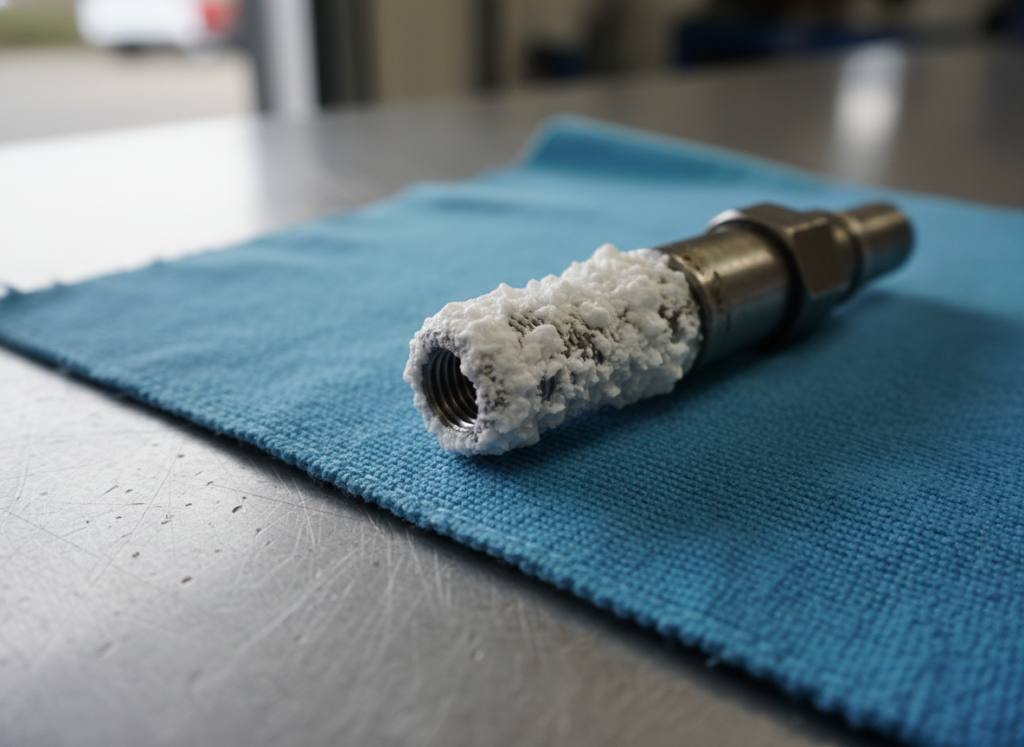
AdBlue is a mixture of 32.5% high-purity urea and 67.5% deionised water. When the water component evaporates — through heat, air exposure, or infrequent vehicle use — the urea is left behind as a white, crusty, salt-like deposit. This is AdBlue crystallisation.
It most commonly occurs in three locations:
- The AdBlue injector nozzle — The dosing injector is exposed to exhaust heat. Any residual fluid at the tip dries and bakes on.
- The AdBlue supply line — Particularly at joints, connectors, and bends where flow is restricted.
- The SCR catalyst inlet — If an injector has been misfiring or leaking, crystallised deposits can build up inside the catalyst itself.
Unlike a failed pump or dead sensor, crystallisation is a physical blockage problem. The electrics and sensors may be reading correctly — the system simply cannot move fluid through a blocked path.
Why Does AdBlue Crystallise?
Heat Cycling at the Injector
The AdBlue injector sits close to — or inside — the exhaust stream. Every time the engine stops, residual AdBlue at the injector tip is exposed to radiant heat. Over hundreds of heat cycles, a small amount dries and crystallises at the nozzle. This is a normal wear process, but it accelerates with:
- Short journeys where the SCR system runs for only a few minutes at a time
- High exhaust temperatures from aggressive driving or heavy loads
- Injectors that are slightly weeping or dripping when not commanded
Air Ingress Into the AdBlue Tank
If the AdBlue tank cap is cracked, poorly sealed, or left loose after topping up, air enters the system. Air accelerates evaporation of the water fraction, raising urea concentration above 32.5%. At higher concentrations, urea deposits form faster — particularly in supply lines and at the pump inlet.
Contaminated or Degraded AdBlue
AdBlue has a shelf life of approximately 18 months at temperatures below 30°C. Old or incorrectly stored fluid develops higher urea concentrations as the water fraction evaporates. Using degraded fluid accelerates crystallisation throughout the SCR system.
Infrequent Use
Vans that sit unused for weeks — seasonal vehicles, recovery trucks, agricultural plant — are especially vulnerable. Fluid stagnates, water evaporates through micro-permeation, and deposits form throughout the system. When the vehicle is started again months later, the SCR pump struggles against a blocked line and the system faults immediately.
Important: Crystallisation Looks Like Other Faults
Because crystallisation reduces fluid pressure and flow, it generates the same fault codes as a failed pump, damaged sensor, or faulty heater. Many drivers are told they need a new pump — only to discover crystallisation was the real problem all along. Mobile diagnosis identifies the actual cause before any parts are ordered.
Symptoms and Warning Signs
Crystallisation produces a recognisable pattern of symptoms that builds gradually over time:
Early Stage
- Intermittent AdBlue warning light that clears on its own after a long motorway run
- Slightly elevated NOx sensor readings logged but no active fault yet
- AdBlue consumption appearing slightly higher or lower than expected
Mid Stage
- Persistent low-pressure or quality fault codes that return within a day or two of clearing
- SCR efficiency codes triggered despite a full AdBlue tank
- Visible white crust around the AdBlue injector or at supply line connections
- AdBlue warning light that no longer self-clears on long drives
Late Stage
- Countdown to no-start warning appearing (e.g. “Start engine in 200 km”)
- Complete loss of AdBlue dosing with the system stuck in fault mode
- In severe cases, white or grey deposits visible inside the exhaust pipe near the SCR injector point
- Rough idling caused by exhaust backpressure from a partially blocked catalyst inlet
Which Fault Codes Crystallisation Triggers
Crystallisation can produce several different fault codes depending on where the blockage is and how severe it is. The most common are:
| Fault Code | Description | How Crystallisation Causes It |
|---|---|---|
| P20E8 | Reductant pressure too low | Blocked supply line or injector reduces system pressure below threshold |
| P204F | SCR efficiency below threshold | Reduced or disrupted dosing means insufficient NOx conversion |
| P207F | Reductant quality / concentration out of range | Concentrated urea deposits skew sensor readings for fluid quality |
| P20EE | SCR NOx catalyst efficiency below threshold | Partial catalyst blockage from injector leakage deposits |
| P2BAE | Reductant injection quantity low | Injector nozzle partially blocked, dosing below commanded volume |
The key diagnostic clue is that all these codes return quickly after clearing, even with a full AdBlue tank and apparently functional electrics. That pattern strongly suggests a physical blockage rather than an electronic fault.
How Crystallisation Is Diagnosed
Identifying crystallisation correctly avoids paying for parts that aren’t needed. Mobile diagnosis follows a clear process:
Step 1: OBD Scan and Freeze Frame Data
A live OBD scan reads current fault codes and freeze frame data — the system state at the moment each fault was triggered. Low pressure codes logged at cold start, combined with recovering system pressure once the vehicle warms up, are a strong early indicator of crystallisation at the injector or heated supply line.
Step 2: Visual Inspection of the Injector and Lines
The AdBlue injector is inspected for visible crystalline deposits at the nozzle. Connections and flexible sections of the supply line are checked for external signs of crystallisation — white residue at joints is diagnostic. In many cases, this visual check alone confirms the problem.
Step 3: Pressure Testing
A pressure test measures actual system pressure against commanded pressure. If the pump is operating correctly but downstream pressure is below specification, a physical blockage between the pump and injector is confirmed. This eliminates pump failure as the primary cause.
Step 4: Injector Flow Test
Where equipment allows, the injector is tested for correct dosing volume. A partially crystallised nozzle will dose less than commanded — measurable with specialist diagnostic tools.
Repair Options and What They Cost
The appropriate repair depends on where the crystallisation is and how severe it has become:
Injector Cleaning or Replacement
Minor crystallisation at the injector nozzle can sometimes be cleared with a professional cleaning procedure. If the injector is damaged internally or the nozzle is mechanically blocked, replacement is the reliable fix. AdBlue injectors typically cost £80–£250 depending on make and model, plus labour.
Supply Line Flush and Clear
Crystallisation inside flexible supply lines is addressed by flushing with deionised water under controlled pressure. Severely blocked sections may require section replacement. This is usually a straightforward repair completed on-site.
SCR Catalyst Assessment
If crystallisation at the catalyst inlet is suspected, a back-pressure test determines whether the catalyst itself is compromised. In most cases, the catalyst can be cleaned if addressed early. Severe blockage — usually only seen after prolonged injector leakage — can require catalyst replacement, which is significantly more expensive.
Tank Drain and Refill
Where degraded or contaminated AdBlue is the root cause, the tank is drained, flushed, and refilled with fresh ISO-compliant fluid. This is often combined with injector cleaning as part of a full system service.
How to Prevent AdBlue Crystallisation
Most crystallisation is avoidable with straightforward habits:
- Use ISO 22241-compliant AdBlue only. Cheap, non-compliant fluid has inconsistent urea concentration and degrades faster. Buy from established automotive suppliers.
- Always close the AdBlue filler cap securely. Air ingress is a primary driver of premature crystallisation. Check the cap seal annually.
- Don’t let AdBlue sit in storage for more than 12–18 months. Mark containers with the fill date and rotate stock.
- Take regular longer runs. Short journeys don’t allow the SCR system to reach operating temperature. A 30-minute motorway run every few weeks helps burn off residual deposits at the injector tip.
- If the vehicle is being stored for more than four weeks, consult a specialist. The AdBlue system may need to be purged before lay-up to prevent crystallisation in stagnant lines.
Suspected AdBlue Crystallisation? Get It Diagnosed On-Site
Crystallisation is almost always misdiagnosed — and parts get replaced unnecessarily. Mobile diagnosis identifies the blockage location in under 30 minutes, usually without removing anything. We come to your location anywhere in Stoke-on-Trent and the surrounding area.
FAQs
Can I drive if my AdBlue system has crystallisation?
In the short term, yes — but the fault codes will not clear, and if the countdown warning has started, the vehicle will eventually refuse to restart after the countdown reaches zero. It is better to get it diagnosed before the countdown begins than to deal with a no-start situation away from home.
Will topping up with fresh AdBlue dissolve the crystallisation?
No. Crystallisation is a solid deposit that does not dissolve when fresh fluid is added to the tank. The blockage is physical and needs to be mechanically cleared or chemically treated at the point of blockage, not at the tank.
How long does it take to fix AdBlue crystallisation?
A mobile repair typically takes one to two hours, depending on the location and severity of the blockage. Injector cleaning or line flush is usually completed in a single visit. If the injector needs replacing, parts are usually sourced the same day or next day.
Is AdBlue crystallisation covered by warranty?
It depends on the vehicle age and warranty terms. Most manufacturer warranties cover SCR system faults within the warranty period, but crystallisation caused by incorrect fluid, contamination, or improper storage is generally treated as a maintenance issue rather than a manufacturing defect. Check with your dealer or warranty provider before booking any repair.
How do I know if my van has crystallisation or a failed pump?
A failed pump typically produces consistent fault codes from cold start with no improvement as the system warms up. Crystallisation often shows intermittent or warming-up-related fault patterns, and sometimes visible white deposits are present at the injector or connections. The only reliable way to confirm which it is is through a proper pressure test and visual inspection — which is exactly what mobile diagnosis provides.