

AdBlue Diagnostics — NOx Sensors
Upstream vs Downstream NOx Sensor: How to Tell Which One Has Actually Failed
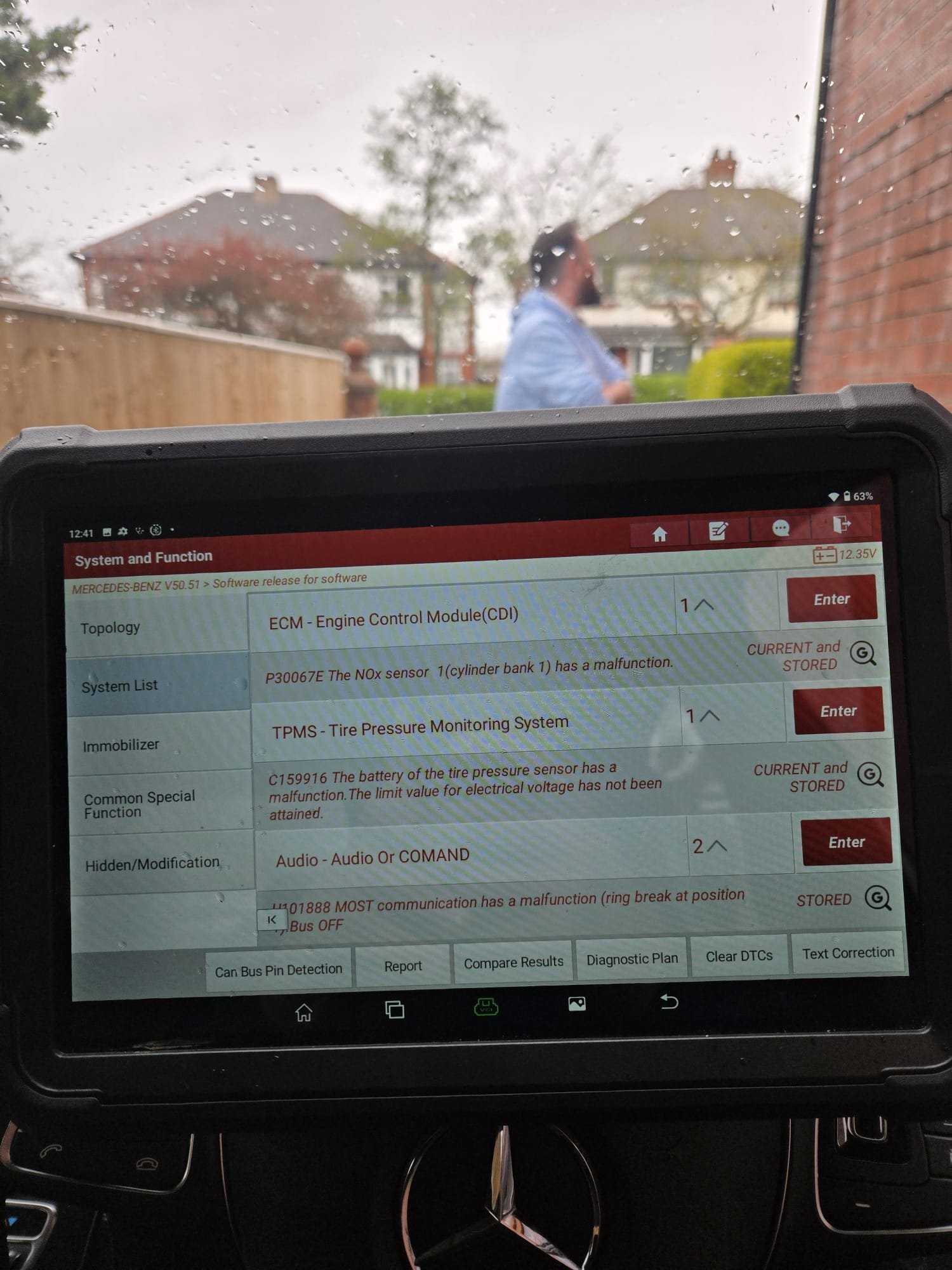
Most diesels with AdBlue carry two NOx sensors, and the fault code almost never names the guilty one. Getting upstream vs downstream NOx sensor diagnosis right is the difference between one sensor and a catalyst — and the two readings that separate them take about ten minutes to gather.
Quick Answer
The upstream NOx sensor sits before the SCR catalyst and tells the ECU how much NOx to treat. The downstream sensor sits after it and reports how much got through. To tell which has failed, compare both readings on a stone-cold engine — they should agree closely — then compare them again once hot with dosing active, where the downstream figure should be far lower. Disagreement when cold identifies a faulty sensor; agreement when hot points at the catalyst or dosing instead.
In This Guide
Two Sensors, Two Completely Different Jobs
People talk about “the NOx sensor” as though there is one. On almost every Euro 6 diesel there are two, they do different work, and they fail in different ways.
The upstream sensor
Fitted before the SCR catalyst, usually close to the turbo or just after the particulate filter. Its reading is the input to the dosing calculation: the ECU takes engine-out NOx and works out how much AdBlue is needed to deal with it. An upstream sensor reading low makes the system under-dose. Reading high makes it over-dose, which is its own set of problems.
The downstream sensor
Fitted after the catalyst, at the tailpipe end of the system. It exists to mark the homework. The ECU compares what went in with what came out and calculates conversion efficiency. It also watches for ammonia slipping past the catalyst, because an over-dosing system shows up here.
Both are heated, and both need to be hot
NOx sensors are not simple two-wire devices. Each has its own control module on the harness and an internal heater, because the sensing element only works properly at high temperature. That heater circuit is a genuine failure point in its own right, and it is why the sensors are not trusted for the first part of a cold start.
Why Euro 6 Needs Both of Them
The reason the system is this elaborate is the size of the reduction being asked for. Euro 6 cut the NOx limit for a diesel car to 0.08 g/km, down from 0.18 g/km at Euro 5 — and for the heaviest light commercial vehicles the Euro 6 figure is 0.125 g/km.
You do not hit a reduction of that order with an open-loop system squirting fluid to a map. It needs closed-loop control, which means measuring the result and correcting continuously. DieselNet puts it plainly in its overview of urea-SCR systems for diesel engines: high efficiency, low-NOx SCR depends on advanced closed-loop control strategies and improved NOx sensor technology.
That is useful context for a diagnosis, because it explains the ECU’s behaviour. The system is not looking for a broken sensor. It is looking for a result it is not getting, and a sensor is only one of the things that can be responsible.
The Four Checks That Separate Them
None of these need the sensors removed. All four are live data.
1. The cold agreement check — the most useful single test
Leave the vehicle overnight. On first key-on, before the engine has run, both sensors are reading the same ambient air. Their values should be close to each other and close to zero.
If one reads a sensible value and the other reads wildly differently, or does not report at all, you have found the failed sensor without going any further. This one check resolves a large share of NOx sensor jobs.
2. The warm, dosing-active comparison
Get the vehicle properly hot and confirm dosing is running. Now the two readings should diverge strongly, with downstream well below upstream. That gap is the catalyst doing its job.
If both readings are high and similar on a hot, dosing system, no conversion is happening. That is not a sensor fault — both sensors are agreeing with each other, which is the opposite of a sensor fault.
3. Heater and communication status
Check whether each sensor module is actually on the bus and whether its heater has reached target. A sensor that never comes ready looks identical to a sensor reading wrong until you check this, and the cause is frequently the connector or a chafed harness rather than the sensor.
4. Response to a change in load
Snap the throttle on a warm engine. Engine-out NOx rises sharply, so the upstream reading should move immediately and the downstream one should barely react while the catalyst has ammonia stored. A sensor that sits flat through a load change has stopped measuring even if its value looks plausible.

Symptom to Suspect: A Quick Reference
| What the live data shows | Most likely cause |
|---|---|
| Sensors disagree on a cold engine at rest | The odd one out has failed |
| One sensor never becomes ready or reports no value | Heater circuit, connector or harness on that sensor |
| Both high and similar when hot with dosing active | Catalyst, deposits or insufficient dosing — not the sensors |
| Downstream higher than upstream when hot | Downstream sensor faulty, or ammonia slip from over-dosing |
| Upstream flat through throttle changes | Upstream sensor has stopped responding |
| Good conversion but a stored efficiency code | Monitor completing in poor conditions — check duty cycle first |
Two sensors agreeing is not good news
It is easy to read “both sensors match” as a clean result. On a hot engine with dosing active it is the opposite: matching readings mean nothing is being converted. The sensors are working correctly and telling you the SCR system is not.
The Expensive Mistake: Swapping the Downstream Sensor
The single most common wasted repair in this area is fitting a downstream NOx sensor for an SCR efficiency code. The logic seems sound — the efficiency figure comes from the downstream sensor, so the downstream sensor must be lying.
Usually it is not. An efficiency code is raised because the calculated conversion did not meet target, and there are several ways to miss that target with two perfectly good sensors: a dosing system not delivering the commanded quantity, a mixing pipe restricted by deposits, an ageing catalyst, or a monitor that only ever runs in poor conditions.
Our breakdown of what causes a P20EE SCR efficiency fault and how it is actually fixed goes through that list in order, and it is worth reading before anyone orders a part.
The reverse mistake also happens. A quality code gets read as bad fluid, when the sensor that measures quality is often the real problem — we cover that split in our guide to how NOx sensor failures trigger AdBlue warnings.
When a “Failed” Sensor Is Reporting Perfectly
This is the point of view we would push hardest: on this system, the component named in the fault description is frequently the messenger.
A NOx sensor measures a gas. If the gas genuinely contains more NOx than it should, the sensor reports that faithfully and the ECU raises a code that mentions NOx. Nothing about that chain is broken. The reading is correct and the repair lies upstream of the reading — in dosing, in heat, or in the catalyst itself.
The practical consequence is that you should never buy a NOx sensor on the strength of a code description alone. Confirm with the cold agreement check first. If both sensors agree at rest and both respond properly to load, they are almost certainly fine and the money belongs elsewhere.
It is also worth knowing what the sensors physically tolerate before you condemn one. We looked at whether the element survives cleaning in our guide to whether you can clean a NOx sensor, and at what replacement involves in our NOx sensor replacement cost guide for the UK.
What a Proper Diagnosis Looks Like
In the order we work through it:
- Read everything stored, including freeze frames. The conditions recorded when the code set are often more useful than the code.
- Cold agreement check on both sensors. If this identifies a failed sensor, the job is largely done.
- Inspect the connectors and harness routing. These sensors live in a hot, wet, vibrating environment and their looms suffer for it.
- Warm drive with all four data points logged. Temperature, dosing quantity, upstream NOx, downstream NOx.
- Only then decide what to replace. And verify the monitor actually completes and passes afterwards, rather than clearing the code and handing the keys back.
One regulatory note, because it catches people out: at MOT a tester inspects emission control equipment that is visible and identifiable, and a malfunction indicator lamp indicating a malfunction is a Major defect. Clearing a NOx code to get through the test does not work if the monitor re-runs and the lamp returns, and it also deletes the history that would have shortened the repair.
Before You Buy a NOx Sensor, Get It Tested
AdBlue Specialist is a mobile service covering Stoke-on-Trent, Staffordshire and Cheshire East. We log both NOx sensors cold and hot at your home or yard, prove which one is wrong before anything is ordered, and confirm the monitor passes afterwards.
Frequently Asked Questions
How do I know which NOx sensor is bad?
Compare both live readings on a stone-cold engine before it has run. They are both measuring the same ambient air at that point, so they should agree closely. The one that disagrees, or fails to report at all, is the faulty one. If they agree cold, the fault is very unlikely to be a sensor.
Which NOx sensor is sensor 1 and which is sensor 2?
Naming varies by manufacturer and scan tool, but the convention follows exhaust flow: the lower number is the upstream sensor before the SCR catalyst, the higher number is the downstream sensor after it. Always confirm against the vehicle’s own data rather than assuming, because the labels are not consistent between makes.
Can you drive with a faulty NOx sensor?
Usually for a while, but not indefinitely. AdBlue systems are designed to escalate: a warning becomes a restriction and eventually a no-start countdown. There is also a real risk of the system dosing incorrectly in the meantime, which can cause deposits and turn a sensor job into a bigger one.
Do both NOx sensors need replacing at the same time?
No. They fail independently and there is no technical reason to change a healthy one. Some suppliers sell them in pairs, which is convenient rather than necessary. If the testing points at one sensor, replace that one and verify the result.
Will a new NOx sensor need coding or a reset?
Frequently, yes. Many systems need adaptation values reset or the new sensor module recognised before the readings are trusted, and the relevant monitor has to complete before the light will stay off. A basic code reader will clear the lamp without doing either, which is why the fault often reappears within days.