
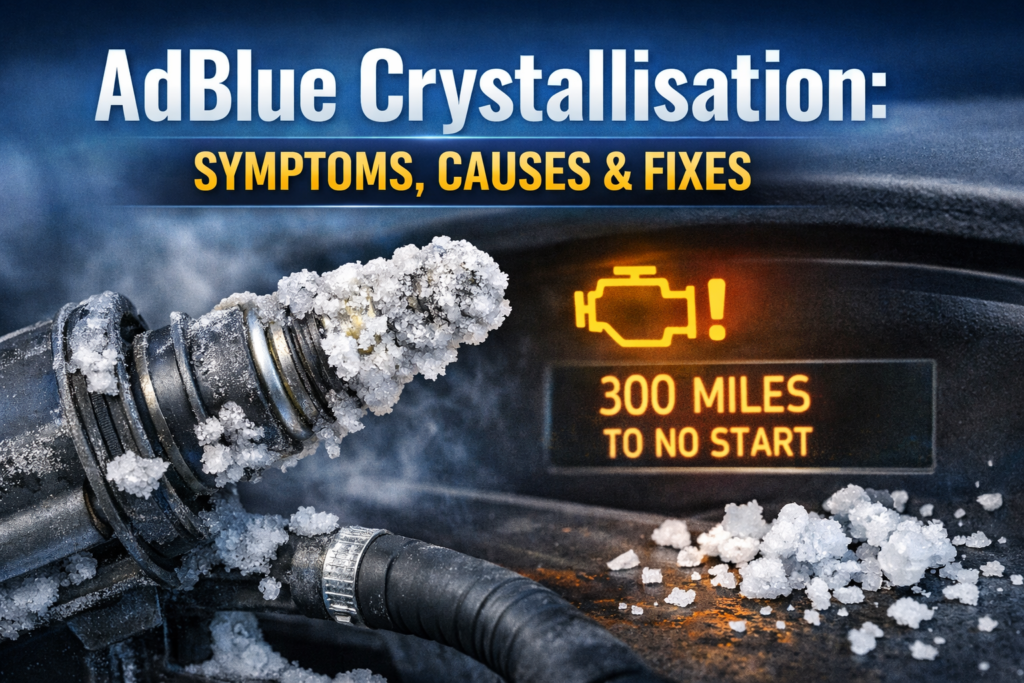
AdBlue Crystallisation: Symptoms, Causes and Fixes
If your van or car keeps showing AdBlue warnings, starts a no-start countdown, or throws repeat SCR faults after topping up, crystallisation could be the real cause. Dried AdBlue leaves hard white deposits inside injectors, pipes, tanks and dosing components. Those deposits restrict flow, upset pressure readings and can trigger faults that look like pump failure, sensor failure or poor SCR performance.
This guide explains the most common AdBlue crystallisation symptoms, why it happens, what parts it can damage, and when a simple reset is not enough. If you need proper fault finding rather than guesswork, our mobile service can come to your vehicle and check the system where it sits.
Quick Answer
AdBlue crystallisation happens when DEF dries out and turns into solid white deposits. Those deposits can block the injector, narrow the lines, affect pressure, and stop the SCR system dosing as it should. Common signs include warning lights, repeated countdowns, poor SCR efficiency faults, and problems that return soon after a refill or reset.
Contents
What is AdBlue crystallisation?
AdBlue is a fluid made from deionised water and urea. When it sits where it should not, leaks from a joint, dries around an injector tip, or gets left as residue after repeated short dosing cycles, it can dry into a chalky white deposit. That deposit hardens over time.
Once that happens, flow through the system is no longer clean and even. The injector may not spray properly. The line may narrow. The dosing unit may struggle to hit target pressure. The SCR system then reads the result as poor performance, poor quality, weak dosing or a component fault.
This is why one vehicle can show a pump code, another can show an efficiency code, and another can show a countdown, even though the root issue started with the same white build-up.
Common symptoms you will notice
The exact warning depends on the vehicle, the ECU strategy and how far the blockage has gone. These are the symptoms drivers and fleet operators usually notice first.
1. AdBlue warning light stays on
You top up the tank, clear the fault, or drive a few miles, and the warning comes back. That often means the system still cannot dose or read the result properly.
2. No-start countdown begins
Many vehicles start a mileage countdown when the SCR system believes emissions control has failed. Crystallisation can be one of the causes behind that chain of events.
3. Repeated SCR efficiency faults
The engine runs, but the SCR side keeps failing self-checks. That can happen when the injector pattern is poor, dose quantity is wrong, or deposits affect how the system performs under load.
4. Low pressure or dosing faults
If deposits build around the injector or in the line, pressure can fall out of range. Some vehicles then flag dosing, pump or pressure-related faults.
5. White residue around the filler or injector area
Visible white crust is a strong clue. It does not confirm the whole system is blocked, but it tells you dried AdBlue has already been present.
6. Fault returns soon after a reset
A temporary clear with no proper diagnosis is a common pattern. The ECU sees the same failed condition again and the warning returns.
If your vehicle is already in this cycle, do not keep guessing. A proper AdBlue fault check is far cheaper than swapping parts one by one.
Why it happens
Short trips and incomplete heat cycles
Vehicles that do short urban runs often do not keep the exhaust and SCR system in a stable working window for long enough. That can leave residue and make repeat dosing problems more likely over time.
Injector leakage or poor spray pattern
If the injector dribbles rather than sprays properly, fluid can collect where it should not. That can dry and harden into deposits. Once the spray pattern is disturbed, the problem can feed itself.
Existing contamination or old residue
A vehicle can have old build-up in the line, at the nozzle, or around the tank hardware. Fresh fluid then moves through a dirty system and faults return.
Cold weather and repeated stop-start use
Cold weather does not automatically mean crystallisation, but winter use can expose a weak heater, restricted line or marginal dosing setup. That makes an existing issue easier to trigger.
Spillage around the filler neck
Not every white deposit means internal failure. Sometimes the first clue is simple spillage around the filler. That said, visible residue outside the tank should still make you suspicious of what is happening inside the system.
What it can damage
| Component | How crystallisation affects it | Typical result |
|---|---|---|
| Injector | Blocks the tip or disturbs spray pattern | Poor dosing, efficiency faults, repeat warnings |
| AdBlue line | Restricts flow through narrowed sections | Pressure faults, weak delivery, intermittent faults |
| Pump or dosing unit | Works harder against restriction | Low pressure readings or apparent pump failure |
| SCR catalyst performance | Receives poor or inconsistent dosing | SCR efficiency faults and failed checks |
| Sensor interpretation | System data no longer matches expected outcome | Faults that look like NOx or quality issues |
This is why crystallisation is often linked with faults that seem unrelated at first glance. The ECU only sees failed results. It does not always tell you that dried deposits upstream are the reason those results are happening.
Can it be cleaned or reset?
Sometimes, yes. Not always.
If build-up is light and the right component is accessed early, cleaning can help. If the problem has already restricted flow, damaged an injector, upset pressure control, or triggered a hard countdown, a quick clean and a generic scan reset may not solve it for long.
When a clean may help
Early residue, visible deposits, no obvious hardware failure, and no deep countdown lock.
When a reset may help
Only after the root cause is sorted. Clearing codes first rarely gives a lasting result.
When neither is enough
Heavy blockage, damaged injector, failed dosing checks, or repeated faults that come back fast.
A lot of drivers lose time here. They top up. They clear a code. They try a motorway run. They restart the vehicle three times. The warning returns because nothing changed inside the system.
When you need a proper fix
You are past the “wait and see” stage if any of the points below sound familiar:
- The warning came back after refill
- The countdown is active or keeps returning
- You can see white crust and the vehicle has pressure or dosing faults
- The injector, pump or sensor has already been changed and the issue is still there
- The van is off the road and needs a clear answer fast
In those cases, the real job is to prove what is blocked, what is still working, and what the ECU is actually unhappy about. That is why diagnosis matters more than swapping parts. Our approach is to inspect the fault pattern, check likely restriction points, review the system behaviour and work out whether the route is cleaning, component repair, reset, or a bigger SCR fault solution.
If you are weighing up repair options and want a second route explained clearly, see our AdBlue removal page for broader service information. That gives you the commercial support page this topic should feed into without turning this guide into a second service page.
Mobile help for AdBlue faults
The hardest part of these faults is often the downtime. You get a warning, the vehicle starts a countdown, and now you are trying to work out whether it is safe to keep using it. A mobile visit makes that easier because the vehicle can be checked where it stands rather than waiting for workshop space or a tow.
AdBlue Specialist covers Staffordshire, Stoke-on-Trent, Staffordshire Moorlands and nearby areas with on-site support for AdBlue and related diesel emissions faults. If your dashboard is showing a warning after a refill, a repeat SCR fault, or signs of a dosing issue, start with the mobile service page or go straight to the contact page to book help.
Need help with repeat AdBlue warnings or white crystal build-up?
Do not keep throwing parts at the problem. If your vehicle has AdBlue crystallisation symptoms, repeated countdown messages, or SCR faults that will not stay cleared, get the system checked properly.
You can also start here:
AdBlue fault diagnosis
Mobile AdBlue service
AdBlue removal support
FAQs
What does AdBlue crystallisation look like?
It usually looks like a white chalky or crusty residue. You may see it around the filler neck, injector area or related SCR components.
Can AdBlue crystallisation cause a no-start countdown?
Yes. If crystallisation affects dosing or SCR performance badly enough, the system can trigger faults that lead to a countdown.
Will topping up AdBlue fix crystallisation?
No. A refill only adds fluid. It does not remove dried deposits, unblock an injector, or restore correct dosing on its own.
Can a fault code prove crystallisation by itself?
Not always. Fault codes point to the failed system result. Proper diagnosis is still needed to confirm whether crystallisation is the cause behind that result.
Should I keep driving with AdBlue crystallisation symptoms?
That depends on the warning and the vehicle behaviour. If a countdown has started or the fault keeps returning, get it checked before the vehicle becomes harder to use.