
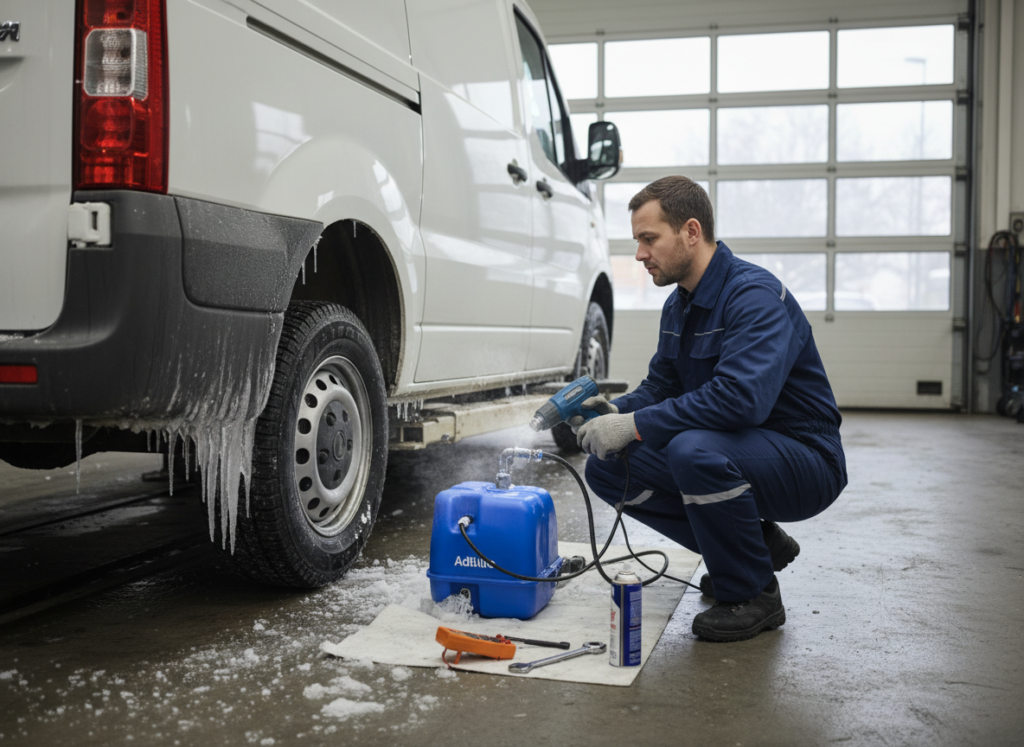
Frozen AdBlue: Why It Happens and What to Do Next
Cold weather brings the same panic every year for some diesel owners. The van or car was fine yesterday. Then the temperature drops, an AdBlue or SCR warning appears, and suddenly you are wondering whether the fluid has frozen and whether the vehicle is heading towards a no-start issue.
That concern is not as far-fetched as it sounds. Frozen AdBlue, or an AdBlue system struggling in low temperatures, can trigger heater faults, pressure problems, dosing issues, and wider SCR warnings. The hard part is that the dashboard does not always say “your AdBlue is frozen”. It usually throws a broader warning instead.
Quick Answer
Frozen AdBlue or cold-weather AdBlue system problems can lead to heater faults, pressure issues, injector problems, SCR warnings, and restart countdowns. The fluid itself may freeze or the system may fail because the heater, pump, or related control parts are not coping properly in low temperatures. If the warning stays on after the vehicle has warmed up, or comes back on every cold start, the issue usually needs proper diagnosis rather than a simple top-up.
Contents
- Can AdBlue actually freeze?
- Why frozen AdBlue causes wider faults
- Common warning signs
- What cold weather does to the system
- What to check first
- Can you still drive?
- Why the issue may disappear and come back
- Diagnosis vs guesswork
- What usually fixes the problem
Can AdBlue actually freeze?
Yes. That is the short answer.
AdBlue is not like diesel fuel. It reacts differently in low temperatures, which is why vehicles that use it need a system designed to manage the fluid properly during cold starts and winter operation.
That does not mean every cold morning leaves the whole tank as a solid block. In many cases the bigger issue is not a dramatic full freeze. The real issue is that the fluid and system components are too cold to behave as the vehicle expects during startup.
This is where the heater side of the system matters. Modern SCR systems are meant to manage cold conditions so the fluid can be used correctly. If that process is delayed, weak, or faulty, you start seeing warnings even though the real problem is temperature-related system performance rather than simply “no AdBlue present”.
So yes, frozen AdBlue is real, but the practical issue for most drivers is usually this: the system is not coping with the cold properly.
Why frozen AdBlue creates wider SCR problems
The AdBlue system works as a chain. If one part struggles, the rest of the chain feels it.
When temperatures are low, the system may struggle with:
- warming the fluid quickly enough
- building correct pressure
- moving the fluid through the system
- injecting it properly into the exhaust
- hitting the expected SCR performance after startup
That means a cold-weather issue can show up as a completely different-looking fault on the scanner. You may see pressure-related faults, reductant quality faults, heater faults, SCR efficiency warnings, or a no-start countdown. The vehicle is not always telling you “the fluid is frozen”. It is telling you “the system is not performing correctly”.
This is why cold-weather AdBlue problems are often misdiagnosed. Someone focuses on the code name without stepping back and noticing that the warnings began right after temperatures dropped.
Common signs that frozen AdBlue or cold-weather system issues are involved
Warning appears on very cold mornings
The system may behave normally in milder weather, then start failing when temperatures drop.
AdBlue, SCR, or emissions message on startup
The warning often appears shortly after starting rather than after a long drive.
Repeat faults in winter
You clear it, the weather improves, then the warning returns with the next cold spell.
No-start countdown begins
If the system continues to underperform, some vehicles escalate the warning.
Heater-related or pressure-related fault codes
The cold effect may trigger a wider control or pressure fault rather than a simple fluid-level warning.
Van drives fine once warm
This can make the issue feel minor, even though the cold-start problem remains unresolved.
Top-up does nothing
If the problem is temperature-related system performance, adding fluid will not fix it.
Fault seems intermittent
This is common because the weather and startup conditions keep changing.
If the pattern is clearly linked to cold weather, that is one of the strongest clues you will get.
What does cold weather do to the AdBlue system in real life?
It takes away the system’s margin for error.
A slightly weak heater, a slightly lazy pump, or a slightly restricted injector may not cause obvious symptoms in warmer conditions. Once winter arrives, those same weak points get exposed much faster.
That is why drivers often say things like:
- it only does it when it is freezing
- the warning is worse first thing in the morning
- the light vanished once the weather improved
The vehicle is effectively telling you that the fault is temperature-sensitive.
This matters because it changes how the issue should be approached. You are not just looking for a random fault code. You are looking for the part of the system that stops coping once the weather turns cold.
On work vans, this is a serious issue because cold mornings are often exactly when the vehicle needs to start and go with no delay.
What should you check first?
| Check | Why it matters |
|---|---|
| Weather pattern | If the warnings started during a cold spell, that strongly points to a temperature-related issue. |
| AdBlue level | Low level can still confuse the picture and trigger additional warnings. |
| Other stored fault codes | Heater, pressure, injector, NOx, or SCR faults together often tell a much clearer story. |
| Warning timing | If it appears mainly on startup and in cold weather, that pattern matters. |
| Whether the countdown has started | If restart warning logic is active, the issue needs urgent attention. |
These checks do not prove the exact cause on their own, but they help you stop treating the problem like a random one-off. Cold-weather patterns are useful information, not just background detail.
Can you still drive with frozen-AdBlue-related faults?
Sometimes yes, but you should not rely on that continuing.
One of the biggest traps with winter AdBlue faults is that the vehicle may still drive well enough after it has warmed up. That makes people think the issue is minor. The danger is that the countdown logic and fault memory are still active in the background.
So the real question is not “can I drive it today?”
The real question is “what happens at the next cold restart if I ignore it?”
If your vehicle is already showing countdown messages, or if the fault keeps returning every cold morning, you are well past the point where waiting is a sensible strategy.
For vans, fleet vehicles, and anyone who depends on a diesel daily, this is where the issue becomes operational, not just technical.
Why does the fault disappear and then come back?
Because temperature changes the system’s behaviour.
Once the vehicle warms up, some symptoms reduce. The system may run closer to normal and the warning may seem less urgent. Then the next cold start exposes the weakness again and the messages return.
This is exactly why drivers get stuck in a cycle of false reassurance:
- warning comes on
- weather improves
- warning disappears
- cold weather returns
- warning comes back worse than before
That does not mean the fault fixed itself. It means the system only just manages when conditions are more forgiving.
If the pattern is repeatable, that is a strong sign you need proper diagnosis rather than another reset.
Diagnosis vs guessing at the fix
This is where many people waste time and money.
A cold-weather AdBlue problem can lead to the wrong conclusion very easily. Someone may drain the fluid, replace a sensor, or keep clearing faults without ever checking what the system is doing during cold starts.
That can lead to:
- the wrong part being blamed
- repeat warnings after a reset
- countdown progression continuing
- extra costs with no real fix
Proper diagnosis should look at the whole cold-weather picture. That includes stored faults, live readings, heater behaviour, system readiness, pressure performance, and whether the SCR side is recovering properly after startup.
This is why frozen-AdBlue-type faults are not really “fluid problems” alone. They are system-behaviour problems that happen to show up in low temperatures.
What usually fixes frozen-AdBlue-related problems?
The repair route depends on what the testing confirms, but the most common fixes include:
Heater-related repair
Used where the system cannot warm the fluid or related components correctly.
Pressure-side repair
Used where the pump or control side cannot cope properly in low temperatures.
Injector clean or replacement
Used where crystallisation or poor dosing is part of the cold-weather performance issue.
Wiring repair
Used where signals or power supply are unstable in the heater or control circuit.
System clean and reset
Used where cold-weather operation has contributed to contamination or repeat fault logic.
Winter SCR fault
Cold start warning
No-start risk
The important part is making sure the fix matches the cause. Some vehicles need one targeted repair. Others have a wider issue where heater, pressure, and dosing faults all sit together.
When should you get it checked?
You should get the vehicle checked quickly if:
- the warning appears every cold morning
- the issue returns after a reset
- the fault started during freezing weather
- a countdown has begun
- the vehicle is used daily for work and cannot be left to chance
Dealing with it early is usually far easier than dealing with a no-start message when temperatures are at their worst.
Need help with frozen-AdBlue or winter SCR faults?
We diagnose cold-weather AdBlue, heater, pressure, and SCR problems properly at your location, so you are not left guessing whether the issue is the fluid, the heater, or a wider system fault.
For mobile fault finding, warning resets, and practical next steps, call 07503 134362 or email info@adbluespecialist.co.uk.
Mobile support across Staffordshire, Cheshire East, and Staffordshire Moorlands. Open 7 days.
Final thought
Frozen AdBlue is real, but the more useful way to think about it is this: cold weather exposes weaknesses in the whole AdBlue and SCR system.
If your warnings only appear when temperatures drop, that is not something to shrug off. It is one of the clearest clues the van or car is giving you. The sooner the real cause is identified, the better chance you have of avoiding a countdown, a recovery, or a vehicle that refuses to start when you need it most.
FAQs
Can AdBlue actually freeze?
Yes. More importantly, low temperatures can stop the system from handling the fluid properly and trigger wider SCR faults.
Why do my AdBlue warnings only appear in cold weather?
Because cold conditions often expose heater, pressure, dosing, or control-side weaknesses that are less obvious in milder weather.
Will topping up AdBlue fix a frozen-AdBlue warning?
Not usually. If the problem is heater or system performance related, the warning will often return.
Can frozen-AdBlue problems cause a no-start countdown?
Yes. If the wider SCR fault remains unresolved, some vehicles escalate the issue into restart restrictions.
Should I wait for warmer weather and see if it clears?
No. If the fault is repeated or a countdown has started, it should be diagnosed properly rather than left to chance.