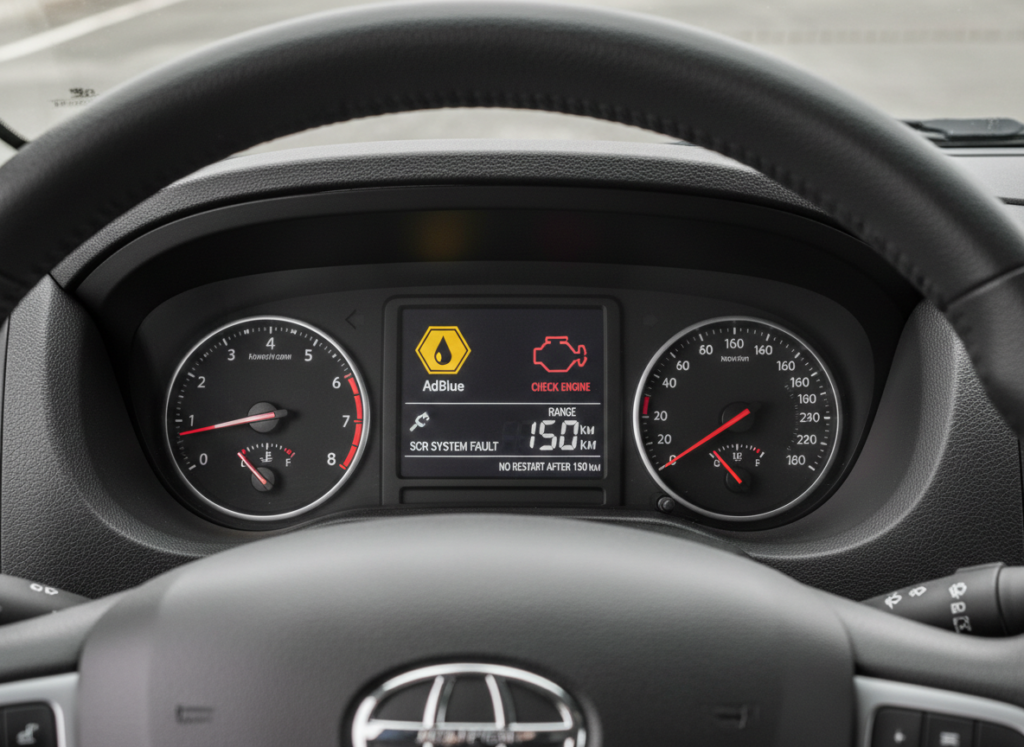
The AdBlue delete cost in the UK usually depends on the vehicle, ECU type, existing fault codes, and whether the job is a simple software solution or part of a wider AdBlue fault visit.
In many real cases, delete costs are lower than repeated spending on NOx sensors, pumps, heaters, tank work, and failed resets that do not last.
If your dash is showing AdBlue warnings, an SCR fault, or a no-start countdown, one of the first things you will search is cost.
Not theory. Not workshop jargon. Just the real number you are likely to pay and whether it makes more sense to repair the system or draw a line under it.
This guide explains the real-world AdBlue delete cost UK drivers and van owners research, what changes the price, how it compares with common repairs, and when delete becomes the lower-cost route.
If you are still weighing up your options, these pages help before you spend any money on the wrong route.
Average AdBlue delete cost in the UK
The first thing most people want is a rough number.
That is fair.
You are not reading this because you want a lesson on chemistry. You are here because the vehicle is playing up and you want to know what you may have to spend.
In the UK, the AdBlue delete cost usually sits in a range rather than one fixed figure.
That is because no two vehicles arrive in exactly the same state.
A clean software job on a common ECU is not the same as a van with active pressure faults, a heater issue, stored countdown data, and a history of failed resets.
For most owners, the useful way to look at cost is this:
| Vehicle / scenario | Typical pricing behaviour | Why the price changes | What to ask before booking |
|---|---|---|---|
| Common cars and light vans | Usually the lower end of the price range | More common ECUs, easier access, familiar software strategy | Does the vehicle only need AdBlue delete, or is fault diagnosis still needed first? |
| Popular work vans Transit, Sprinter, Boxer, Crafter |
Middle range in many cases | Active fault history, countdown issues, and fleet use can add complexity | Are there live faults like P20EE, P20E8, P204F, or heater faults still present? |
| Vehicles with repeated failed repairs | Often higher because more time is needed to inspect what has already been done | Past parts swaps, coding attempts, and old faults can complicate the visit | Has the vehicle already had sensors, pumps, or tank parts fitted? |
| Vehicles with countdown or no-start risk | Varies by urgency and condition | Extra checks are needed because the owner needs the van back working fast | Is the vehicle still driving, or is it already close to non-start? |
If you are comparing quotes, never compare on price alone.
Compare what is actually included: mobile visit, fault scan, support with active AdBlue issues, and whether the specialist deals with your exact ECU and vehicle type.
That matters because a cheap quote that ignores active faults can cost more in the end.
You save nothing if the van still shows warnings, stays in countdown, or ends up needing another visit.
What affects the price of an AdBlue delete
When people search how much does AdBlue delete cost, they often expect one flat number.
Real jobs do not work like that.
Price changes for clear reasons, and most of them are easy to understand once you know what the technician is dealing with.
1) ECU type and software strategy
Some ECUs are straightforward because they are seen all the time.
Others need a more careful route because of how the SCR logic is built into the software.
On modern diesel vans, ECU family matters.
SID212, SID213, EDC17 and similar systems do not all behave the same way.
That affects the time needed and the route used to complete the job properly.
2) Active fault codes
A clean delete on a vehicle with no unusual history is one thing.
A vehicle carrying active faults like P20EE, P20E8, P204F, or heater faults is another.
These faults do not always raise the delete price on their own, but they do change the work needed during the visit.
Sometimes the owner thinks they are paying for one task when the vehicle really needs a full diagnostic look first.
3) Vehicle model and access
A Sprinter used daily by a courier, a Transit with EcoBlue SCR faults, and a Crafter with refill countdown issues can all search for the same answer, but the job context is different.
Vans work harder than private cars.
They do more miles, more stop-start driving, more cold starts, and often keep running with faults active for longer because the owner is trying to finish the week first.
4) Previous failed repair attempts
If the vehicle has already had a pump, NOx sensor, or heater fitted, the story changes.
You are no longer dealing with a clean first visit.
You are dealing with a vehicle that has already cost the owner money and may still carry old stored problems.
That is why the AdBlue removal cost on one vehicle may be lower than another that looks similar on paper.
They assume the part named on the scan tool is the full story.
In practice, the real cost driver is often not the code itself but the wider condition of the system and how many wrong turns have already happened before the specialist arrives.
AdBlue repair cost vs AdBlue delete cost
This is the real question behind most cost searches.
You are not only asking for the price of a delete.
You are asking whether delete is cheaper than continuing to repair the system.
On some vehicles, repair is still the right route.
If the problem is simple, early, and limited to one part, repair can make sense.
On others, the costs stack up fast and make delete the better financial move.
| Issue | Repair path | Repair cost pattern | Delete cost comparison |
|---|---|---|---|
| Single NOx sensor issue | Sensor replacement and checks | Can be manageable if caught early | Delete may still be cheaper if the vehicle has wider SCR history |
| AdBlue pump fault | Pump replacement, checks, possible extra parts | Often climbs once labour and coding are counted | Delete can undercut the total spend on older vans |
| Heater fault | Heater or tank-side repair, winter checks | Can become expensive fast depending on layout | Delete often looks better where winter faults keep returning |
| Repeated P20EE / efficiency faults | Sensor, injector, leak, catalyst testing and parts | Very easy to spend heavily without a lasting fix | Delete can be the lower-cost route when several likely causes exist |
| No-start countdown after past repairs | More diagnosis, more parts, more labour | Usually the most frustrating spend | Delete often becomes attractive because downtime is expensive |
The key point is this:
AdBlue repair cost is often not one bill. It can become a chain of bills.
First comes the diagnosis.
Then one part.
Then the fault returns.
Then another part is suggested.
Then the countdown comes back after a few drive cycles.
That is why many drivers start by searching repair costs but end up searching adblue delete cost uk a few days later.
They are no longer asking what the system should do. They are asking what will stop the spending.
Start with the route that matches your vehicle history, fault pattern, and downtime pressure.
Common AdBlue system repairs and where the money goes
To understand whether delete is worth the price, it helps to see how normal repair spending builds up.
Owners often hear one fault named and assume the repair bill begins and ends there. In practice, the total cost usually comes from three things:
- the part itself
- the labour and diagnosis around it
- the risk that the first repair is not the only one needed
A NOx sensor can look like a simple answer because the fault memory points in that direction.
The trouble is that an SCR system can throw NOx-related faults when the deeper issue is poor dosing, a leak, or another system fault affecting the readings.
So the real cost is not only the part. It is the risk of fitting the part and still having the fault.
That is why owners researching adblue system repair cost often end up disappointed after one sensor bill leads to another visit.
Pump faults can become costly because they sit near the heart of the dosing system.
If the pump is weak, pressure-related faults start to appear, dosing becomes unreliable, and the system begins to fail its checks.
On paper, replacing the pump sounds simple.
In practice, the owner is paying for access, testing, installation, and the time needed to confirm the new part has actually solved the problem.
If pressure faults are already part of the story, this page helps: AdBlue pump near me: fast checks.
Heater faults are common in cold weather and can be awkward because they often arrive on vans that cannot afford downtime.
The problem is not only the part but the timing. If the van is a work van, every extra day off the road has a cost on top of the repair bill.
When owners compare the AdBlue delete cost with heater repair costs, they are often really comparing certainty and downtime, not only parts.
This is where the bills can become painful.
P20EE and related faults can send owners round in circles because the exact weak point is not always obvious at the start.
You may pay for testing, then an injector clean, then a sensor, then further checks, and still be told the catalyst could be the issue.
That chain is exactly why a clear delete price becomes attractive on older vehicles or hard-worked vans.
Vehicle examples: where cost decisions become clearer
Cost pages are far more useful when they reflect real vehicles people own.
The exact numbers change, but the decision pattern is often the same.
Mercedes Sprinter
Sprinters often appear in cost research because they are valuable work vans and the owner needs a quick answer.
If the issue is a simple sensor and the van has otherwise behaved well, repair can still be sensible.
If the van has a heater history, pressure issues, or repeated countdown problems, the total spend can rise fast.
At that point, the AdBlue delete cost UK query becomes a business decision, not just a technical one.
Related help: Mercedes Sprinter AdBlue problems
Ford Transit EcoBlue
Transit owners often reach this point after dealing with SID212EVO or related SCR faults.
They may already have seen P20EE, P204F, P20E8, or a no-start warning.
If one repair does not hold, owners usually stop asking “what does this code mean?” and start asking “what is the lower-cost route that actually lasts?”
Related help: Ford EcoBlue AdBlue faults guide
VW Crafter and MAN TGE
On these vans, the frustration is often around refill warnings, countdown issues, and faults that seem to come back after topping up or clearing codes.
Owners can spend money on diagnosis and still not feel closer to a final answer.
That makes cost certainty more valuable.
A defined delete price is easier to work with than open-ended repairs that may stretch over weeks.
Related help: VW Crafter AdBlue problems
Peugeot Boxer and similar vans
Boxer owners often search by fault code first, then price second.
Once they see the likely routes for tank faults, dosing issues, or efficiency faults, the cost question becomes urgent.
If the van is near no-start and used for work every day, the financial picture changes quickly.
The real cost is not only the repair invoice. It is lost jobs, missed runs, and stress.
Related help: Peugeot Boxer AdBlue problems
Mobile AdBlue delete vs garage pricing
Another part of the cost question is whether a mobile service changes the price.
Sometimes it does. Sometimes it does not. What matters more is what you get for the money.
A garage may seem cheaper at first glance.
But if you have to:
- take time off work
- arrange recovery
- wait days for a booking
- pay for repeated visits
then the true cost can be higher than it looks.
- You avoid workshop waiting lists.
- You avoid towing or arranging transport for a non-start vehicle.
- You get help at home, work, or roadside.
- You reduce downtime for work vans.
For many fleet operators and self-employed drivers, that convenience is not a luxury.
It is the difference between losing a day and keeping the week moving.
Compare total outcome.
A cheaper quote is poor value if it leaves you with active warnings, more downtime, or another booking next week.
If fast mobile support matters most, see mobile service and same-day service.
When AdBlue delete makes financial sense
Not every vehicle should jump straight to delete.
But there are cases where the numbers and the circumstances make the decision much easier.
- the vehicle has already had one or more failed repairs
- multiple AdBlue-related faults are active together
- downtime is costing you work
- the van is older and you want spend certainty
- the owner needs a practical solution rather than another round of testing
Think of it in plain terms.
If a single targeted repair is likely to solve the issue cleanly, repair may still be sensible.
If the vehicle has become a money pit, the adblue delete cost starts to look less like an expense and more like a cap on further spend.
That is even more true on working vans.
A van that loses two or three days of work is not only costing you in garage bills. It is costing you earnings, missed jobs, and disruption.
Cost should not be judged in isolation.
The right question is not only “what is the delete price?”
It is “what will this vehicle cost me over the next few weeks if I keep chasing repairs?”
How to judge whether a quote is fair
If you are gathering quotes, use these checks.
- Does the quote match your exact vehicle and ECU?
- Does it account for active faults already present?
- Is the visit mobile or workshop-based?
- Does the specialist work with vans like yours every week?
- Is there clear follow-through if the vehicle already has warnings or countdown data stored?
A fair quote is not the lowest number on the screen.
It is the quote that fits the real condition of your vehicle and gets you to a proper outcome in one visit where possible.
What this page is not about
This page is about cost and value, not detailed legal debate or code-by-code diagnosis.
If your main concern is MOT checks after a delete, start here: MOT after AdBlue delete.
If you are still choosing between a reset and delete, use: AdBlue reset vs delete.
If the vehicle is already close to non-start, use: What to do if your car won’t start due to AdBlue issues.
That separation matters for SEO as well as usability.
You should land on the page that answers the exact question you are asking.
We provide mobile AdBlue support across Stoke-on-Trent, Staffordshire, and nearby areas, with same-day slots most weeks.
Phone: 07503 134 362
Email: info@adbluespecialist.co.uk
Hours: Monday–Sunday 09:00–20:00
Internal links for next steps
- AdBlue delete service if you want the service page first
- AdBlue removal if you want the broader service overview
- AdBlue repair if you are still considering fixing the existing system
- AdBlue reset vs delete if you are still weighing up the two routes
- DPF vs AdBlue delete: what’s legal in 2025 if your concern is legality rather than price
FAQ
The answer depends on the vehicle, ECU type, and whether the job is a clean software solution or part of a wider fault visit.
Vans with active AdBlue faults, countdown warnings, or a history of failed repairs can take more work than vehicles with no wider issues.
Often, yes.
It is especially attractive when repair costs are stacking up through multiple sensors, pump issues, heater faults, or repeated efficiency faults that keep coming back.
One simple repair can still be the right route, but repeated repairs often cost more in the long run.
The main factors are the ECU type, vehicle model, active fault codes, and whether the vehicle has already had unsuccessful repairs.
Mobile support and urgency can also shape the final quote.
Not always once you look at the full picture.
Mobile service can save recovery costs, workshop waiting time, and lost working hours, which matters a lot for vans used daily.
Start with What to do if your car won’t start due to AdBlue issues.
If you are comparing routes after that, use AdBlue reset vs delete.
A lot of AdBlue cost searches are really searches for certainty.
Owners are tired of spending money without knowing where the finish line is.
If your vehicle has one clear repair and no wider history, repair may still be the sensible move.
If faults keep returning, downtime is hurting your work, or the system has already swallowed enough money, the AdBlue delete cost often becomes easier to justify.
The right route is the one that suits the vehicle, the fault pattern, and the money you are willing to keep putting into the system.