
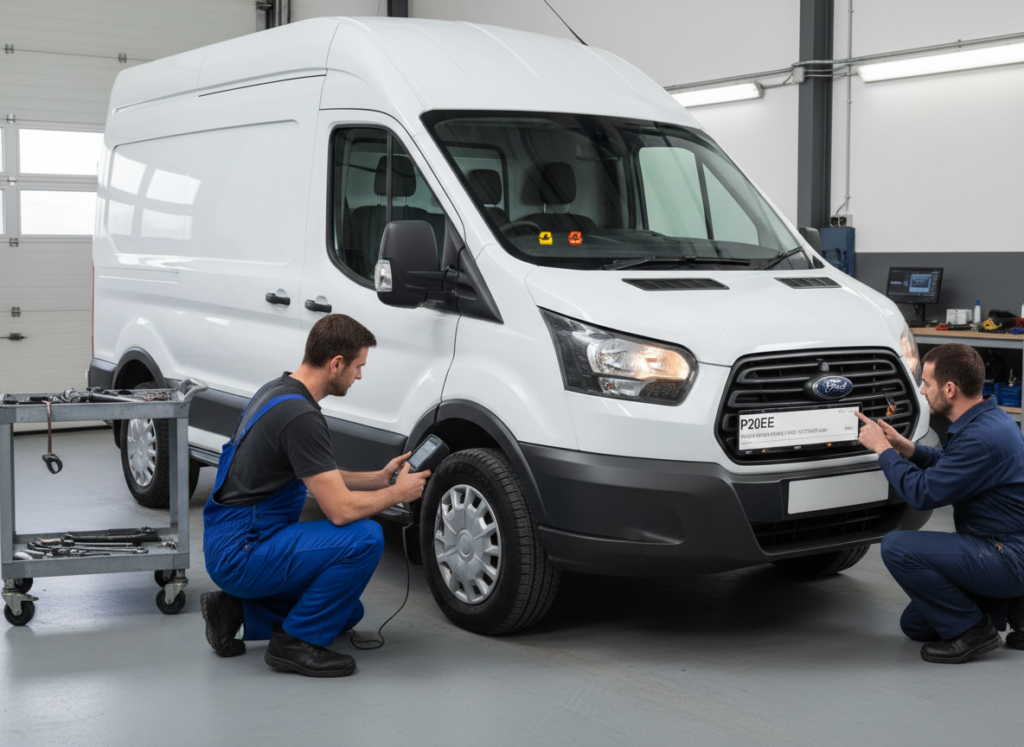
P20EE on Ford Transit: What the Fault Usually Means
If your Ford Transit has logged P20EE, the van is usually telling you the SCR system is not reducing emissions as it should.
That sounds technical, but the practical issue is simple. Something in the AdBlue and SCR setup is underperforming, and if it is left unresolved the fault can move from a warning light to a countdown and then to a no-start risk. For a working Transit, that is the part that matters most.
Quick Answer
P20EE on a Ford Transit usually points to low SCR efficiency. In plain English, the van thinks the AdBlue and emissions control system is not doing enough to clean up the exhaust gases. The cause is not always the same. It can be linked to dosing problems, crystallisation, injector blockage, poor AdBlue pressure, NOx sensor faults, heater issues, or wider catalyst and SCR performance problems. The key is to diagnose the real cause before the warning escalates.
Contents
- What P20EE means on a Ford Transit
- Why the code appears
- The most common causes
- Symptoms you may notice
- What to check first
- Can you still drive with P20EE?
- Why the fault keeps coming back
- Diagnosis vs guessing at parts
- What usually fixes the issue
What does P20EE mean on a Ford Transit?
P20EE is usually described as an SCR NOx catalyst efficiency below threshold fault.
That wording sounds awkward, but the idea behind it is straightforward. The van expects the SCR system to reduce emissions by a certain amount once AdBlue is dosed into the exhaust stream. If the readings do not show enough improvement, the control unit decides the system is underperforming and flags P20EE.
That does not automatically mean the SCR catalyst itself has failed. It only means overall efficiency is too low. The poor result can be caused by a number of upstream problems, which is why this code causes so much wasted money when people jump straight to replacing parts.
On a Ford Transit, P20EE is best treated as a system-performance fault rather than a single-component fault. The van is telling you the end result is wrong, not necessarily which part created that result.
Why does P20EE come up on Ford Transit vans?
Because the Transit works hard, and its AdBlue and SCR system has to work hard with it.
These vans do delivery work, trades work, motorway miles, local stop-start routes, depot runs, and cold starts. Over time, the AdBlue system, injector, sensors, pressure side, and catalyst all deal with wear, contamination, heat cycles, and changing conditions. When one part drifts out of range, the whole chain can look inefficient.
That is why P20EE often appears after a period of smaller issues. A van may have had minor warnings, occasional poor starts, or another emissions code in the past. Then one day P20EE arrives because the system has reached the point where the ECU no longer accepts the overall result.
Some owners expect one simple answer, but the more realistic answer is this: P20EE usually appears when the van is no longer happy with how the whole SCR process is working.
The most common causes of P20EE on a Ford Transit
Blocked or weak AdBlue injector
If the injector is restricted or spraying badly, the exhaust does not get the right dose at the right time.
Crystallisation in the dosing path
AdBlue can leave white crystal build-up around injectors and lines, which affects flow and spray pattern.
Poor pressure from the AdBlue system
If pressure is weak or unstable, dosing becomes unreliable.
NOx sensor problems
If the NOx readings are inaccurate, the van may think SCR efficiency is worse than it really is.
Heater or cold-start related faults
In low temperatures, poor system readiness can affect how the SCR process starts working.
Contaminated or poor-quality AdBlue
Less common than people think, but still possible if the wrong fluid or contaminated fluid has been used.
Wiring and connector faults
Damaged wiring or poor connectors can cause misleading readings or poor activation.
Genuine SCR catalyst underperformance
Sometimes the catalyst side is genuinely weak, but this should be confirmed, not assumed.
The main point is this: P20EE does not always mean “replace the catalyst”. That is one possibility, but far from the only one.
What symptoms do you usually get with P20EE?
Not every Ford Transit behaves in exactly the same way, but common signs include:
- engine management light
- AdBlue or emissions warning messages
- repeat fault after clearing
- restart countdown on some vans
- other stored SCR, NOx, or dosing-related faults
- normal driving at first, then more obvious warning escalation later
This is what catches many owners out. The van often still feels usable. It may drive to work, pull normally, and do a full shift. That makes it easy to delay the repair. But the countdown logic and emissions fault logic do not care whether the van still feels fine. If the system still sees low efficiency, the issue can keep progressing.
For a Transit used in business, that delay can become expensive very quickly.
What should you check first?
| Check | Why it matters |
|---|---|
| Other stored fault codes | P20EE alongside pressure, NOx, heater, or injector faults gives a much clearer route to the real cause. |
| AdBlue level and refill history | Low or contaminated fluid can muddy the picture, even if it is not the only issue. |
| Signs of crystallisation | Visible white residue often points to injector or dosing-path problems. |
| Countdown status | If a restart countdown has begun, the van needs urgent attention. |
| Previous parts replaced | If sensors or injector parts have already been changed, the real cause may sit elsewhere in the chain. |
These checks are not the full diagnosis, but they help avoid the most common mistake, which is treating P20EE like a random standalone code with no context.
Can you still drive a Ford Transit with P20EE?
Sometimes yes, but that is not the same as saying it is wise to leave it.
Many Transits will still drive for a while with P20EE active. The bigger concern is what happens over the next few starts and the next few journeys. If the van keeps deciding the SCR system is underperforming, it can move towards restart countdown behaviour.
So the better question is not “does it still run today?”
The better question is “how much risk am I taking by ignoring an efficiency fault on a work van?”
If the vehicle is used for deliveries, site work, tools, or daily transport, the answer is usually the same. The risk is not worth stretching out if the van is already telling you the system is unhappy.
Why does P20EE keep coming back after a reset?
Because the underlying cause is still present.
This is the typical pattern:
- the code is read
- the warning is cleared
- the van drives normally for a while
- the warning returns
That does not mean the scanner failed. It means the Transit ran its checks again, looked at SCR performance, and decided the result was still below the threshold it expects.
If the injector still doses badly, if the NOx sensor still reads badly, or if pressure is still weak, the reset has nothing solid to hold onto. The ECU just re-applies the warning logic.
This is why repeated resets without proper testing become a waste of time. They do not move you closer to the real repair.
Diagnosis vs guessing at parts
P20EE is one of those faults that punishes guesswork.
People often jump to the biggest-looking part first, but that is not always where the problem sits. This can lead to:
- a NOx sensor being changed when the injector is the real issue
- an injector being changed when pressure is too low
- a catalyst being blamed when the readings are being distorted by another fault
- a reset being done with no real fix behind it
A proper diagnosis should look at the whole system. That includes stored faults, live sensor values, injector operation, pressure, readiness, and what the van sees before and after dosing. That is how you separate a catalyst issue from a dosing issue, and a real efficiency problem from a false result caused by poor data.
On a working Transit, this matters because downtime is expensive and trial-and-error repairs quickly add up.
What usually fixes P20EE on a Ford Transit?
The right repair depends on what testing confirms, but common repair routes include:
Injector cleaning or replacement
Used where poor dosing or crystal build-up is affecting SCR performance.
Pressure-side repair
Used where the system cannot deliver AdBlue consistently.
NOx sensor replacement
Used where readings are proven to be wrong and causing false or exaggerated efficiency faults.
Wiring and connector repair
Used where poor electrical signals are distorting system behaviour.
Heater or cold-start related repair
Used where temperature-related behaviour is affecting early SCR operation.
Wider SCR fault resolution
Used where the catalyst side or full emissions chain is genuinely underperforming.
SCR efficiency fault
AdBlue diagnosis
No-start risk
Some vans need a small targeted repair. Others need proper system testing because the visible P20EE code is only the end result of another upstream fault.
When should you get the van checked?
You should stop waiting and get it diagnosed if:
- the warning keeps returning after being cleared
- there are multiple AdBlue, NOx, or SCR codes stored together
- a restart countdown has started
- another garage has replaced parts but the fault remains
- the van is needed daily for work and cannot be left to chance
The earlier the issue is narrowed down, the better your options usually are. Waiting rarely makes P20EE cheaper or simpler.
Need help with a Ford Transit P20EE fault?
We diagnose Ford AdBlue and SCR faults properly at your location, so you are not left guessing whether the real issue is the injector, pressure side, sensors, or wider SCR performance.
For mobile fault finding, countdown support, and practical next steps, call 07503 134362 or email info@adbluespecialist.co.uk.
Mobile support across Staffordshire, Cheshire East, and Staffordshire Moorlands. Open 7 days.
Final thought
P20EE on a Ford Transit is best read as a result problem. The van is telling you SCR efficiency is too low, but the real reason may sit in dosing, pressure, sensors, wiring, cold-start behaviour, or the catalyst side itself.
The right move is to find out which one. That is what turns a repeating warning into a real fix, and what helps stop a working van sliding into countdown trouble when you can least afford it.
FAQs
What does P20EE mean on a Ford Transit?
It usually means the van believes SCR efficiency is below the level it expects, so the emissions system is underperforming.
Does P20EE always mean the SCR catalyst is faulty?
No. It can also be caused by injector, pressure, NOx sensor, heater, wiring, or dosing-related issues.
Can I clear P20EE and keep driving?
You can clear it, but if the root cause remains the warning will usually return and may progress towards a restart countdown.
Can a blocked injector cause P20EE on a Transit?
Yes. Poor dosing is one of the most common reasons SCR efficiency faults appear.
When should I get the van checked?
As soon as the fault returns after a reset, appears with other SCR codes, or starts a restart countdown.