
AdBlue Specialist — Mobile Fault Diagnosis Stoke-on-Trent
AdBlue Consumption Fault: Why Your Vehicle Thinks It’s Using Too Much or Too Little
An AdBlue consumption fault means the SCR system has detected a mismatch between expected and actual fluid use. Here is what causes it, what fault codes appear, and how to fix it before it leads to a no-start countdown.
Quick Answer
An AdBlue consumption fault occurs when the vehicle’s ECU calculates that the AdBlue system is using significantly more or less fluid than expected. The most common causes are a faulty dosing injector, an internal AdBlue leak, a defective level or quality sensor, or an ECU calibration error. Left untreated, most consumption faults will eventually trigger a no-start countdown. Mobile diagnosis takes 20–30 minutes with live OBD data and resolves the fault in one visit. Call 07503 134362 for same-day availability.
Contents
What Is an AdBlue Consumption Fault?
Your vehicle’s SCR (Selective Catalytic Reduction) system is designed to inject a precise quantity of AdBlue fluid into the exhaust stream. The ECU monitors how much fluid is being consumed over time and compares it to a calculated expected rate based on engine load, temperature, and exhaust conditions.
An AdBlue consumption fault is triggered when the measured consumption rate deviates significantly from that expected figure — either using far more fluid than it should, or showing no consumption at all when the system should be actively dosing.
This is an important distinction from a simple low-level warning. A low-level warning tells you the tank needs topping up. A consumption fault tells you something is wrong with how the system is using fluid — and that is a different kind of problem that does not go away with a top-up.
Consumption faults are particularly common on higher-mileage vans and fleet vehicles where the dosing injector has seen several years of heat cycling, or where a slow internal leak has developed and gone unnoticed because the driver has been topping up without realising the rate of use is unusually high.
The Four Root Causes
1. Faulty or Clogged Dosing Injector
The dosing injector is the component that sprays AdBlue into the exhaust pipe ahead of the SCR catalyst. When it partially clogs — which is common after AdBlue crystallisation builds up at the nozzle tip — it can either restrict flow (causing under-dosing) or leak fluid continuously (causing over-dosing).
A clogged injector will show under-consumption: the system sends a dosing command but the actual amount delivered is less than what was ordered. An injector that is stuck partially open shows the opposite — constant fluid loss even when dosing should have stopped. Both conditions generate a consumption fault flag.
The injector can often be cleaned and tested rather than replaced outright, depending on the degree of crystallisation and whether the needle valve is still operating correctly.
2. Internal AdBlue Leak
The AdBlue tank, supply lines, heated pipes, and pump housing form a sealed circuit. A small crack or deteriorated seal anywhere in that circuit can allow fluid to escape without it ever reaching the exhaust — meaning the tank level drops faster than the dosing record suggests it should.
Internal leaks are especially common in cold climates, where the freeze-thaw cycle on the tank and pipework puts stress on seals and connectors. A vehicle that regularly parks outside overnight in winter is at higher risk. In these cases, the consumption fault appears because the ECU sees the tank level dropping at a rate it cannot account for through normal dosing activity.
Leak diagnosis requires a pressure test of the AdBlue circuit and a visual inspection of connections, particularly around the heated supply line joints and tank outlet fittings.
3. Defective Level or Quality Sensor
The level sensor tells the ECU how much AdBlue is in the tank. If it reads incorrectly — reporting the level as lower than it actually is, or jumping erratically — the ECU may calculate that consumption has been far higher than reality.
Quality sensors measure the urea concentration of the fluid. Standard AdBlue should be approximately 32.5% urea. If the sensor misreads this, the ECU may respond by ordering more dosing to compensate for what it perceives as sub-quality fluid — artificially inflating apparent consumption.
Sensor faults can produce confusing symptoms: the consumption fault appears even after a fresh full tank of high-quality fluid, and the fault may come and go depending on temperature and fill level. This is one of the reasons consumption faults are frequently misdiagnosed without proper live data logging.
4. ECU Software or Calibration Error
Less common but worth noting: some consumption faults originate not from a physical fault at all, but from a software calibration issue in the ECU or the AdBlue dosing module. This is particularly relevant on vehicles that have had aftermarket software work, an incomplete dealer update, or a battery disconnection that has reset certain adaptive values.
In these cases, the ECU’s reference table for expected dosing rates is incorrect, so even a perfectly functioning system registers as consuming the wrong amount. Diagnosis involves reading the current ECU calibration and comparing it against the correct reference data for that vehicle and engine variant.
Fault Codes Associated With AdBlue Consumption
A consumption fault will usually appear alongside one or more of the following OBD codes, depending on the vehicle manufacturer and ECU variant:
| Code | Description | Common Vehicles |
|---|---|---|
| P2BAD | Reductant consumption too high | Mercedes, VW, Audi |
| P2BAE | Reductant consumption too low | Mercedes, VW, Audi |
| P20EA | Reductant consumption high — closed loop control at maximum limit | Ford, Peugeot, Citroën |
| P20EB | Reductant consumption low — closed loop control at minimum limit | Ford, Peugeot, Citroën |
| P207F | Reductant quality performance (often triggers secondary consumption fault) | Wide range |
It is worth noting that P2BAD and P2BAE are sometimes stored as pending codes before becoming confirmed codes. This means a scan may reveal them even before the dashboard warning light has illuminated. Catching them at this stage gives you a much wider window to fix the fault before a countdown begins.
Can You Still Drive With the Fault?
The short answer is yes — initially. A consumption fault alone does not immediately trigger a no-start countdown in most vehicles. You will typically see an amber warning light and a message asking you to check the AdBlue system, but the engine will continue to start normally for a period.
However, the window depends on a few things. First, how depleted the tank is — if the consumption fault is accompanied by a low-level warning, the countdown may be imminent regardless. Second, how the vehicle’s ECU handles persistent faults: some platforms escalate to a start-prevention notice after a set number of confirmed drive cycles with the fault active.
The safe approach is to treat an AdBlue consumption fault as urgent, even if the vehicle is still driving normally. It is significantly cheaper and less disruptive to diagnose it while the vehicle is mobile than to deal with it after it has locked out.
What Happens If You Ignore It?
Ignoring an AdBlue consumption fault typically follows a predictable escalation path. The warning light stays on and fault codes accumulate. If the underlying cause is a leak or a stuck-open injector, the tank depletes faster than expected — the driver tops up more frequently but does not understand why.
Once the ECU determines the fault is persistent and not self-correcting, it moves to the next stage: a start countdown. This is the number of engine starts (not miles) the vehicle will allow before it refuses to start at all. Common countdowns are 100, 50, and 5 starts — after which the vehicle immobilises.
At that point, recovery is more complex: the vehicle needs professional diagnosis to identify the root cause, physical repair of whichever component has failed, and an ECU reset that confirms the fault is cleared. Doing this on a locked-out vehicle is significantly more expensive and time-consuming than addressing it at the warning-light stage.
There is also an MOT implication. An active AdBlue fault — including a consumption fault — will cause an emissions failure, and depending on the associated codes, may prevent the car from completing the test cycle at all.
How It Gets Diagnosed and Fixed
Diagnosing an AdBlue consumption fault properly requires live data, not just fault code reading. A standard code reader will show you the stored codes, but it will not tell you whether the injector is actually delivering the commanded dose, whether the level sensor is reading accurately, or whether the ECU is operating in open-loop or closed-loop dosing mode.
The diagnostic process for a consumption fault typically involves:
- Reading all stored and pending fault codes across the engine, SCR module, and NOx sensor
- Monitoring live dosing commands versus actual delivery data during an active drive cycle
- Checking the AdBlue level sensor reading against a physical dipstick measurement
- Testing AdBlue quality concentration with a refractometer
- Pressure-testing the AdBlue circuit for leaks
- Inspecting the dosing injector nozzle for crystallisation and checking the injector return rate
Once the root cause is identified, the fix depends on what is found. A blocked injector can often be removed and ultrasonically cleaned. A leaking supply line or seal is replaced. A faulty level sensor is swapped. A software calibration issue is corrected with a parameter reset.
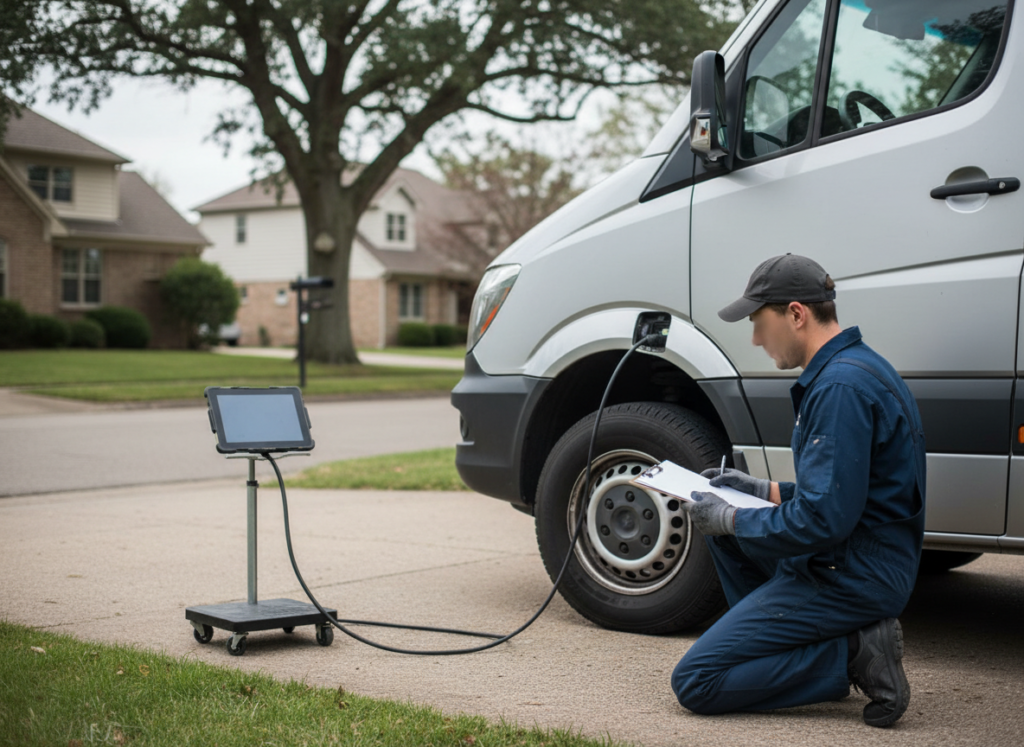
Mobile diagnosis means all of this happens at your location — there is no need to arrange recovery or book the vehicle into a workshop. In most cases, a consumption fault can be diagnosed and repaired in a single visit. Our AdBlue repair service covers diagnosis and physical repair together, so you are not paying for two separate callouts.
If you have already had the fault light on for some time and are unsure how many starts remain on your countdown, check your dashboard for any start-warning messages and call us before the vehicle locks out completely. Our mobile service covers Stoke-on-Trent and surrounding areas with same-day availability most days of the week.
AdBlue Consumption Fault? Get It Diagnosed Today
Mobile diagnosis at your home, workplace, or roadside. We read live dosing data, test the circuit, and repair on the same visit. No recovery required.
Frequently Asked Questions
Will topping up the AdBlue tank clear a consumption fault?
No. A consumption fault is triggered by an abnormal usage rate, not by the tank being empty. Topping up replaces the fluid but does not address the underlying cause — faulty injector, leak, or sensor issue. The fault code will remain active and the warning light will stay on. You need a diagnostic scan and a physical repair to clear it.
Can an AdBlue consumption fault cause an MOT failure?
Yes. An active AdBlue system fault will typically cause an emissions test failure, and some faults prevent the emissions cycle from completing at all. The vehicle needs the fault properly resolved before presenting for its MOT. A cleared fault code without an underlying fix will often return before or during the test cycle.
How quickly does a consumption fault lead to a no-start countdown?
This varies by vehicle make and ECU calibration. On most modern diesels, the ECU will allow several drive cycles with a persistent consumption fault before escalating to a countdown notice. Some vehicles escalate within a few days; others take longer. The safest approach is to treat any AdBlue consumption fault as requiring prompt diagnosis rather than waiting to see what happens.
Is an AdBlue consumption fault the same as an AdBlue quality fault?
Not exactly. A quality fault (such as P207F) is triggered when the ECU detects that the urea concentration in the tank is outside the acceptable range — either too diluted or over-concentrated. A consumption fault is about the rate of fluid use, not its composition. However, the two can be related: a quality fault may cause the ECU to increase dosing to compensate, which in turn produces an apparent over-consumption reading.
Can a consumption fault fix itself?
Occasionally a false consumption fault will clear after a fresh full tank of quality-certified AdBlue, particularly if it was caused by a borderline sensor reading. However, a fault caused by a leaking seal, blocked injector, or failing sensor will not self-resolve. If the fault returns after a fresh top-up, it requires professional diagnosis. Persistent faults that appear to clear and then return are usually indicative of a sensor or injector issue.