
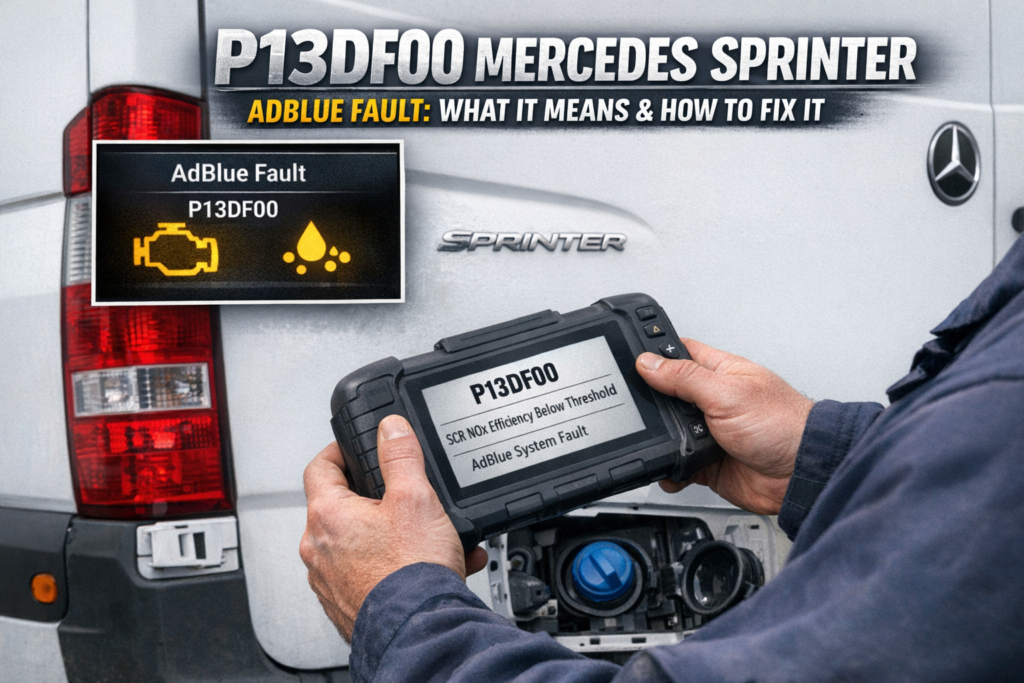
Your Sprinter has thrown a P13DF00 and the dashboard warning is not going away. You’ve tried clearing it. It comes straight back. Here is what that code actually means, why it behaves that way, and what a proper fix looks like.
P13DF00 is a Mercedes-specific AdBlue system warning — stage 1 — stored in the SCR control unit. It means the system has detected a malfunction, most often a NOx sensor signal fault, an SCR control unit issue, or a wiring problem. It will not clear with a standard OBD tool and will escalate to a start countdown if left unresolved. A specialist reset or a software-based NOx sensor fix is the right next step.
What P13DF00 Means on a Mercedes Sprinter
P13DF00 is not a standard OBD-II code. It is a Mercedes-specific diagnostic trouble code stored in the AdBlue SCR (Selective Catalytic Reduction) control unit — a separate module from the main engine ECU. The full description reads: AdBlue system warning stage 1 — the AdBlue system has a malfunction.
The “00” suffix confirms the fault is currently active and stored. Stage 1 is the SCR module’s first formal alert that something within the emissions reduction circuit is not reading or performing as expected. It does not mean you have low fluid, and it does not mean the pump has necessarily failed. It means the SCR module has detected an internal discrepancy it cannot resolve on its own, and it has flagged it as a warning before the countdown begins.
This code appears most commonly on 2015–2023 Sprinters fitted with SCR generation 4 and later systems, covering the 2.1-litre OM651 and 2.0-litre OM654 engine variants. Fleet vehicles doing a lot of short-stop urban work tend to see it sooner — the SCR system never fully reaches operating temperature and the NOx sensors cycle without the benefit of long regeneration runs.
The adblue system malfunction warning on a Mercedes Sprinter is not something to park and revisit. The warning system is staged, and stage 1 is your window to act at the lowest cost with the most options still open.
How P13DF00 Differs From Related Sprinter Fault Codes
Sprinter AdBlue faults follow a structured warning hierarchy. Understanding where P13DF00 sits in that chain tells you how urgent things are and what to expect next.
P13DF00 vs P13E300 — Stage 1 vs Stage 2
P13E300 is the direct escalation of P13DF00. Once the SCR module has logged a stage 1 malfunction and the vehicle has been driven without the underlying fault being resolved, the system steps up to stage 2. At that point, a countdown of permitted engine starts appears on the dashboard and cannot be paused. P13E300 is the code most drivers associate with the “X starts remaining” message — but P13DF00 is what triggers the path to get there. Acting at stage 1 stops that progression before it starts.
P13DF00 vs P20E8 and P204F
P20E8 (reductant pressure too low) and P204F (SCR system performance below threshold) are component-specific codes relating to pump behaviour, line pressure, or NOx catalyst performance. P13DF00 sits above these in the warning hierarchy — it is often triggered by one of them. If your scan shows P20E8 or P204F alongside P13DF00, the lower code is likely the root cause and the stage 1 warning is a consequence of that underlying fault going unresolved. For a detailed breakdown of those codes, see the guide to Sprinter fault codes P20E8 to P204F.
| Code | Description | What it means for you |
|---|---|---|
| P13DF00 | AdBlue system warning — stage 1 malfunction | Act soon — no countdown yet, most options available |
| P13E300 | AdBlue system warning — stage 2, starts limited | Urgent — countdown active, book immediately |
| P13E400 | AdBlue system warning — stage 3, no restart possible | Critical — recovery required |
| P20E8 | Reductant pressure too low | Often a root cause of P13DF00 |
| P204F | SCR system performance below threshold | Often a root cause of P13DF00 |
What Causes P13DF00 on a Mercedes Sprinter
P13DF00 is a consequence code. The SCR control unit generates it when something in the AdBlue circuit falls outside the parameters it expects. These are the most common root causes, roughly in order of how frequently they show up in practice on UK commercial Sprinters.
NOx sensor signal fault
The front (upstream) and rear (downstream) NOx sensors measure nitrogen oxide levels on either side of the SCR catalyst. If either sensor sends a reading that doesn’t align with expected values — through ageing, connector corrosion, or outright failure — the SCR module logs it as a system malfunction. This is the most frequent cause on Sprinters above 80,000 miles, and it typically stores a more specific NOx sensor code such as P229F or P229F62 alongside P13DF00. When you see both codes together, the NOx sensor is almost always where to start.
SCR control unit software state
Mercedes has issued technical service documentation specifically for P13DF00 because the code can be generated by a locked software state within the SCR module itself — not a physical failure at all. On SCR generation 4 Sprinters, the warning counter inside the module must be reset using XENTRY Diagnosis following a precise multi-step protocol. Without that, the code returns immediately after clearing, even when no physical fault is present. This is one of the more frustrating presentations of P13DF00 because everything looks fine on the vehicle, but the module is holding the fault internally.
AdBlue quality or contamination fault
If contaminated, diluted, or degraded AdBlue fluid has been used — or if the tank wasn’t properly flushed after a quality event — the SCR module may detect incorrect fluid concentration through the quality sensor and raise a stage 1 warning. This is less common than sensor or software causes, but it’s worth considering if P13DF00 appeared shortly after a refill, particularly if that refill used a non-compliant product or an older container.
Heater circuit wiring damage
The AdBlue tank heater circuit on some Sprinter configurations runs close to the exhaust system. Heat exposure over time can degrade the wiring harness, causing intermittent signals that the SCR module reads as a system fault. This typically presents with a heater circuit code (such as P20B9 or a specific heater resistance code) alongside P13DF00, rather than appearing as an isolated warning. If you see heater-related codes in the same scan, inspect the wiring run near the exhaust before replacing any components.
Why a Generic OBD Reset Won’t Clear P13DF00
This is the most common frustration reported by Sprinter owners and mechanics who haven’t worked with Mercedes SCR systems before. The fault is erased, the van is started, and P13DF00 is back within seconds or a short drive. There are two distinct reasons this happens.
The first is access. P13DF00 lives in the Mercedes AdBlue SCR control unit — a separate module from the main engine ECU. Many generic OBD readers only communicate with the engine management system. They can read P13DF00 from shared memory, but they cannot reach into the SCR module at the depth required to perform a proper reset. Even professional scan tools that do access the SCR module will see the code return if the underlying cause hasn’t been resolved and the reset procedure hasn’t been followed exactly.
The second is procedure. Mercedes XENTRY — and tools that replicate its capability — requires a specific multi-step reset protocol for SCR generation 4 Sprinters. This includes verifying battery voltage, running an active test on the heater element, confirming all related SCR module fault codes have been processed, and then performing the warning counter reset in sequence. Skipping any part of this results in immediate reactivation. A generic fault erase does none of it.
If you’ve already tried resetting and P13DF00 has come back within minutes, that is not the scan tool malfunctioning — it’s the SCR module confirming the fault is still present and the reset was incomplete. The mercedes benz ld dtc p13df00 reset procedure is not something a standard garage code reader can complete.
What Happens if You Ignore P13DF00
At stage 1, the Sprinter typically runs normally. That’s what makes P13DF00 easy to set aside — the van still starts, pulls, and gets the job done. The danger is how quickly the situation changes.
Once stage 2 is triggered, P13E300 appears and a countdown of permitted starts begins. That countdown shows on the dashboard, decreases with each key-on cycle, and cannot be paused. When it reaches zero, the vehicle enters stage 3 and will not restart after the next key-off. For a fleet vehicle mid-route or a tradesperson two hours from home, stage 3 means recovery costs, lost bookings, and a grounded van on top of whatever the repair itself costs.
Acting at stage 1 gives you the most options. You can choose between a reset, a targeted repair, or a permanent software-based fix depending on the root cause. Waiting until the countdown is running limits what can be done quickly and drives the overall cost up — particularly once recovery is involved.
When a Mobile Fix Is the Right Call
For most commercial Sprinter owners in Staffordshire, Cheshire East, and Staffordshire Moorlands, a mobile specialist visit is the most practical resolution. There is no towing, no workshop queue, and the diagnosis and fix happen at your location — a depot, a job site, or your driveway.
What the right fix looks like depends on what the diagnosis finds:
- NOx sensor fault confirmed: On a high-mileage commercial Sprinter, a NOx sensor delete or NOx sensor bypass is often the most cost-effective permanent resolution. NOx sensor replacement on a Sprinter is expensive, and sensors on vehicles covering 50,000–80,000 miles a year tend to fail again within two to three years. A software-based solution removes the dependency on the sensor entirely and stops P13DF00 returning through that route.
- SCR module software reset required: Where the cause is a locked software state rather than a physical component failure, a specialist carrying XENTRY-compatible software can perform the correct SCR reset procedure on-site. This clears P13DF00 at the module level and resets the warning counter properly, rather than just erasing the stored code.
- Underlying pressure or quality fault: If a P20E8 or similar code is driving the stage 1 warning, diagnosing and resolving that fault through an AdBlue fault reset and targeted investigation clears both the root cause and the P13DF00 that followed from it.
Same-day appointments are available across Staffordshire, Cheshire East, and Staffordshire Moorlands, seven days a week. To discuss your vehicle, confirm the fault, and get a booking in place, book a same-day mobile visit.
P13DF00 on Your Sprinter? Get It Sorted Today
We diagnose and fix Mercedes Sprinter AdBlue faults at your location — no workshop, no towing required. Same-day slots available across Staffordshire and Cheshire East, Monday to Sunday, 09:00–20:00.
Common Questions About P13DF00
Will P13DF00 clear itself if I keep driving?
No. P13DF00 requires the underlying fault to be resolved and a correct SCR module reset to be performed using compatible specialist software. The code will not self-clear through driving, and continued use without addressing it will trigger the stage 2 countdown and P13E300.
Is it safe to drive with P13DF00 stored?
The van will usually run normally at stage 1, but the situation will change once the system escalates. Running a commercial vehicle with a known AdBlue system malfunction and allowing it to progress to stage 3 mid-route carries a real operational risk. Get it diagnosed before the countdown starts — at stage 1 you have the most flexibility in how it’s resolved.
Can any OBD scanner reset P13DF00 properly?
Generic OBD readers can often read and erase the code from shared memory, but without proper communication with the Mercedes SCR control unit and the correct multi-step reset procedure, the code returns almost immediately. XENTRY or an equivalent specialist tool is required to access the SCR module and perform the warning counter reset correctly.
My Sprinter has P13DF00 alongside P229F — what does that mean?
P229F is a NOx sensor comparison fault — it indicates the front and rear sensor readings don’t match as expected. Seeing P229F alongside P13DF00 is a strong indicator that a NOx sensor (or its wiring connection) is the root cause of the stage 1 warning. Resolving the NOx sensor fault will typically clear both codes once the SCR reset is performed correctly. A NOx sensor bypass is often the most cost-effective permanent fix in this situation.
How much does it cost to fix P13DF00?
Cost depends on the root cause found during diagnosis. A mobile software-based reset or NOx sensor fix typically costs considerably less than a main dealer NOx sensor replacement, which can reach several hundred pounds before labour. Contact us with your vehicle details for an accurate quote before committing to any repair route.