

Reset SID212EVO AdBlue Faults: What Works and What Fails (2026)
You can clear some SID212EVO AdBlue warnings with a reset, but it only holds if the ECU’s failed check now passes.
If pressure, quality, or SCR efficiency still fails, the warning returns and a countdown can start.
A reset feels like the quickest way out.
Plug in a reader, clear the code, and hope the dash stays quiet.
On Ford EcoBlue with SID212EVO, it often comes back after the next drive cycle because the ECU runs the same compliance test again.
This guide shows when resets hold, when they fail, and what actually stops the loop.
Don’t gamble on a basic code clear.
Use the emergency guide:
Ford SID212EVO no-start countdown.
Want the full system map first?
SID212EVO AdBlue faults explained.
What a “reset” actually means on SID212EVO
People use “reset” to mean different things.
On SID212EVO, these three actions are not the same, and they do not give the same outcome.
| What you do | What it clears | What it does not clear | Typical outcome |
|---|---|---|---|
| Basic code clear (cheap OBD reader) | Stored fault codes (sometimes) | Underlying failed compliance checks | Warning returns after the same test runs again |
| Proper diagnostic clear (with live data / procedures) | Codes + some learned states (depending on tool) | Pressure/quality/efficiency failures if still present | Can hold if the system now passes |
| Compliance reset pathway (fix + verify + clear) | Codes and countdown pathway when the test passes | Nothing, if root cause still exists | Best chance of a permanent result |
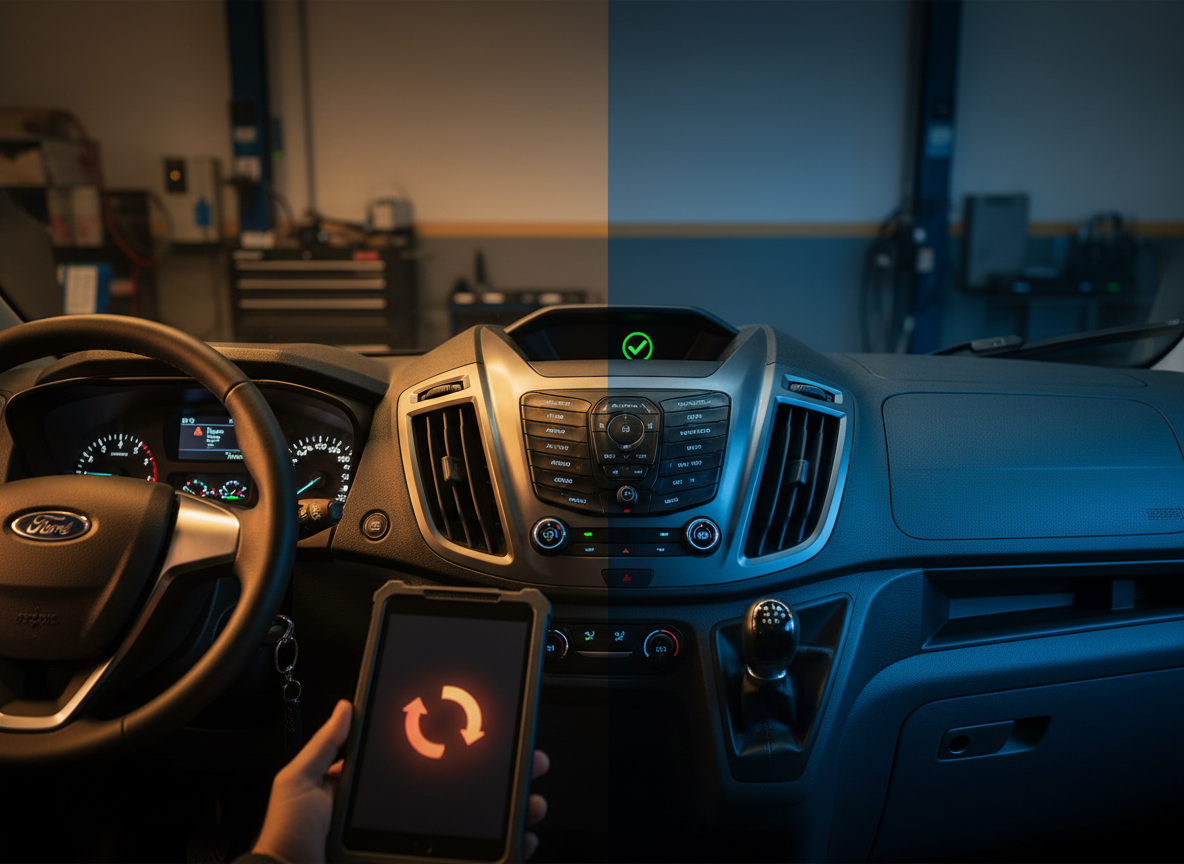
SID212EVO does not “forget” because you cleared a code.
It repeats the test.
If the test still fails, the warning comes back.
When resets work (and why they hold)
Resets can work when the system is actually fine and the fault came from a one-off trigger.
These are the situations where we see resets hold.
Reset holds when
- Low AdBlue level was the only issue and no other codes exist.
- A temporary sensor plausibility issue happened once and doesn’t repeat.
- A repair is complete and you’re clearing the stored fault after proving normal operation.
- No countdown is active and the ECU has not escalated compliance enforcement.
What you’ll notice
- The warning clears and stays cleared after multiple start cycles.
- No new pending codes appear after a normal drive.
- You do not see “no start in X miles” return later.
Still unsure? Start with the master map:
SID212EVO faults explained.
When resets fail (and why the warning returns)
Resets fail when a compliance check still fails.
On SID212EVO, the three checks that trap most people are pressure, quality, and SCR efficiency.
Reset fails when
- P20E8 pressure behaviour still drops under demand.
- P207F quality logic still fails because the ECU does not trust the concentration calculation.
- P20EE efficiency still fails because NOx readings or catalyst performance do not meet threshold.
- The fault clears, then returns after one drive cycle or a short run.
- A countdown started because the ECU believes compliance cannot be met.
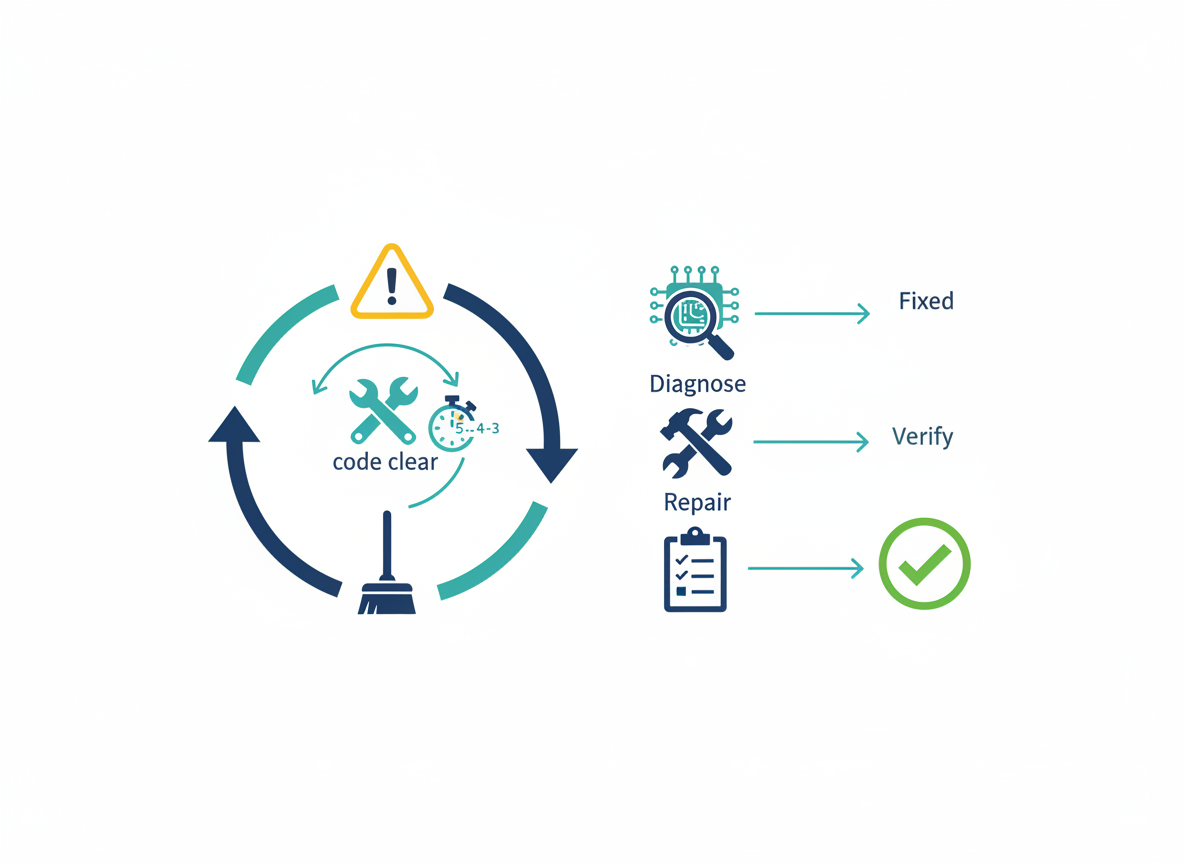
That timing often means the ECU ran the same test again and failed it.
Treat it as a diagnostic problem, not a topping-up problem.
How to tell which bucket you’re in (quick checks you can do)
You do not need to guess.
Use these questions to decide whether a reset is worth trying, or whether you should diagnose properly now.
- Do you have a countdown? If yes, stop trying quick clears and use the countdown guide.
- Did the warning stay after topping up? If yes, it’s rarely level-related.
- Does the warning return after one drive? If yes, the same check still fails.
- Do you have one of these codes? P20E8, P204F, P207F, P20EE. If yes, follow the exact code page.
Countdown pathway:
No-start countdown on SID212EVO.
What actually stops the cycle
This is the part people skip.
You don’t “reset” your way out of SID212EVO faults.
You stop the check failing, then you clear it.
- 1) Identify the failing check: pressure, quality, performance, or efficiency.
- 2) Fix the root cause: not the part name on a generic code description.
- 3) Verify with live data: prove the behaviour is stable under demand.
- 4) Clear and confirm: then run a drive cycle so the ECU can re-test and pass.
Most common “root causes” we see
- P20E8 loop: weak pump behaviour, restriction, crystallisation.
- P207F loop: contaminated/old fluid, concentration plausibility failures.
- P20EE loop: NOx sensor drift under load, injector issues, small exhaust leaks.
Where to go next in the hub
We test the system, fix the root cause, then prove it passes the checks that trigger the warning and countdown.
Start with the master page if you want the full overview:
SID212EVO AdBlue faults explained.
Common SID212EVO codes and how “resets” usually go
Use this table to set expectations before you spend money.
If your code sits in the “usually returns” column, go straight to the correct guide.
| Code | What the ECU is unhappy about | Will a reset hold? | Best page to follow |
|---|---|---|---|
| P20E8 | Pressure too low or unstable under demand | Usually returns unless pressure behaviour is fixed | P20E8 guide |
| P204F | System performance does not match expected dosing behaviour | Often returns if restriction or supply issues remain | P204F guide |
| P207F | Quality logic / concentration plausibility fails | Often returns unless the quality trigger is removed | P207F guide |
| P20EE | NOx reduction below threshold (efficiency) | Usually returns if the efficiency check still fails under load | P20EE guide |
Reset SID212EVO AdBlue faults FAQ
Sometimes, yes.
If the ECU runs the same test again and it still fails, the warning returns.
If you have repeat faults, use the pillar guide:
SID212EVO master guide.
That timing often lines up with the ECU re-running the compliance test.
If it fails again, it re-triggers the warning and can restart the countdown pathway.
Because SID212EVO cares about test results, not tank level.
Pressure, dosing, and NOx reduction must pass.
Start with:
SID212EVO faults explained.
Treat it as urgent and stop trying quick clears.
Use:
Ford SID212EVO countdown guide.
We diagnose the failing check, fix the cause, then confirm it passes so the warning doesn’t return.
Related:
AdBlue reset vs delete
and
SCR system explained.