
On 10 July 2026, the UK High Court handed down its long-awaited judgment in one of the largest automotive litigation cases in British legal history. The ruling — which followed a 10-week trial concluding in December 2025 — involved five car manufacturers, approximately 1.6 million UK vehicle owners, and total claims estimated at £6 billion. For Mercedes diesel owners in particular, the outcome raises questions that go beyond the courtroom: what did the judge actually find, what does it mean for existing claims, and does any of it explain the AdBlue problems that so many Mercedes drivers experience?
Here is a clear, factual breakdown of what happened and what it means for Mercedes diesel owners right now.
The UK High Court ruled on 10 July 2026 that car manufacturers broadly won the £6 billion Dieselgate 2 case. One Mercedes vehicle was found to contain a Prohibited Defeat Device, but the judge ruled that device did not reduce the effectiveness of the emissions control system. Lawyers are considering an appeal and a further trial is scheduled for October 2026. Most Mercedes diesel owners are unaffected by the ruling but may still be dealing with unrelated AdBlue faults that need a practical fix.
In this guide
What was the Mercedes diesel emissions case about?
The litigation — widely referred to as “Dieselgate 2” — was a group action brought on behalf of around 1.6 million UK vehicle owners against five major car manufacturers, including Mercedes-Benz. Claimants alleged that the manufacturers had fitted diesel vehicles with so-called “defeat devices”: software strategies that detected when a vehicle was being subjected to official emissions testing and temporarily reduced NOx output to pass the test, while emitting far higher nitrogen oxide levels in real-world driving conditions.
The allegations against Mercedes-Benz were specific and technically significant. Claimants, led by law firm PGMBM, alleged that Mercedes had configured its AdBlue (diesel exhaust fluid) dosing system to inject less fluid in real-world driving than during standardised test cycles. Because the SCR catalyst relies on a continuous, consistent supply of AdBlue to reduce NOx emissions, dosing less fluid in normal use would mean real-world emissions were substantially higher than what tests showed. According to the claimants, this allowed Mercedes vehicles to appear compliant on paper while producing illegal levels of NOx on UK roads.
Germany’s Federal Motor Transport Authority (KBA) had already ordered a recall of approximately 90,000 Mercedes vehicles in England and Wales before the trial began. Mercedes also carried out hundreds of thousands of additional voluntary recalls across Europe. But the question for the UK High Court was whether the strategies in question legally constituted defeat devices under the relevant EU emissions regulations — and what that meant for UK owners seeking compensation.
What did the High Court actually rule on 10 July 2026?
High Court judge Sara Cockerill ruled, following consideration of 20 representative vehicles across the five defendant manufacturers, that the car makers broadly won the case. Across those 20 vehicles, the court found that three contained Prohibited Defeat Devices (PDDs): one Mercedes-Benz and two PSA models (Peugeot and Citroën). The remaining 17 vehicles, including the majority of the Mercedes vehicles tested, were cleared.
For Mercedes specifically, the one vehicle found to contain a PDD had been fitted with a coolant temperature control strategy that the judge determined had already been removed in a December 2015 software update. Crucially, Judge Cockerill found that this device “did not reduce the effectiveness of the emissions control system.” The legal test she applied was whether a device operates “with the intentional and/or impermissible purpose of causing the [emissions control system] to operate differently when it senses the test cycle” — and most of the Mercedes strategies did not meet this threshold.
Mercedes-Benz described the ruling as being “very largely in favour” of the company. Law firm Leigh Day, which represented claimants, confirmed it was considering whether to seek permission to appeal the judgment. According to Fleet News, the ruling creates a significant legal divergence between Great Britain and much of continental Europe, where emissions cases against manufacturers have fared differently.
Key findings at a glance
| Question | Outcome |
|---|---|
| Did Mercedes broadly win the case? | Yes — the vast majority of allegations were rejected |
| Was any defeat device found in a Mercedes? | Yes — one vehicle had a coolant temperature strategy (already removed in December 2015) |
| Did that device undermine emissions performance? | No — the judge found it did not reduce the effectiveness of the emissions control system |
| Can claimants appeal? | Lawyers at Leigh Day are considering seeking permission to appeal as of July 2026 |
| Is the case completely over? | Not yet — a further trial is listed for October 2026 to address remedies and consequences |
Which Mercedes diesel vehicles were included in the case?
The litigation covered Mercedes diesel models manufactured between approximately 2009 and 2020. This included vehicles across the C-Class, E-Class, GLC, and Sprinter van ranges, particularly those fitted with the OM651 and OM654 engine families. These engines were sold across hundreds of thousands of UK vehicles during that period and are among the most common diesel platforms on British roads.
The KBA recall specifically targeted vehicles where Mercedes used certain thermal window strategies — temperature-linked approaches that adjusted emissions system behaviour depending on ambient conditions. Some of these strategies had already been addressed through software updates before the trial began. The recall and any resulting software changes do not automatically entitle UK owners to financial compensation; that would depend on the outcome of any appeal or subsequent legal proceedings.
If you are unsure whether your specific vehicle was covered by the recall, the DVSA’s official recall checker at check.dvsa.gov.uk will confirm whether any recall notice applies to your registration. You can also contact Mercedes-Benz UK directly with your VIN.
What is the connection to AdBlue, and does it explain ongoing faults?
The AdBlue dosing allegation in the Mercedes case was a specific technical claim: that the quantity of diesel exhaust fluid injected into the SCR system was deliberately lower in real-world driving than during official test cycles. If true, this would mean real-world NOx emissions were higher than tests suggested, because the SCR system was not receiving enough AdBlue to reduce nitrogen oxides to the permitted level.
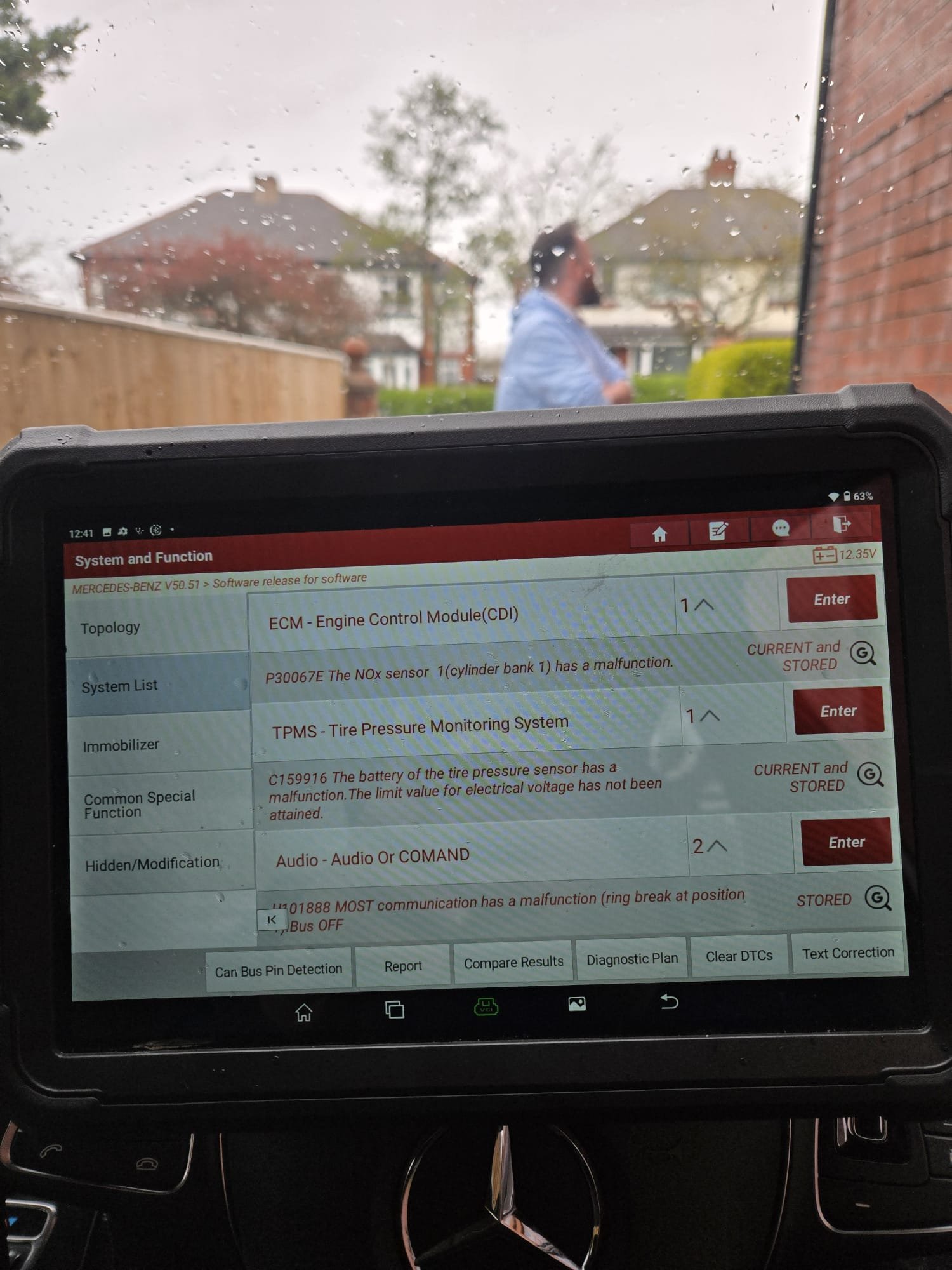
This is, however, very different from the everyday AdBlue faults that Mercedes diesel owners experience and that a mobile specialist would address. Day-to-day problems — P20E8 low pressure faults, P204F SCR performance faults, P13DF heater circuit faults, no-start countdowns triggered by low or contaminated AdBlue — are engineering and wear-related issues. They arise from sensor failures, pump degradation, dosing injector crystallisation, or frozen lines in cold weather. They are not the result of the emissions strategies that were at the centre of the legal case.
In other words: if your Mercedes is showing an AdBlue warning or has entered a no-start countdown, that is a practical fault that needs a practical fix. It will not resolve itself through a legal ruling, and waiting for the outcome of any appeal will not get your vehicle moving again. A mobile diagnostic session can usually identify the root cause and address it on-site without towing or workshop downtime. For more on the most common fault patterns, see our guides to Mercedes Sprinter AdBlue problems and Mercedes P204F fault code.
Can Mercedes diesel owners still pursue a claim after the ruling?
As of July 2026, the legal position for most Mercedes diesel owners is that the High Court has ruled against the majority of the claims brought on their behalf. The ruling is a significant setback for the group litigation. However, the process is not entirely concluded:
- Lawyers at Leigh Day, who represent many of the 1.6 million claimants, are considering whether to seek permission to appeal Judge Cockerill’s findings.
- A further trial has been listed for October 2026. This hearing will determine the legal consequences of any actionable breaches that were found, and any questions relating to damages or other remedies for the limited findings against manufacturers.
- The legal outcome in the UK diverges substantially from several European jurisdictions, where courts have reached different conclusions on similar allegations against Mercedes-Benz.
If you are currently registered as a claimant in the Mercedes emissions litigation, your solicitor or the law firm managing your claim will be best placed to advise on next steps in light of the judgment. This article provides factual information only and does not constitute legal advice.
What should you do if your Mercedes has ongoing AdBlue problems?
Whether or not the emissions ruling ultimately results in any compensation for Mercedes diesel owners, it does not address the very real AdBlue faults that many drivers are dealing with right now. These faults can cause warning lights, limp mode, and in serious cases, a no-start condition that leaves a vehicle immobilised until a specialist resets the system.
Common Mercedes AdBlue issues we see across Staffordshire, Cheshire East, and the wider Staffordshire Moorlands include:
- No-start countdown: triggered when the ECU detects an AdBlue system fault or critically low fluid. Requires a specialist diagnostic reset in addition to refilling.
- P20E8 low AdBlue pressure: often linked to a failing dosing pump, blocked injector, or frozen pipework. Common on Sprinter models in winter.
- P204F reductant system performance: points to SCR catalyst efficiency below threshold — a wider system assessment is needed to identify the root cause.
- P13DF heater fault: affects OM651 and OM654 engines; the AdBlue heater element fails, causing quality and pressure faults to cascade.
- Warning light on after refilling: the ECU has logged a fault that does not clear just from topping up the tank — a reset is required.
AdBlue Specialist attends vehicles at your location — home, workplace, or roadside — with professional diagnostic equipment. Most Mercedes AdBlue faults can be diagnosed and resolved without needing to tow the vehicle, and same-day appointments are often available. You can also find out more about Mercedes AdBlue removal or our general AdBlue repair service if you want to understand the options before calling.
Mercedes AdBlue fault? We come to you.
Mobile diagnostics across Staffordshire, Cheshire East and Staffordshire Moorlands. Most faults resolved on-site, same day, without recovery.
AdBlue repair service
Sprinter AdBlue problems
P204F fault code
No-start countdown
Frequently asked questions
Did the High Court find that Mercedes cheated on diesel emissions tests?
One Mercedes vehicle was found to contain a Prohibited Defeat Device — a coolant temperature control strategy that had already been removed in a December 2015 software update. However, the judge found this device did not reduce the effectiveness of the emissions control system. Most of the defeat device allegations against Mercedes were rejected.
Is the Mercedes diesel emissions class action still open?
As of July 2026, the High Court has ruled largely in favour of Mercedes. Lawyers at Leigh Day are considering whether to seek permission to appeal. A further trial is listed for October 2026 to address consequences and any remedies from the limited findings against manufacturers.
My Mercedes has AdBlue faults — is this connected to the emissions case?
No. Day-to-day AdBlue faults — sensor failures, dosing pump issues, heater circuit problems, no-start countdowns — are engineering issues unrelated to the emissions strategies alleged in the legal case. They need a diagnostic fix from a specialist, not a legal outcome.
Which Mercedes diesel models were recalled by the KBA?
Germany’s KBA ordered a recall of approximately 90,000 Mercedes vehicles in England and Wales, targeting certain diesel models manufactured between 2009 and 2020. Mercedes also conducted additional voluntary recalls across Europe. You can check your vehicle via the DVSA recall checker or contact Mercedes UK with your VIN.