
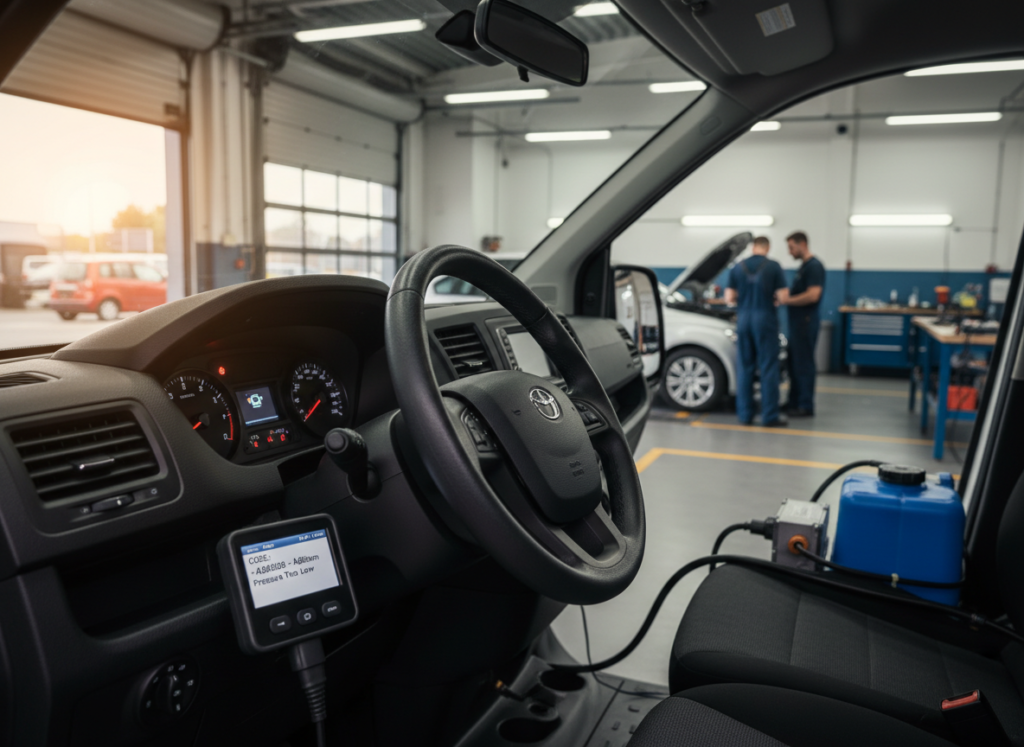
P20E8 Fault Code: Low AdBlue Pressure Causes and Fixes
Your dash shows a warning. You scan it. P20E8 appears.
This fault points to low AdBlue pressure in the SCR system. Left unchecked, it can lead to a no-start countdown.
Quick Answer
The P20E8 fault code means the AdBlue system cannot build enough pressure. This is usually caused by a failing pump, blocked injector, crystallisation, or a faulty pressure sensor. If ignored, it can trigger a no-start warning.
Contents
- What P20E8 actually means
- Common causes of low AdBlue pressure
- Symptoms you will notice
- What to check first
- Can you keep driving?
- Proper diagnosis vs guesswork
- Repair options explained
- When to book a fix
What does the P20E8 fault code mean?
P20E8 is a reductant pressure fault.
In simple terms, your vehicle is not getting the pressure it needs to inject AdBlue into the exhaust system.
The SCR system relies on pressure to:
- Push AdBlue through the lines
- Deliver it at the correct rate
- Maintain emissions control
If pressure drops below a set level, the ECU flags P20E8.
This is not a minor warning. It tells you the system is not working as intended.
Common causes of P20E8
1. Failing AdBlue pump
This is one of the most common causes.
The pump cannot build pressure, so the system fails.
2. Crystallisation in the system
AdBlue can form crystals inside pipes and injectors.
This blocks flow and reduces pressure.
3. Blocked injector
If the injector cannot spray correctly, pressure readings drop.
4. Pressure sensor fault
The system may be working, but the sensor is giving false readings.
5. Wiring or electrical issue
Loose connections or damaged wiring can trigger incorrect readings.
6. Frozen or contaminated AdBlue
Low temperatures or poor fluid quality can affect pressure.
In many cases, it is not just one issue. You often see a combination of wear, contamination, and sensor faults.
Symptoms you will notice
P20E8 rarely appears on its own without warning signs.
- AdBlue warning light on dashboard
- “Emissions fault” message
- Reduced engine performance
- Increased fuel consumption
- No-start countdown warning
You might also notice the vehicle driving normally at first. Then suddenly, warnings escalate.
This is where many drivers get caught out.
What should you check first?
Before jumping into parts replacement, check the basics:
- AdBlue level – is it actually full?
- Recent top-up – was the correct fluid used?
- Temperature conditions – has the system frozen?
- Any visible leaks or damage
If all of these look fine, the issue is likely internal.
This is where proper diagnostics matter.
Can you still drive with P20E8?
Short answer: yes, but only for a limited time.
Most vehicles will trigger a countdown.
Once that reaches zero, the car may refuse to start.
This is not something you want to ignore.
Ask yourself:
- Do you rely on this vehicle daily?
- Can you risk it not starting tomorrow?
If the answer is no, you need to act early.
Proper diagnosis vs guesswork
This is where many repairs go wrong.
People replace:
- Pumps
- Injectors
- Sensors
Without confirming the actual fault.
The result?
The warning comes back.
A proper diagnostic process checks:
- Live pressure readings
- System activation tests
- Sensor accuracy
- Flow through the injector
This avoids wasted time and money.
Repair options explained
Option 1: Component replacement
Replace the faulty part.
This works if the exact issue is confirmed.
Option 2: System clean and reset
Useful when crystallisation is the cause.
Option 3: Software-based solution
In some cases, faults are recurring or uneconomical to fix.
A software solution can prevent the issue from returning.
This is often chosen when:
- The system has multiple faults
- Repair costs are too high
- The vehicle is used for work and downtime matters
When should you book a fix?
You should not wait if:
- The countdown has started
- Warnings keep returning
- The vehicle is going into limp mode
Early diagnosis gives you more options.
Leave it too late, and you are forced into urgent repairs.
Low pressure issue
SCR system fault
Need help with a P20E8 fault?
We diagnose AdBlue pressure faults properly and fix them at your location.
No guessing. No unnecessary parts.
Call 07503 134362
info@adbluespecialist.co.uk
Open 7 days: 09:00 – 20:00
Final thoughts
P20E8 is a pressure problem. But the cause is not always obvious.
The key is not to guess.
Get the system checked properly. Fix the root issue. Avoid repeat faults.
That is what saves time, money, and stress.
FAQs
What does P20E8 mean?
It means the AdBlue system cannot build enough pressure to operate correctly.
Is P20E8 serious?
Yes. It can lead to a no-start condition if ignored.
Can low AdBlue cause P20E8?
Yes, but usually it is a pump, sensor, or blockage issue.
Will clearing the code fix it?
No. The fault will return unless the root cause is fixed.
How quickly should I act?
As soon as possible, especially if a countdown warning appears.