
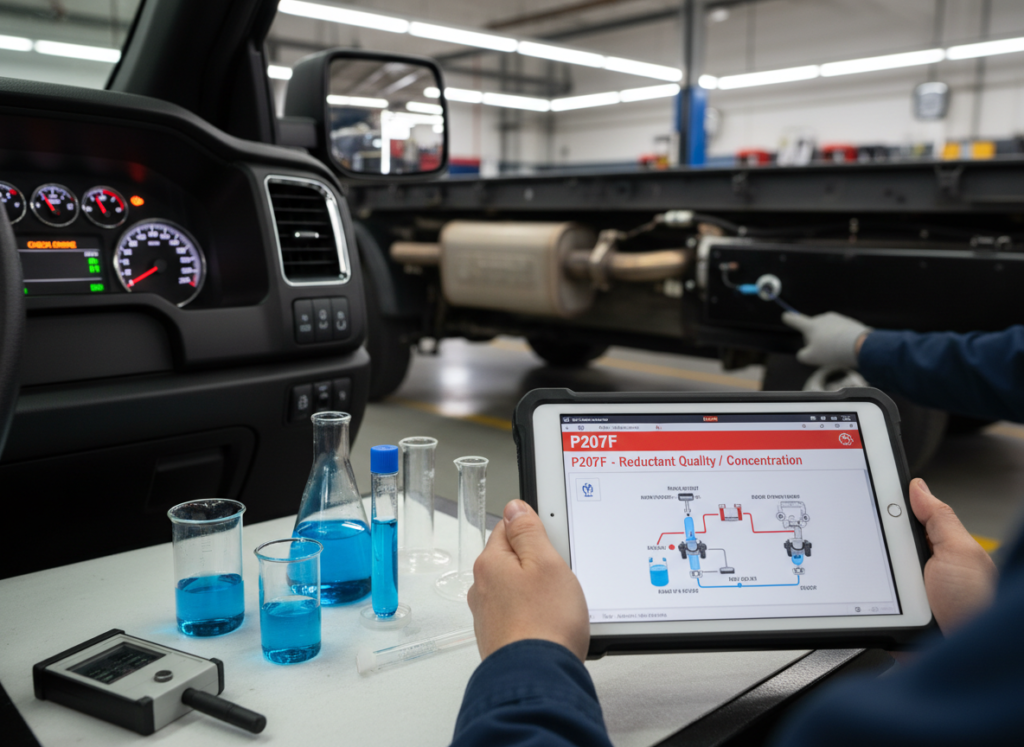
P207F Fault Code: AdBlue Quality, Sensor or SCR Problem?
If you have scanned your vehicle and found P207F, you are usually dealing with a problem in the AdBlue or SCR system rather than a one-off warning that will clear on its own.
This code often appears with dashboard messages about emissions, AdBlue quality, or a countdown to no start. The difficult part is that the code does not always point to one single failed part. It can be caused by poor AdBlue quality, a sensor issue, low system performance, or a wider SCR fault.
Quick Answer
P207F usually means the engine management system thinks the reductant quality is outside the expected range. In plain English, the vehicle believes the AdBlue being delivered is not right, or the system reading it is not right. That can be caused by contaminated fluid, poor dosing, a NOx sensor fault, crystallisation, wiring issues, or an SCR system problem that makes the ECU think AdBlue quality is the issue when the real cause sits elsewhere.
Contents
- What P207F means
- Why this code appears
- The most common causes
- Symptoms you are likely to notice
- What to check first
- Can you keep driving with P207F?
- Why AdBlue top-ups do not always fix it
- Proper diagnosis vs parts guessing
- Repair routes and next steps
What does P207F actually mean?
P207F is usually described as a reductant quality performance fault.
The key phrase there is reductant quality. In most diesel vehicles that use SCR, the reductant is AdBlue. The control system expects a certain result when AdBlue is stored, heated, pumped, injected, and measured through emissions readings. If those results do not line up with what the ECU expects, P207F can be triggered.
That does not automatically mean the fluid itself is bad. It only means the system believes something about AdBlue quality or delivery is wrong.
This is why P207F can be confusing. One driver will have contaminated fluid. Another will have a dosing issue. Another will have a NOx sensor reading badly. Another will have crystallisation blocking proper operation. The same code can appear, but the repair route is different.
That is why this fault needs proper diagnosis rather than a quick guess.
Why does P207F come up on so many vehicles?
The SCR system has a lot of moving parts.
There is the AdBlue tank, the pump, the heater, the lines, the injector, the level and quality calculations, the temperature readings, and the NOx sensors before and after the catalyst. If one part underperforms, the ECU may decide the end result looks like poor reductant quality even when the actual fluid is fine.
Think of it like this. The system is not judging the AdBlue bottle in isolation. It is judging the whole emissions process.
That is why drivers often get caught out after doing what seemed sensible:
- they topped up AdBlue
- they cleared the code
- they changed one sensor
Then the warning came back because the real fault sat elsewhere.
The most common causes of P207F
Contaminated or poor-quality AdBlue
If the wrong fluid has been added, if water has got into the tank, or if old contaminated AdBlue is sitting in the system, the vehicle may flag a quality fault.
Crystallisation in the injector or lines
AdBlue can crystallise when the system ages, leaks slightly, or is used in stop-start conditions. That can affect dosing and trigger the code.
NOx sensor problems
If the NOx readings are wrong, the ECU may think the SCR process is not working and label it as a reductant quality problem.
Weak pump or pressure issue
If the system cannot build or maintain correct pressure, dosing becomes inconsistent.
SCR catalyst underperforming
Sometimes the AdBlue side is not the real problem. The catalyst itself may not be reducing emissions as expected.
Faulty injector
A blocked or sticking injector can mean the fluid never reaches the exhaust properly.
Wiring or connector faults
Corrosion, poor connections, and damaged loom sections can create confusing readings and repeat faults.
Software history and repeat fault logic
Some vehicles are very sensitive after earlier SCR faults. Even when one issue has been fixed, another weak point can keep the code active.
The important point is this: P207F is often a system fault, not just a fluid fault.
Symptoms you are likely to notice
Not every vehicle behaves in the same way, but P207F often comes with one or more of these signs:
- AdBlue warning light on the dash
- emissions system fault message
- engine management light
- countdown warning before restart is blocked
- reduced power or limp-home behaviour on some vehicles
- repeat warnings shortly after clearing codes
Sometimes the vehicle still drives fine at first. That is what makes this code easy to ignore. The real pressure starts when the countdown message arrives and the driver realises the issue is no longer just a warning. It is now a start-risk problem.
This is especially frustrating on work vans and fleet vehicles because one warning can quickly turn into missed jobs, late deliveries, or a van stuck on the drive the next morning.
What should you check first?
Before replacing anything, it helps to check the simple points first.
| Check | Why it matters |
|---|---|
| AdBlue level | Low fluid can trigger related warnings, though it is not always the root cause of P207F. |
| Correct fluid used | The wrong product, contamination, or mixed fluid can create quality faults. |
| Recent refill history | If the fault appeared after a refill, the fluid or fill process may be relevant. |
| Other stored codes | P207F alongside NOx, pressure, temperature, or dosing faults gives a much clearer picture. |
| Visible leaks or crystal build-up | Crystals around the injector or pipework often point to dosing issues. |
These checks are useful, but they only take you so far. Once the basics are ruled out, the next step is proper live diagnosis.
Can you keep driving with P207F?
You might be able to for a while, but it is not a code you should sit on.
Many vehicles with SCR faults will move into a staged response. First you get the warning. Then you get repeat warnings. Then you get a countdown. Once the countdown reaches zero, restart may be blocked.
So the better question is not “can I still drive it today?”
The better question is “how much risk am I taking if I leave it?”
If you use the vehicle for work, school runs, deliveries, site visits, or daily travel, the risk is usually not worth it. Early diagnosis gives you a better chance of a simpler fix and stops you ending up under pressure later.
If your vehicle is already showing a restart countdown, this is the point to stop guessing and get it checked.
Why topping up AdBlue does not always fix P207F
This is one of the biggest misconceptions around this code.
Drivers see the word quality, assume the fluid must be low or old, and go straight for a top-up. Sometimes that helps if the issue was linked to a simple low level event. Often it does not.
Why?
Because P207F is frequently triggered by how the system performs, not just what is in the tank.
If the injector is blocked, fresh AdBlue does not fix the blocked injector.
If the NOx sensor is reading badly, fresh AdBlue does not fix the sensor.
If the pump is weak, fresh AdBlue does not fix low delivery pressure.
If crystallisation is affecting dosing, topping up may simply add more fluid into a system that already cannot process it properly.
This is why the “top it up and hope” approach often fails.
Proper diagnosis vs parts guessing
P207F is exactly the sort of code where parts guessing gets expensive.
It is easy to waste money on:
- a new NOx sensor when the real issue is poor dosing
- an injector when the pressure system is weak
- a pump when the sensor readings are wrong
- a fluid drain and refill when the SCR side is underperforming
A proper diagnosis should look at the whole chain.
That includes stored codes, live readings, system activation, sensor plausibility, dosing behaviour, and what the vehicle is seeing before and after injection. Done properly, this narrows the fault instead of broadening the bill.
This is the difference between a general garage taking a stab at it and a specialist who deals with AdBlue and emissions faults all the time.
When a vehicle is already close to no start status, that difference matters.
What usually fixes P207F?
There is no one universal answer, because the right repair depends on what the testing shows. That said, common repair routes include:
AdBlue system clean and fault reset
Used where contamination or light crystallisation is the main issue.
Injector cleaning or replacement
Used where dosing is restricted or uneven.
NOx sensor replacement
Used where sensor readings are proven to be inaccurate.
Pump or pressure-side repair
Used where the system cannot build or hold the pressure needed for correct operation.
SCR fault resolution after wider testing
Used when the catalyst side or combined system performance is the real cause.
The key point is that P207F needs the fix to match the cause. One vehicle may need a clean. Another may need a sensor. Another may have repeat failures because the full system was never checked in the first place.
SCR system fault
AdBlue quality issue
Sensor checks
When is it time to book the vehicle in?
If the warning has come back more than once, if the code returns after clearing, or if the countdown has started, that is the point to stop treating it like a small dashboard annoyance.
You should also get it checked quickly if:
- the vehicle is a work van or fleet vehicle
- another garage has already changed parts without solving it
- the system shows a mix of AdBlue, NOx, or emissions faults together
- the vehicle is still drivable now, but you cannot risk it becoming a no-start
The earlier the fault is narrowed down, the better your options usually are.
Need help with a P207F fault code?
We diagnose AdBlue, NOx, and SCR faults properly at your location, so you are not left guessing which part to replace next.
For fault finding, warning resets, and practical next steps, call 07503 134362 or email info@adbluespecialist.co.uk.
Mobile support across Staffordshire, Cheshire East, and Staffordshire Moorlands. Open 7 days.
Final thought
P207F sounds like a fluid problem, but in real-world cases it is often wider than that. The code is best treated as a sign that the AdBlue and SCR process is not behaving as it should.
That is why proper testing matters. It helps separate bad fluid from bad readings, and a genuine SCR issue from a simple assumption.
If you deal with it early, you stay in control of the repair. Leave it too long, and you may end up dealing with a countdown and a vehicle that will not restart when you need it most.
FAQs
Does P207F always mean bad AdBlue?
No. It can mean the system believes AdBlue quality is wrong, but the real cause may be a sensor, injector, pressure issue, or wider SCR fault.
Can I clear P207F and keep driving?
You can clear the code, but if the cause is still present it will usually return. Some vehicles will also move towards a no-start countdown.
Can a NOx sensor trigger P207F?
Yes. A faulty NOx sensor can make the ECU think SCR performance is wrong, which can lead to a reductant quality fault.
Will draining and refilling AdBlue solve it?
Only if contaminated fluid is the actual cause. If the fault sits in the injector, pump, sensor, or SCR side, the code will usually come back.
Is P207F linked to a no-start countdown?
It can be. Many vehicles escalate unresolved SCR faults into restart countdown warnings if the issue is left unresolved.