
AdBlue Specialist — Mobile Emissions Fault Solutions, Staffordshire
Hyundai and Kia AdBlue Faults: Warning Lights, SCR Fault Codes and What to Do
Hyundai or Kia diesel showing an AdBlue warning or SCR fault? This guide covers the warning stages, the most common fault codes on Hyundai Tucson, Santa Fe, Kia Sportage, and Sorento models, and how mobile diagnosis resolves these faults quickly.
Quick Answer
Hyundai and Kia diesel models sold in the UK from around 2015 onwards use a urea-based SCR (Selective Catalytic Reduction) system to meet Euro 6 emissions standards. The most common AdBlue faults on these platforms are NOx sensor failure, SCR efficiency codes, and reductant quality warnings. Most faults trigger a countdown — ignore it and the vehicle will refuse to start. Mobile diagnosis identifies the specific fault at your location without needing a dealer visit.
Contents
Which Hyundai and Kia Models Are Affected
The SCR / AdBlue system is fitted to Euro 6 diesel variants of several Hyundai and Kia models. If your vehicle was registered from around 2015–2016 onwards and is powered by a diesel engine, it almost certainly has an AdBlue system.
Hyundai Models with AdBlue
- Hyundai Tucson — 1.6 and 2.0 CRDi diesel variants (2015 onwards)
- Hyundai Santa Fe — 2.2 CRDi diesel (2015 onwards)
- Hyundai i30 — 1.6 CRDi diesel (Euro 6 variants)
- Hyundai i40 — 1.6 and 2.0 CRDi diesel (Euro 6)
- Hyundai IONIQ — 1.6 CRDi diesel hybrid variant
- Hyundai H350 — commercial van 2.5 CRDi (fleet and light commercial)
Kia Models with AdBlue
- Kia Sportage — 1.6 and 2.0 CRDi diesel (Euro 6, 2015 onwards)
- Kia Sorento — 2.2 CRDi diesel (Euro 6 variants)
- Kia Stinger — 2.2 CRDi diesel (where fitted)
- Kia Niro — 1.6 CRDi diesel hybrid variant
- Kia Ceed — 1.6 CRDi diesel (Euro 6 variants)
Hyundai and Kia share engine platforms under the Hyundai Motor Group, so the SCR systems on these vehicles are closely related. Fault code families and diagnostic approaches are broadly the same across both brands.
AdBlue Warning Stages on Hyundai and Kia
The warning escalation follows a pattern similar to other European manufacturers, though the dashboard messages and countdown thresholds vary slightly between models.
Stage 1 — Low Fluid or Early Fault Warning
An amber warning appears on the dashboard, often accompanied by a message such as “AdBlue: Refill” or “Exhaust System Fault”. At this stage the vehicle continues to run normally. If the AdBlue level is fine and the warning persists, a fault code scan is needed.
Stage 2 — Countdown Warning
The dashboard shows a countdown message — typically the number of kilometres or starts remaining before lockout. On Hyundai and Kia models, this often appears alongside the engine management light. Common messages include “Vehicle will not start in X km” or a mileage countdown in the instrument cluster.
Stage 3 — No-Start Lockout
Once the countdown reaches zero, the vehicle will complete its current journey and then refuse to restart. The ECU lockout is software-enforced and cannot be bypassed by simply topping up the AdBlue tank. The fault must be resolved and the system rescanned and reset through specialist software.
Common AdBlue Fault Codes on Hyundai and Kia
Hyundai and Kia use OBD-standard fault codes for their SCR systems, which means the same code families that appear on European vans and cars also apply here.
| Fault Code | Description | Likely Component |
|---|---|---|
| P20EE | SCR NOx catalyst efficiency below threshold | NOx sensor failure or SCR catalyst degradation |
| P207F | Reductant quality performance fault | Contaminated AdBlue, wrong fluid, or NOx sensor giving incorrect readings |
| P20E8 | Reductant pressure too low | AdBlue pump fault or supply line blockage |
| P204F | Reductant system performance | General SCR efficiency fault — multiple possible causes |
| P11DC | NOx sensor 1 circuit | Upstream NOx sensor fault on Hyundai/Kia platforms |
| P229F | NOx sensor 2 performance | Downstream NOx sensor degradation or failure |
| P2BAE | Reductant quality / system range fault | SCR system range and performance — fluid or sensor issue |
As with other platforms, the fault code is the starting point rather than the definitive answer. A P20EE code on a Kia Sportage might be caused by a failing NOx sensor, contaminated AdBlue, or a degraded SCR catalyst — each requires a different repair. Live data testing alongside the fault code is essential for accurate diagnosis.
Root Causes of SCR Faults on Hyundai and Kia Diesels
NOx Sensor Failure
NOx sensors monitor exhaust gas nitrogen oxide levels upstream and downstream of the SCR catalyst. When a sensor begins to degrade — giving drifting voltage readings or occasional dropouts — the ECU interprets this as an efficiency fault and triggers a warning. Sensor failure is the most common cause of P20EE and P207F codes on these platforms.
Hyundai and Kia NOx sensors typically last 80,000–130,000 miles. Higher mileage vehicles or those that have seen a lot of short-trip urban driving are at greater risk of earlier failure.
Contaminated or Incorrect AdBlue
Using a non-ISO-compliant AdBlue product, accidentally topping up with tap water, or allowing old degraded fluid to sit in the tank causes the NOx sensor to detect incorrect urea concentration. The ECU logs a quality fault and may trigger a countdown. A drain and refill with correct fluid is sometimes sufficient, but the fault code must be cleared through software after the refill.
SCR Catalyst Degradation
Over time, the SCR catalyst loses efficiency. This is a gradual process and typically affects higher-mileage vehicles. However, catalyst degradation can be accelerated by repeated use of incorrect AdBlue, by excessive soot contamination from a poorly functioning DPF, or by oil contamination in the exhaust stream. P204F is often linked to catalyst condition.
AdBlue Pump Faults
The AdBlue pump delivers fluid at a precise pressure to the SCR injector. Pump wear or failure causes a drop in delivery pressure, triggering P20E8 or similar codes. The pump on Hyundai and Kia models is typically located within or close to the AdBlue tank module. Replacement is a confirmed fix when the pump is confirmed at fault through live pressure testing.
Urea Crystallisation
AdBlue can crystallise in the dosing lines, injector, and around tank fittings — particularly on vehicles that see infrequent use or that have had repeated short cold-start cycles. Crystallisation restricts fluid flow and causes the system to flag pressure or dosing faults. A thorough clean of the dosing system and fresh fluid resolves this in most cases, but requires hands-on access to the components.
Hyundai and Kia-Specific SCR Issues to Know About
Shared Platform Variations
Hyundai and Kia models share engines and SCR hardware, but the software calibrations and fault thresholds can differ between models and model years. A procedure confirmed to work on a Kia Sportage may not produce the same result on a Hyundai Tucson despite the close platform overlap. Model-specific diagnostic procedures matter.
Software-Related False Faults
Some Hyundai and Kia models with early Euro 6 calibrations have known software quirks that cause SCR fault codes to appear even when the hardware is functioning correctly. These tend to be triggered by cold starts, extended idle periods, or specific driving patterns. In these cases, a software update from Hyundai or Kia alongside a system reset resolves the issue — but this requires a proper diagnostic check to confirm the fault is software-related rather than hardware-related.
Tank Module Design
The AdBlue tank module on some Hyundai and Kia models integrates the pump, heater, and level sensor into a single assembly. If one component within the module fails, the entire module may need replacement — which is more involved than a standalone pump or sensor swap. Accurate diagnosis avoids unnecessary module replacements.
What to Do When the AdBlue Warning Appears
Warning light on but no countdown yet
Check the AdBlue level on the dashboard. If it’s genuinely low, top up with ISO 22241-compliant AdBlue. If the level is fine or the warning persists after topping up, book a diagnostic scan. The system has detected a fault rather than just a low level.
Countdown message showing
Do not rely on topping up to clear the countdown. Book a mobile diagnosis as soon as possible. The van or car is still driveable, but the ECU lockout is approaching. Resolving the fault before lockout is significantly less disruptive than dealing with a no-start situation.
Vehicle won’t restart
The ECU lockout has activated. The vehicle needs specialist software to reset the system after the underlying fault is resolved. A mobile specialist can attend your location and perform the ECU reset on-site — this avoids the need for recovery to a dealer and typically results in a faster resolution.
Mobile Diagnosis for Hyundai and Kia AdBlue Faults
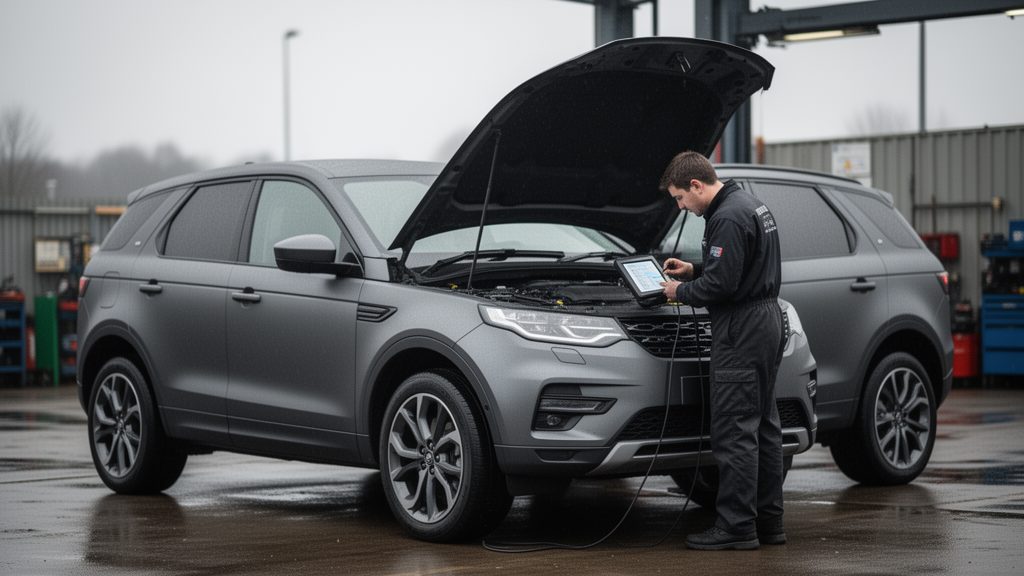
Mobile AdBlue diagnosis removes the need for recovery or a dealer appointment. The process covers:
- Full multi-system scan — fault codes read across the ECU and SCR control module, with all stored and pending codes captured.
- Live data review — NOx sensor voltages, pump pressure, and dosing system performance monitored in real time to confirm which component is at fault rather than guessing from the code alone.
- Component-level diagnosis — determines whether the fault is in the sensor, pump, catalyst, software, or fluid quality.
- On-site repair where possible — sensor replacements, heater faults, and crystallisation clears are typically completed in a single visit.
- System reset and verification — the system is rescanned after the repair to confirm all fault codes are cleared and no pending issues remain.
Most Hyundai and Kia AdBlue faults are resolved within a single mobile visit. The approach is faster, more cost-effective, and less disruptive than a main dealer appointment — and the diagnosis is based on confirmed live data rather than a parts-swap approach.
Hyundai or Kia AdBlue Warning? Get Diagnosed On Your Driveway
AdBlue Specialist provides mobile SCR diagnosis across Staffordshire, Cheshire East, and Staffordshire Moorlands. We attend your location with specialist diagnostic tools — no towing, no dealer waiting lists, same-day availability for most callouts.
Frequently Asked Questions
Does my Hyundai or Kia have AdBlue?
If your Hyundai or Kia is a diesel model registered from around 2015–2016 onwards, it almost certainly has an AdBlue system to meet Euro 6 emissions standards. Check the area near the fuel filler cap — many models have a separate blue-capped filler for AdBlue. The dashboard will also show an AdBlue level indicator or warning message when the level drops.
Can I top up AdBlue on a Hyundai or Kia myself?
Yes. Most Hyundai and Kia models have an accessible AdBlue filler cap near the fuel filler or under the bonnet. Use ISO 22241-compliant AdBlue from a reputable supplier. Do not use tap water or non-approved products. If the warning light does not clear after topping up, a fault is stored and a diagnostic scan is needed.
Will a Hyundai or Kia start without AdBlue?
Yes, initially — but only until the countdown reaches zero. Once the ECU lockout activates (at the end of the countdown), the vehicle will refuse to restart after the current journey is completed. Topping up the tank at this stage is not enough — the system needs a software reset after the underlying fault is resolved.
How much does it cost to fix a Hyundai AdBlue fault?
Costs vary by fault. A NOx sensor replacement typically falls in the £200–£450 range including parts and labour. An SCR pump replacement or fluid drain and refill is usually less. Catalyst replacement is more significant. Mobile diagnosis confirms exactly what the fault is before any repair is agreed, so you know the cost upfront.
Why does my Kia Sportage AdBlue warning keep coming back after being cleared?
A recurring AdBlue warning after clearing almost always means the underlying fault has not been resolved — the code was cleared without fixing the cause. This is common when a generic reset is applied without proper diagnostic testing. The fault will reappear within a few hundred miles. Accurate component-level diagnosis is the only reliable fix.
If you’d prefer a permanent fix, our Hyundai AdBlue removal service eliminates the fault codes permanently — no more warning lights, no more countdowns.