
AdBlue Specialist — Mobile Emissions Fault Solutions, Staffordshire
How Long Does AdBlue Last? Tank Range and Consumption Guide for Vans and Cars
Wondering how long your AdBlue will last before the warning light appears? This guide covers consumption rates for common vans and cars, what affects how quickly you use it, and what to do when the warning light comes on.
Quick Answer
Most diesel vans use AdBlue at a rate of roughly 1 litre per 600–800 miles under normal conditions. A full 20-litre Sprinter tank will typically last 12,000–16,000 miles. Cars with smaller 5–10 litre tanks may need topping up every 6,000–10,000 miles. Consumption increases significantly with motorway driving, heavy loads, and cold temperatures. If your AdBlue is running out faster than expected, a fault in the SCR system — not just high usage — is often the cause.
Contents
How Long Does AdBlue Last by Vehicle Type
AdBlue consumption varies significantly between vehicle types. Commercial vans generally use more than passenger cars because they run harder, carry heavier loads, and spend more time at motorway speeds — all of which increase NOx output and therefore SCR reagent demand.
Commercial Vans
Panel vans and light commercial vehicles typically consume AdBlue at 1 litre per 600–800 miles. High-mileage delivery drivers or those doing long motorway runs may see consumption closer to 1 litre per 500 miles. For a van doing 30,000 miles per year, that means topping up every four to six months at most.
Passenger Cars and SUVs
Diesel cars generally use AdBlue more efficiently than vans — consumption of around 1 litre per 1,000–1,200 miles is typical. A BMW 5 Series diesel or a Mercedes E-Class doing standard mixed driving might go 8,000–12,000 miles on a single tank. Many modern diesel cars now have service reminders that alert you when AdBlue is due.
Pickup Trucks
Pickups like the Ford Ranger, Toyota Hilux, Nissan Navara, and Volkswagen Amarok sit between cars and vans in terms of consumption. Expect 1 litre per 700–900 miles under mixed driving, with faster consumption when towing or running fully loaded.
What Affects AdBlue Consumption Rate
AdBlue consumption is not fixed — it varies with how the vehicle is used. Understanding the main factors helps you plan top-ups and spot when something is genuinely wrong with the SCR system.
Driving Speed and Style
Motorway driving at sustained high speeds produces more NOx emissions than town driving. The SCR system responds by injecting more AdBlue to meet emissions targets. A van that spends most of its time on the motorway will consume AdBlue noticeably faster than one doing mainly urban delivery routes.
Engine Load
Carrying heavy loads, towing, or running uphill forces the engine to work harder and produce more exhaust gases. Higher exhaust temperatures and flow rates increase AdBlue demand. Builders’ vans and delivery trucks running at or near payload will always use AdBlue faster than lightly loaded vehicles.
Cold Weather
In cold temperatures, AdBlue thickens and the SCR system takes longer to reach operating temperature. The heater circuit must work harder to keep the fluid liquid in the lines and injector. Some additional consumption occurs during the warm-up phase. Cold weather is also when heater circuit faults are most likely to appear.
Engine Condition
A poorly maintained diesel engine — particularly one with EGR issues, injector wear, or high soot loading — can produce more NOx and force the SCR system to work harder. If your AdBlue consumption has noticeably increased without a change in driving pattern, the engine should be checked alongside the SCR system.
SCR System Condition
A degrading NOx sensor, a partially blocked injector, or reduced SCR catalyst efficiency can cause the system to overconsume AdBlue as it attempts to compensate. This is one of the most common reasons drivers find their AdBlue running out much faster than expected — and it is a fault condition, not just high usage.
AdBlue Tank Sizes by Make and Model
Tank capacity has a direct effect on how often you need to top up. Here are the common tank sizes on popular commercial vans and diesel cars:
| Vehicle | Tank Capacity | Approx. Range |
|---|---|---|
| Mercedes Sprinter (OM651/OM654) | 19–22 litres | 12,000–18,000 miles |
| Mercedes Vito (W447) | 10–13 litres | 7,000–10,000 miles |
| Ford Transit (2.0 EcoBlue) | 20 litres | 13,000–16,000 miles |
| Vauxhall Vivaro / Movano | 13–17 litres | 8,000–13,000 miles |
| Renault Master / Trafic | 13–17 litres | 8,000–13,000 miles |
| Volkswagen Crafter | 13 litres | 8,000–10,000 miles |
| BMW 5 Series (diesel) | 8–10 litres | 8,000–12,000 miles |
| Mercedes E-Class (diesel) | 7–10 litres | 7,000–11,000 miles |
| Audi A6 / A7 (TDI) | 8 litres | 8,000–10,000 miles |
| Toyota Hilux / Land Cruiser | 7–9 litres | 5,000–8,000 miles |
Note that these are approximate ranges. Actual mileage will vary based on the driving conditions discussed above. The figures assume no SCR system faults.
When the Warning Light Appears
Most vehicles give an early warning when the AdBlue tank drops to around 10–15% capacity. This gives enough time to top up without urgency. The warning escalates if you don’t act:
- First warning — amber light, typically at 1,500–2,000 miles remaining. Informational only.
- Second warning — countdown message appears, often at around 1,000 miles or fewer starts remaining. Action required.
- Final warning — the van or car will complete its current journey but will not restart. At this stage, topping up alone is unlikely to be enough if a fault code is also stored.
Using AdBlue Too Fast — Is It a Fault?
If your AdBlue seems to be running out much faster than the ranges above — for example, a Transit needing a top-up every 3,000–4,000 miles instead of 13,000–16,000 — there is almost certainly a system fault contributing.
Common Causes of Excessive AdBlue Consumption
- Faulty NOx sensor — a sensor giving incorrect readings causes the ECU to inject more AdBlue than needed to try to hit emissions targets.
- Leaking AdBlue injector — a seal or injector fault allows fluid to drip continuously, reducing the tank faster than normal.
- Degraded SCR catalyst — reduced catalyst efficiency forces higher dosing to compensate.
- Pump overcalibration — a pump fault causing higher than normal delivery pressure.
- Crystallisation in the dosing system — urea crystallisation can cause irregular delivery and apparent overconsumption.
In all these cases, the fix requires diagnostic scanning and component-level testing — not just adding more AdBlue. A mobile diagnosis can identify the specific cause at your location without the need for recovery or a main dealer appointment.
AdBlue Top-Up Tips
For routine top-ups, these simple practices help avoid common problems:
- Use ISO 22241-compliant AdBlue from a recognised supplier. Supermarket and petrol station products are generally fine if they carry the ISO mark.
- Do not overfill the tank — leave a small air gap to allow for temperature expansion.
- Never use tap water or any other liquid to top up AdBlue. Contamination causes immediate fault codes.
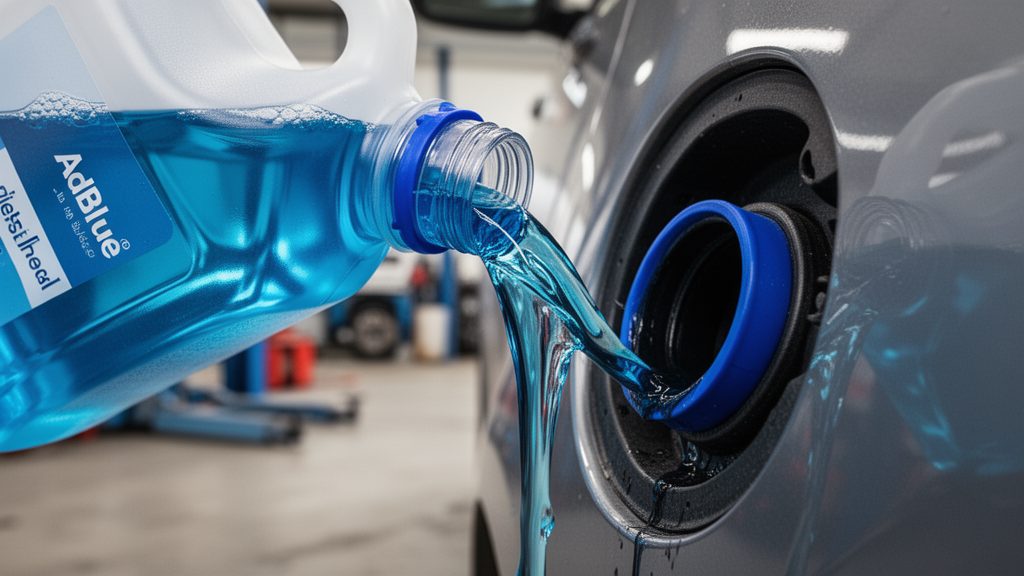
- If the filler cap is hard to reach (as on some vans with the filler under the bonnet), use a proper dispensing nozzle to avoid spills — AdBlue crystallises when it contacts painted surfaces or metal components.
- After topping up, if the warning light remains after a short drive, book a diagnostic scan. The light should clear on its own once the ECU confirms the fluid level — if it doesn’t, a fault is stored.
AdBlue Warning Won’t Clear? Get It Diagnosed On-Site
If your AdBlue warning light is staying on after a top-up, or if the fluid is running out faster than it should, there’s likely a system fault. AdBlue Specialist attends your location across Staffordshire, Cheshire East, and Staffordshire Moorlands — no recovery required.
Frequently Asked Questions
How often do I need to top up AdBlue?
It depends on your vehicle and driving style. Vans doing mixed driving typically need a top-up every 6,000–15,000 miles. Cars usually go longer between top-ups. If you’re topping up far more often than this, a diagnostic scan is recommended to rule out an SCR system fault.
Can I drive without AdBlue?
Not for long. Once the warning countdown reaches zero, most modern diesel vehicles with Euro 6 emissions systems will refuse to restart after the current journey. You cannot bypass the lockout without specialist software — simply running the tank empty is not an option.
Does AdBlue go off or expire?
Yes. AdBlue has a shelf life of around 12–18 months when stored correctly. Exposure to heat, direct sunlight, or contamination accelerates degradation. Using old or degraded fluid can trigger quality fault codes (P207F) and cause SCR system warnings even after topping up correctly.
Why is my van using AdBlue so fast all of a sudden?
A sudden increase in AdBlue consumption usually points to a system fault — most commonly a failing NOx sensor, a leaking injector, or SCR catalyst degradation. These faults cause the system to overdose or waste fluid. A diagnostic scan will confirm which component is at fault.
What happens if AdBlue freezes?
AdBlue freezes at around -11°C. Vehicles with AdBlue systems include a heater circuit to prevent freezing. If the heater circuit fails, frozen AdBlue causes the SCR system to malfunction and can trigger warning codes. The van may still start, but an AdBlue fault will appear. This needs a diagnostic scan, not just waiting for a thaw.