
AdBlue Specialist — Mobile NOx & SCR Fault Diagnostics
How NOx Sensor Failures Trigger AdBlue Warnings: The Symptom Chain Drivers Miss
Most drivers see an AdBlue warning and assume the AdBlue system is at fault. But on modern diesels, a failing NOx sensor is one of the most common hidden triggers — and topping up fluid will never fix it.
Quick Answer
NOx sensors monitor exhaust gases before and after the SCR catalyst. When one fails, the ECU can’t confirm that AdBlue is doing its job — so it triggers an AdBlue warning, often accompanied by codes like P207F, P20EE, P20E8 or P229F. The problem isn’t the AdBlue fluid or the dosing system. It’s the sensor reporting bad data. Mobile diagnosis isolates the failed sensor in around 20 minutes and avoids unnecessary AdBlue tank or pump replacement.
Contents
What NOx Sensors Actually Do
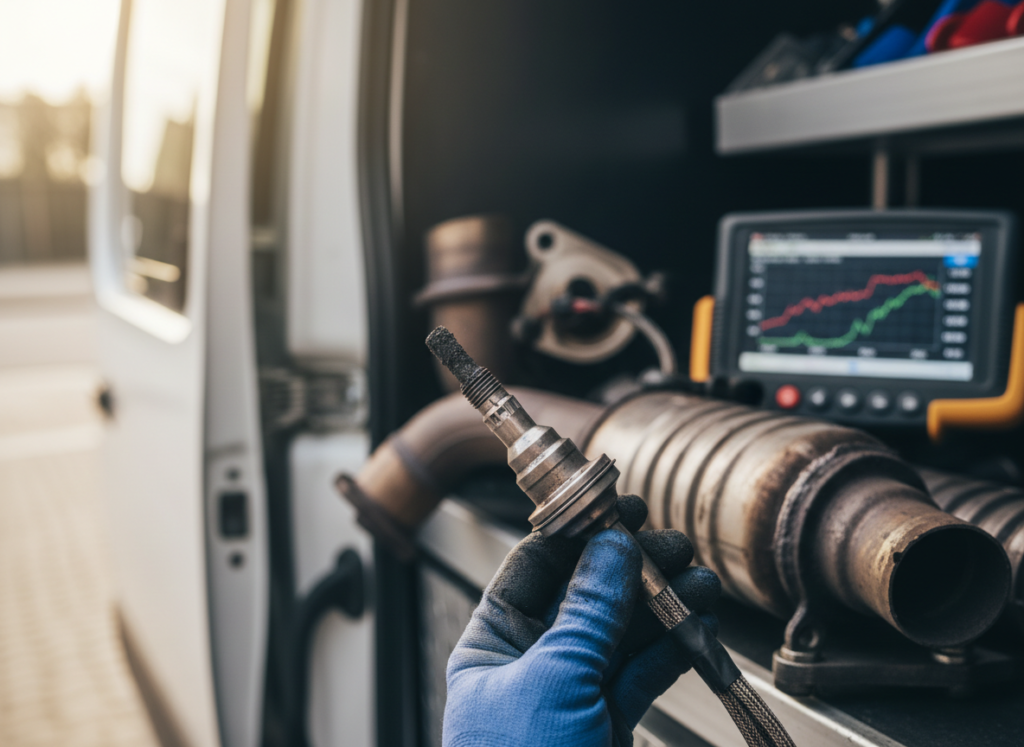
Modern Euro 6 diesels carry one or two NOx sensors as part of the SCR (Selective Catalytic Reduction) system. Their job is straightforward but critical: measure how much nitrogen oxide is in the exhaust before and after the SCR catalyst, so the ECU can verify that AdBlue is converting NOx into harmless nitrogen and water.
You’ll typically find:
- Upstream NOx sensor — fitted before the SCR catalyst, measures raw exhaust NOx
- Downstream NOx sensor — fitted after the SCR catalyst, measures post-treatment NOx
The ECU compares the two values, calculates the conversion efficiency of the SCR system, and uses that data to decide whether the AdBlue dosing is working. If the maths doesn’t add up, the ECU assumes there’s a problem and starts logging emissions-related warnings.
The catch is that the ECU has no way of knowing whether the AdBlue system is genuinely failing or whether the NOx sensor itself is lying to it. Both produce the same warning lights.
Why a Failing NOx Sensor Triggers AdBlue Warnings
NOx sensors are exposed to the harshest environment in the entire vehicle — soot-laden, sulphur-laden, 600°C exhaust gases, plus condensation and vibration. The internal ceramic element ages, the heater circuit weakens, and the wiring loom suffers chafing and water ingress.
When a sensor starts to fail, it doesn’t simply stop reporting. It reports plausible but incorrect data. The ECU sees:
- Post-SCR NOx values higher than the catalyst should allow
- Sensor heater circuit drawing the wrong current
- Implausible signal voltage during light-off
- Conversion efficiency below the legal threshold
From the ECU’s perspective, this looks identical to a properly working sensor reporting that AdBlue dosing has stopped working. The result: the SCR controller flags an emissions fault, the AdBlue warning lamp lights up, and you start ticking towards a no-start countdown — even though the AdBlue tank is full and the pump is running perfectly.
Why this matters
Drivers who don’t realise this end up paying for AdBlue tank flushes, new pumps, or full SCR system replacements when the actual failure was a £200 sensor that takes 30 minutes to swap. A specialist diagnostic catches this every time.
The Full Symptom Chain
NOx sensor failure rarely shows up as a single symptom. It runs through a predictable sequence over days or weeks:
Stage 1 — Intermittent EML
The first sign is usually a check engine light (EML) that comes and goes. The fault may clear after the engine cools and reappear after a long motorway drive. At this stage there’s no AdBlue warning yet, just a generic emissions fault stored in the ECU.
Stage 2 — Solid AdBlue light
As the sensor data drifts further from expected values, the ECU escalates to a solid amber AdBlue warning. Drivers often top up at this point, see no change, and assume they bought bad fluid.
Stage 3 — Flashing AdBlue light + drivability changes
The light starts flashing. You may notice the engine feeling slightly less responsive, especially under acceleration. Some vehicles will reduce torque to limit emissions output while the fault is active.
Stage 4 — Limp mode or reduced power
If the conversion efficiency calculation drops too low for too long, the ECU pulls the engine into limp mode. Top speed is capped, throttle response is dulled, and the dashboard typically shows multiple warnings at once.
Stage 5 — No-start countdown
The final stage. The vehicle now displays a starts-remaining or distance-remaining countdown. Once it hits zero, the engine will not crank — even if the sensor is replaced — until a specialist scan tool resets the lockout.
Fault Codes That Point to NOx, Not AdBlue
This is where most drivers (and a lot of general garages) get it wrong. The fault codes look like AdBlue codes, but they’re triggered by NOx sensor data. Reading them correctly is the difference between fixing the problem and replacing parts that were never broken.
| Code | Description | Likely cause |
|---|---|---|
| P207F | SCR efficiency below threshold | Failing downstream NOx sensor or genuine catalyst failure |
| P20EE | SCR catalyst NOx conversion below threshold (bank 1) | Almost always the downstream NOx sensor reporting drift |
| P20E8 | Reductant pressure too low | Could be pump, but often a NOx sensor pulling dosing into a defensive mode |
| P229F | NOx sensor 2 circuit malfunction | Direct downstream sensor electrical fault |
| P220A | NOx sensor heater circuit | Heater element inside the sensor has failed |
| P11D9 | NOx sensor implausible signal | Sensor returning out-of-range readings |
| U029D | Lost communication with NOx sensor module | Wiring fault, connector corrosion, or sensor module failure |
Notice that P207F and P20EE — the two highest-impression fault codes we see across the workbook — both look like SCR or AdBlue catalyst faults but are most often caused by a failing downstream NOx sensor. Replacing the SCR catalyst on the assumption it’s worn out is one of the most expensive misdiagnoses in modern diesel work.
Vehicles Most Commonly Affected
NOx sensor failures cluster around certain platforms because of where the sensors are mounted, how the wiring is routed, and how aggressive the SCR mapping is.
Mercedes-Benz Sprinter and Vito
Sprinter NOx sensors (especially the post-SCR sensor) are well known for early failure, often pairing with P229F or P207F codes. The sensor sits close to the DPF and is exposed to high regeneration temperatures.
Ford Transit and Tourneo (EcoBlue 2.0)
The EcoBlue platform has had repeated NOx sensor issues, particularly the upstream sensor. Codes like P20EE and P207F appear together, and the SCR efficiency calculation is unforgiving.
Peugeot, Citroën, Vauxhall, Fiat (Stellantis 2.0 BlueHDi)
The Stellantis platform pairs P20EE with P20E8 frequently. The downstream sensor wiring runs close to the rear axle and suffers chafing damage on long-mileage vans.
VW Crafter / Transporter (TDI)
VW NOx sensors tend to fail more from heater circuit issues (P220A) than from sensor element drift. When they fail, the system jumps quickly to a starts-remaining countdown.
BMW and Audi
Premium diesels often run two upstream and two downstream sensors. Failure rates are lower per sensor, but with four sensors per vehicle the chance of one failing inside 80,000 miles is high.
How to Diagnose a NOx-Triggered AdBlue Fault
A proper diagnosis takes around 20–30 minutes with the right scan tool. The sequence we follow on every job:
- Pull all stored, pending, and permanent codes — including freeze-frame data
- Live-data the NOx sensors — both upstream and downstream values during a controlled rev
- Check sensor heater circuit current draw — confirms whether the heater element is healthy
- Read SCR conversion efficiency adaptation values — shows how the ECU has been compensating
- Verify AdBlue dosing pressure and quantity — rules out pump or quality issues
- Cross-check against vehicle service history — many sensors were silently swapped under warranty
The goal is simple: prove which side of the fence the fault sits on. Either the AdBlue dosing system is genuinely failing, or the NOx sensor is lying to the ECU. The fix is completely different in each case.
Repair Options and Costs
Replace the failed sensor
For a confirmed NOx sensor fault, the cleanest fix is sensor replacement plus an ECU adaptation reset. Costs vary by vehicle (typically £200–£450 for the sensor alone) but the labour is short — most are accessible without removing the DPF or rear axle.
Repair the wiring or connector
Where the sensor itself tests fine but the wiring is chafed or the connector is corroded, a loom repair clears the fault for a fraction of the cost of replacement. We see this regularly on Stellantis vans where the rear loom rubs against the chassis.
Software-based solutions (off-road only)
For vehicles declared off-road or for export markets, we offer software-based NOx bypass and SCR efficiency mapping. These are not legal for use on UK public roads and are only suitable for vehicles that meet the off-road exemption criteria.
What to avoid
Replacing the AdBlue tank, pump, or SCR catalyst before confirming the sensor is healthy. We see this almost weekly — a dealer or general garage swaps £1,500 of parts and the same warning returns within 200 miles, because the actual fault was the £200 sensor.
Stop Replacing Parts That Aren’t Broken
If your AdBlue warning won’t clear and the codes mention SCR efficiency or NOx, get a proper diagnosis before spending on parts. We come to your vehicle with the right scan tools and live data to isolate the fault first time.
Frequently Asked Questions
Can a NOx sensor fault really cause an AdBlue countdown?
Yes — and it’s one of the most common causes we see. The ECU uses NOx sensor readings to verify that AdBlue dosing is working. If the sensor reports bad data, the ECU assumes the AdBlue system has failed and starts the countdown, even if the tank is full and the pump is fine.
How do I know if it’s the sensor or the AdBlue system?
You can’t tell from the dashboard alone — both faults look identical. A specialist scan tool reading live NOx sensor data and SCR conversion efficiency will show which side of the system is genuinely at fault. This is the single most important test before spending money on parts.
Why didn’t the dealer find this?
Many dealer scan tools only read stored codes, which point to the SCR system rather than the underlying NOx sensor. Without a live data comparison, the obvious assumption is that the AdBlue catalyst or dosing system has failed. Specialist tooling combined with experience is what catches the real cause.
Can I just unplug the NOx sensor?
No. Unplugging a NOx sensor immediately triggers a permanent fault code that can’t be cleared by reconnecting the sensor — and on most modern diesels it triggers limp mode within minutes. It will not clear the AdBlue warning either; it will make things worse.
How long do NOx sensors usually last?
Original-equipment sensors typically last 80,000–120,000 miles, though high-mileage vans, vehicles with lots of short trips, or those that see frequent regenerations often see failures earlier. Aftermarket sensors vary in quality — we only fit OE or OE-equivalent parts to avoid repeat failures.
Will the warning stay clear after the sensor is replaced?
Provided the sensor is the right part number, fitted correctly, and the SCR adaptation values are reset properly, the warning should clear during the verification drive cycle and stay clear permanently. We always perform a road test and re-scan before leaving site to confirm the fix.