
AdBlue Specialist — Mobile SCR Fault Diagnosis
AdBlue Pump Failure: Symptoms, Testing & How to Tell It Apart from a Sensor or Heater Fault
When your AdBlue system stops working, there are three likely culprits: the pump, the sensor, or the heater. Each one fails differently. Replacing the wrong part costs hundreds. Here’s how to tell them apart before any money changes hands.
Quick Answer
A failed AdBlue pump typically produces a consistent low-pressure fault code (P20E8) that appears immediately on cold start and does not improve as the system warms up. A heater fault causes pressure issues only in cold weather. A sensor fault produces quality or concentration codes without genuine pressure loss. Correct diagnosis requires a live pressure test — not just a code reader. Call 07503 134362 for mobile diagnosis at your location.
Contents
How the AdBlue Pump Works
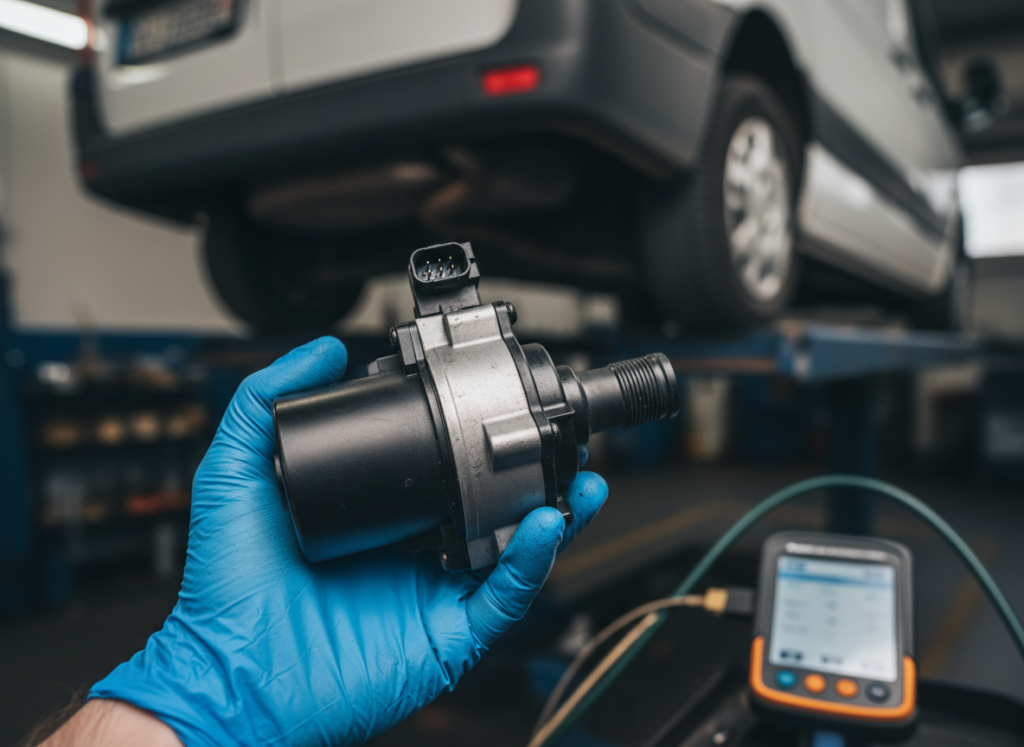
The AdBlue pump draws fluid from the tank and pushes it to the SCR dosing injector at a controlled pressure — typically between 5 and 9 bar depending on the vehicle. The pump is usually a compact electric unit mounted either inside the AdBlue tank module or externally on the supply line.
Most modern diesel systems use a combined pump-and-sensor module that integrates the pump, tank level sensor, temperature sensor, and heating element into a single replaceable unit. This is why a single component failure can produce multiple, confusing fault codes across different systems simultaneously.
The pump is commanded by the ECU through the SCR control module. When the exhaust temperature reaches the threshold for AdBlue dosing — usually above 200°C — the pump is activated. If the pump cannot reach target pressure within a set time window, a fault is logged.
Signs of a Failed AdBlue Pump
A genuinely failed pump has a recognisable failure signature. These are the symptoms that point specifically to the pump rather than associated components:
Fault Codes That Don’t Clear
A pump failure almost always generates P20E8 (reductant pressure too low) as the primary code. This code returns within minutes of clearing because the pump cannot physically reach operating pressure. Associated codes like P204F (SCR efficiency below threshold) follow as a consequence of zero or insufficient dosing.
Immediate Fault at Cold Start
The pump runs a self-test cycle when the ignition is switched on. A failed pump fails this test immediately — the fault appears before the vehicle has moved. This distinguishes pump failure from heater faults, which only affect cold-weather operation.
No Pressure Response on Live Data
On a diagnostic scan tool with live data capability, a working pump shows rising pressure after start-up. A failed pump shows zero pressure or pressure that rises briefly before dropping to zero. This is the clearest single indicator of pump failure and requires a proper diagnostic tool — not just a code reader.
Audible or Tactile Clues
A working AdBlue pump produces a faint hum when the ignition is on and dosing is commanded. A completely failed pump is silent. You can sometimes hear this by listening near the AdBlue tank with the engine running at operating temperature.
How to Tell Pump Failure from a Heater Fault
This is the most common misdiagnosis. Both produce low-pressure fault codes — but they behave very differently.
Pump vs Heater: The Core Diagnostic Difference
Pump failure produces consistent low-pressure codes in all temperatures, at all times of year, regardless of how long the engine has been running.
Heater failure produces low-pressure codes only in cold conditions — typically below 5–10°C. In warmer weather, the system often works perfectly. The heater warms the AdBlue fluid so it flows correctly; if the fluid is too cold and viscous, the pump cannot achieve target pressure even if the pump itself is functioning normally.
| Symptom | Pump Failure | Heater Failure |
|---|---|---|
| Fault appears in warm weather | Yes | Rarely |
| Fault disappears after long warm-up | No | Sometimes |
| Fault present at first cold start | Yes | Yes (in cold weather) |
| Fault code type | P20E8, P204F | P13DF, P20B9, P20E8 |
| Live pressure reading | Zero or dropping | Low but rising once warm |
| Seasonal pattern | No pattern | Worse in autumn/winter |
If your AdBlue faults are seasonal — appearing in October and clearing by April — suspect the heater first. If the faults are year-round and consistent, suspect the pump.
How to Tell Pump Failure from a Sensor Fault
Sensor faults produce a different set of codes and behave differently on live data:
What a Sensor Fault Looks Like
AdBlue systems use two main sensors: a quality/concentration sensor and a level sensor. A faulty quality sensor generates P207F (reductant quality out of range) even with a full tank of fresh, correct fluid. The pump continues to operate normally — system pressure is fine — but the sensor reports incorrect fluid quality.
A faulty level sensor may report a low or empty tank when the tank is actually full. The ECU, believing the tank is empty, prevents dosing — which then generates efficiency codes. Again, the pump itself is functioning correctly.
The Key Difference
With a sensor fault, live system pressure is normal — the pump is building pressure correctly. The fault is in the measurement or reporting, not the mechanical system. Replacing the pump in this situation does nothing. The correct fix is sensor replacement or, in the case of the combined module, replacement of the whole tank module.
How the Pump Is Properly Tested
A reliable pump diagnosis requires more than reading fault codes. The correct procedure is:
1. Full OBD Scan with Freeze Frame Data
Read all stored codes, pending codes, and freeze frame data. The conditions under which each code was triggered — temperature, engine runtime, vehicle speed — provide critical diagnostic context. A code triggered at -3°C after 30 seconds of running is very different from one triggered at 20°C after 10 minutes.
2. Live Pressure Monitoring
With the engine running at temperature and AdBlue dosing commanded, live system pressure is monitored in real time. A working pump maintains pressure within specification. A failed pump shows either zero pressure or unstable pressure that spikes and collapses.
3. Pump Activation Test
Most professional diagnostic platforms can command the AdBlue pump to activate independently of the engine. This tests whether the pump motor responds to command signals. If the pump is mechanically seized or the motor has failed, it will not respond. If it responds but still cannot build pressure, a mechanical blockage or internal wear is the likely cause.
4. Supply Line and Filter Check
Before condemning the pump, the supply line and filter are checked for blockage. A blocked filter or crystallised line can cause pressure symptoms identical to pump failure — but costs a fraction of the price to fix. This check should never be skipped.
Which Vehicles Have the Most AdBlue Pump Problems
Some platforms develop pump failures more predictably than others:
Mercedes Sprinter (OM651 and OM654)
The Mercedes Sprinter uses a tank-mounted pump module that integrates pump, heater, and sensors. Combined module failures are common at high mileages, and the P13DF and P20E8 codes are frequently seen together. The module is expensive, which makes correct diagnosis before replacement especially important.
Ford Transit (SID212EVO / SID213EVO)
Ford Transit vans with the EcoBlue engine use a separate pump mounted on the AdBlue supply line. Pump failures are associated with the P20EE and P20E8 codes and often follow injector issues that allow the pump to run dry or against excessive back-pressure. The Ford system is also sensitive to fluid quality — degraded AdBlue can accelerate pump wear.
VW Crafter and Transporter
The VW/MAN platform uses a similar architecture to the Sprinter. P207F and P204F codes are common, and while these frequently originate with sensor or quality issues, genuine pump failures are seen at higher mileages in vehicles with a history of AdBlue quality problems.
Peugeot and Citroën (1.5 and 2.0 BlueHDi)
The French platform pump is generally reliable but vulnerable to contamination from non-ISO compliant AdBlue. P20EE is the most common code, and pump diagnosis on these vehicles is complicated by the sensitivity of the combined quality/pressure sensor.
What an AdBlue Pump Repair Costs
Cost varies significantly by vehicle and whether the pump is a standalone unit or part of a combined module:
| Vehicle | Pump Type | Typical Cost (parts + mobile labour) |
|---|---|---|
| Mercedes Sprinter | Combined tank module | £600–£1,200 |
| Ford Transit EcoBlue | Standalone line pump | £300–£600 |
| VW Crafter / Transporter | Combined tank module | £500–£900 |
| Peugeot/Citroën BlueHDi | Standalone pump | £250–£500 |
| Vauxhall Movano / Renault Master | Combined module | £400–£800 |
These are guide prices for genuine OEM or quality aftermarket parts fitted by a mobile specialist. Dealer prices for the same work are typically 30–60% higher. Always confirm the pump is the actual cause before authorising replacement — an incorrect diagnosis costs exactly the same as a correct one.
Need Your AdBlue Pump Diagnosed Correctly Before You Spend?
Mobile diagnosis identifies whether you have a pump failure, heater fault, or sensor issue — at your home, workplace, or breakdown location. We carry common pump parts and can often complete the repair in a single visit anywhere in Stoke-on-Trent and the surrounding area.
FAQs
Can a failed AdBlue pump cause the engine not to start?
Not immediately — but indirectly, yes. A failed pump prevents AdBlue dosing. The SCR system logs cumulative efficiency failures. After a set number of start cycles without a working AdBlue system, many vehicles enter a countdown sequence that eventually prevents the engine from restarting. Getting the pump fault resolved early avoids this outcome.
How long does an AdBlue pump last?
With correct fluid and normal use, an AdBlue pump should last 150,000 to 200,000 miles. Premature failure is usually caused by contaminated AdBlue, running the tank dry repeatedly, or the pump working against a partially blocked injector or supply line. Addressing the root cause alongside pump replacement prevents the same failure recurring.
Will a pump failure clear with an OBD reset?
The fault codes will clear temporarily — but they will return within the same drive cycle as soon as the system attempts to dose AdBlue again. If codes return within 20 minutes of clearing, a genuine mechanical fault is present and a reset is not a fix.
Is it worth replacing an AdBlue pump on a high-mileage van?
It depends on the overall condition of the vehicle and the cause of the failure. If the pump has failed due to contaminated fluid or a blocked injector, and those root causes are addressed at the same time, a replacement pump should give many more miles of reliable service. If the vehicle has other significant issues, it is worth discussing options before committing to a major repair.
Can I bypass the AdBlue pump temporarily?
Bypassing or deleting the AdBlue system is illegal for UK road use under the Road Traffic Act and will result in MOT failure. It also voids insurance. The correct solution is diagnosis and repair, not deletion — and in most cases, mobile repair is faster and more cost-effective than people expect.