
AdBlue Specialist — Mobile Emissions Fault Diagnosis, Staffordshire
Iveco Daily AdBlue Faults: Warning Lights, Fault Codes & What to Do
The Iveco Daily is one of the UK’s most widely used commercial vans — and its SCR AdBlue system has a well-documented set of fault patterns. Whether you’re seeing a dashboard warning, a countdown message, or a no-start condition, this guide explains what’s happening and how to get your Daily back on the road fast.
Contents
Quick Answer
Iveco Daily AdBlue faults are most commonly caused by a faulty AdBlue quality sensor, a heater circuit issue, a failing dosing injector, or low/contaminated fluid. After a warning appears, a countdown to no-start typically begins within two to three warning stages. Mobile OBD diagnosis with manufacturer-level tools identifies the root cause in around 20–30 minutes. Call 07503 134362 for same-day support across Staffordshire and Cheshire East.
How AdBlue Works on the Iveco Daily
Euro 6 versions of the Iveco Daily — covering most models built from 2014 onwards — use an SCR (Selective Catalytic Reduction) system to reduce nitrogen oxide (NOx) emissions. This system requires AdBlue, a precise 32.5% urea-water solution, to function correctly.
The SCR system works by injecting AdBlue into the exhaust flow upstream of a catalytic converter. A chemical reaction converts the NOx gases into harmless nitrogen and water vapour. Without AdBlue, the SCR system cannot operate, which is why vehicles are programmed to force a no-start condition once the AdBlue supply drops below a critical threshold — or if the system detects a fault serious enough to prevent safe SCR operation.
The Daily uses a combined tank and sensor assembly that monitors AdBlue level, temperature, and quality simultaneously. The SCR control module processes this data and, if readings fall outside expected parameters, logs a fault code and illuminates the warning light on the dashboard. This can happen due to low fluid, contaminated fluid, sensor failure, heater circuit issues, or dosing system problems.
Understanding which part of this chain has failed is the key to resolving the fault quickly and correctly. Many Daily owners find that simply topping up the AdBlue tank doesn’t clear the warning — because the warning is often triggered by a sensor or system fault rather than an empty tank.
Warning Light Stages — What Each Message Means
The Iveco Daily uses a staged warning system as AdBlue-related faults develop. The stages typically progress as follows:
| Stage | Dashboard Message | What It Means | Urgency |
|---|---|---|---|
| Stage 1 | AdBlue low / AdBlue warning | Level is low or a system fault has been detected — top-up may resolve if level is genuinely low | Monitor and top up |
| Stage 2 | AdBlue fault / SCR system fault | A fault has been confirmed — could be sensor, heater, quality, or dosing issue | Get diagnosed soon |
| Stage 3 | No restart in X km / Engine start not possible in X km | Countdown has started — vehicle will not restart after engine-off once countdown expires | Urgent — book diagnosis now |
| Stage 4 | No restart possible | Countdown has expired — vehicle will not start until fault is resolved | Critical — immobilised |
The countdown distance shown at Stage 3 is not always consistent. Some Daily models show a 2,400 km countdown; others show shorter or longer distances depending on software version and fault severity. The key point is that once the countdown has started, the clock is running regardless of whether you’re driving or not. The vehicle needs diagnosis before the countdown reaches zero.
Don’t ignore Stage 2 warnings
A Stage 2 AdBlue fault on an Iveco Daily rarely resolves on its own. Leaving it unaddressed risks the countdown beginning on a subsequent start-up, potentially leaving you stranded mid-job or at a customer site. Early diagnosis costs less and causes far less disruption than a no-start event.
Common Fault Codes on the Iveco Daily
The following OBD-II and manufacturer-specific codes appear most frequently during Iveco Daily AdBlue diagnosis:
| Fault Code | Description | Common Cause |
|---|---|---|
| P20EE | SCR NOx Catalyst Efficiency Below Threshold | Failing NOx sensor, aged catalyst, or AdBlue dosing fault |
| P207F | Reductant Quality Performance | Contaminated fluid, faulty quality sensor, or incorrect AdBlue type |
| P20E8 | Reductant Pressure Too Low | Failing AdBlue pump, line blockage, or crystallisation in supply circuit |
| P204F | Reductant Quality Performance (variant) | Quality sensor fault or fluid contamination |
| P0420 / P0421 | Catalyst System Efficiency Below Threshold | SCR catalyst degradation or persistent dosing fault |
These codes rarely appear in isolation on a Daily. More commonly, a scan will reveal two or three related codes, which together tell a clearer story about where in the SCR system the fault lies. A single code read with a generic OBD reader often isn’t enough — manufacturer-level live data is needed to see the full picture.
The Most Common Root Causes
Having diagnosed AdBlue faults on numerous Iveco Dailies across Staffordshire and the surrounding region, the following patterns come up most frequently:
AdBlue Quality Sensor Failure
The combined level and quality sensor in the Daily’s AdBlue tank is one of the most common single points of failure. The sensor measures the urea concentration of the fluid. When it fails — either due to age, crystallisation contamination, or electrical degradation — it reports incorrect quality data, triggering a P207F or P204F fault even when the fluid itself is perfectly good. Sensor replacement is a straightforward repair that resolves most quality-code faults permanently.
AdBlue Pump Failure or Crystallisation Blockage
The pump that delivers AdBlue from the tank to the dosing injector can fail or become partially blocked by crystallised urea. This causes low dosing pressure, which the SCR control module detects and logs as P20E8 or a related fault. In some cases, the blockage builds up gradually over time — starting as an intermittent fault and becoming permanent as the restriction worsens. The pump assembly on the Daily is typically located within the tank module.
NOx Sensor Degradation
The Daily uses one or two NOx sensors to monitor the effectiveness of the SCR process. As these sensors age or become contaminated with soot and exhaust deposits, their readings degrade. When the ECU can no longer confirm that the SCR system is reducing NOx to the required level, it logs P20EE and may begin a countdown sequence. NOx sensor replacement is often the right repair here, but confirmation via live data is needed — a P20EE code can also result from a dosing fault that leaves the sensor reporting accurately but unfavourably.
Heater Circuit Issues in Cold Weather
Like other commercial vehicles, the Daily has heating elements to prevent AdBlue from freezing in winter. A failed heater element or wiring fault causes the system to log a fault on cold starts, particularly at temperatures below -5°C. This fault type is seasonal and will often present as an intermittent warning during cold weather that clears as the vehicle warms up — until the heater circuit fails completely.
Dosing Injector Wear or Blockage
The injector that sprays AdBlue into the exhaust stream can become worn or blocked with crystallised urea over time, particularly on high-mileage vehicles or those that have run low on AdBlue repeatedly. A blocked or failing injector causes insufficient dosing, which the NOx sensors detect as reduced SCR efficiency, triggering downstream fault codes. This is often associated with P20EE appearing alongside low NOx conversion data in the live stream.
Iveco Daily AdBlue Fault? Book Mobile Diagnosis Today.
We come to your van at home, work, or a safe roadside location. No recovery needed. Same-day availability across Staffordshire, Cheshire East and surrounding areas. Proper live-data diagnosis, not guesswork.
Why the Warning Won’t Always Clear After Topping Up
This is one of the most common frustrations Daily owners contact us about. The AdBlue tank is full, fresh fluid was used, but the warning light is still on and the countdown hasn’t cleared. The reason is almost always one of the following:
- The fault is hardware-related, not fluid-related. A failed sensor, pump, or injector won’t be resolved by adding fluid. The root cause needs to be addressed and the fault cleared with a proper scan tool that can access the SCR system controls.
- The system needs reinitialisation. Even after a fluid fault is corrected, the SCR control module on the Daily often requires a specific reset sequence — not just a code clear — before it accepts the new fluid as valid. Generic OBD readers typically can’t perform this procedure.
- The previous fluid was contaminated. If poor-quality AdBlue was used (too dilute, expired, or mixed with tap water), the quality sensor will flag a fault even after a partial top-up. The tank usually needs draining and refilling with correctly spec’d fluid before the system will clear.
- The countdown has already started. Once the no-start countdown has been triggered, the code clear alone won’t restart the countdown timer without a confirmed system repair being verified by the ECU.
In all these scenarios, the correct next step is a proper diagnostic session — not another top-up or another attempt at code clearing.
How Mobile Diagnosis Helps
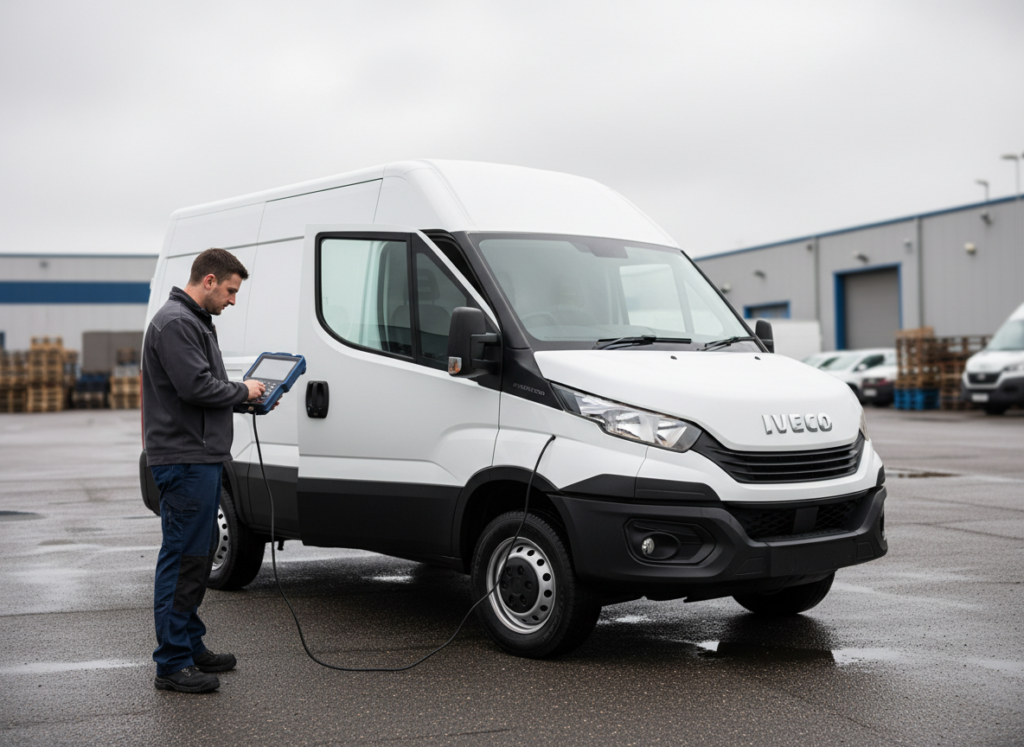
AdBlue Specialist provides fully mobile SCR fault diagnosis and repair across Staffordshire, Cheshire East, and Staffordshire Moorlands. For Iveco Daily operators, this means we come directly to your vehicle — whether it’s on a building site, parked outside your depot, or at home — and carry out a complete diagnostic session using professional-grade equipment.
A typical Iveco Daily AdBlue diagnosis covers:
- Full system scan identifying all stored and pending fault codes across the SCR module
- Live data capture showing NOx levels, AdBlue dosing rate, pump pressure, sensor readings, and heater circuit status simultaneously
- AdBlue fluid quality check and contamination assessment
- Pump and injector function testing where codes indicate a dosing fault
- NOx sensor output review to confirm whether the sensor or the dosing system is the primary issue
- SCR system reinitialisation and fault clearance once the repair has been carried out
The whole process is designed to resolve the fault in a single visit. Most Iveco Daily AdBlue faults — sensor replacement, pump repair, fluid flush, or NOx sensor work — can be completed on-site. You don’t need to tow the van to a workshop or book it in for days. If your Daily is showing any AdBlue warning and you’re based in Staffordshire or the surrounding region, call 07503 134362 or contact us online.
Frequently Asked Questions
How long do I have once the Iveco Daily countdown starts?
The countdown varies by model and software version — typically between 2,400 km and 500 km remaining before the engine will no longer start. Once the countdown appears, it should be treated as urgent. Book a diagnostic session as soon as possible rather than waiting until the counter reaches zero and the vehicle is immobilised.
Can I top up AdBlue myself on an Iveco Daily?
Yes — the AdBlue filler cap is usually located in the engine bay or beside the fuel filler. Use only ISO 22241-compliant AdBlue fluid. Avoid using tap water as a dilutant, using old or stored fluid past its expiry, or purchasing low-cost unbranded fluid from unknown sources, as all of these can trigger quality faults even if the level itself is correct.
Does the Iveco Daily use the same AdBlue system as other vans?
The Daily uses a similar SCR architecture to most Euro 6 commercial vehicles, but the specific sensors, pump assembly, and software control differ from brands like Mercedes, Ford, or VW. This means that diagnosis should use tools that can access Iveco-specific system data — not just generic OBD readers, which often miss manufacturer-specific live data needed for accurate fault identification.
Is AdBlue delete legal on an Iveco Daily?
No. AdBlue and SCR systems are legally required emissions equipment on UK-registered Euro 6 vehicles. Disabling or removing the system is illegal for road use, will result in an MOT failure, and may void your insurance. If you are facing repeated AdBlue faults, the correct approach is to identify and repair the underlying cause rather than consider a delete solution.
Why does my Daily’s AdBlue warning keep coming back after being reset?
The warning returns because the underlying fault hasn’t been fixed — only the stored code has been cleared. The ECU will relog the fault as soon as the SCR monitoring system completes its next diagnostic cycle, typically within a few minutes of driving. Proper repair of the root cause — whether a sensor, pump, fluid, or heater issue — is the only way to permanently resolve a recurring warning.