
AdBlue Specialist — Mobile BMW Emissions Fault Repair
BMW AdBlue Fault Warning: What It Means and How to Fix It
Your BMW diesel is showing an AdBlue warning and you’re not sure what it means or how urgent it is. This guide covers every warning stage, the most common BMW AdBlue fault codes, and why mobile diagnosis almost always resolves the issue faster than a dealer visit.
Quick Answer
BMW AdBlue faults appear in four stages — from an initial amber warning to a no-start lockout. The most common causes are low or poor-quality AdBlue fluid, a failed NOx sensor, a faulty heater element, or a defective SCR pump. Fault codes P20EE, P207F, and P11D0 are typical on BMW diesels. A mobile specialist can diagnose the root cause on your driveway without a dealer booking. Call 07503 134362 for same-day support across Staffordshire and Cheshire.
Contents
Why BMW Diesel Vehicles Develop AdBlue Faults
BMW has fitted AdBlue SCR (Selective Catalytic Reduction) systems to its diesel range since Euro 6 regulations came into force in 2014. The system injects a precise amount of AdBlue fluid into the exhaust stream to convert harmful NOx gases into nitrogen and water vapour before they leave the tailpipe.
Unlike a simple fluid top-up system, the BMW SCR setup involves a quality sensor in the AdBlue tank, a heated supply line, a dosing pump, a dosing injector, and upstream and downstream NOx sensors. Any one of these components can trigger a fault — and when they do, BMW’s warning system escalates through clearly defined stages.
BMW uses the Bosch SCR platform across most of its diesel models. This system is reliable when maintained correctly but is sensitive to fluid quality, heating failures in cold conditions, and contamination. When it detects a problem, it logs fault codes and begins restricting the vehicle to force the driver to seek a repair before the next start cycle.
The key difference between a BMW AdBlue fault and a simple low-fluid warning is that most BMW AdBlue faults are not resolved by simply topping up the fluid. The underlying cause — sensor failure, heater fault, pump failure, or software miscalibration — needs to be identified and cleared with specialist diagnostic equipment.
BMW AdBlue Warning Stages Explained
BMW’s AdBlue warning system escalates through four distinct stages. Understanding which stage you are at tells you how much time you have and what action to take.
Stage 1 — Initial Amber Warning
An amber triangle with an exclamation mark appears on the instrument cluster, often accompanied by a text message such as “Exhaust fluid level low” or “AdBlue: Range X km.” This is an early warning. The vehicle runs normally. You have time to investigate and book a diagnosis.
Stage 2 — Countdown Message
The countdown begins, typically showing a distance such as “Vehicle can be restarted X more times” or “Engine start in X km.” This stage appears roughly when AdBlue fluid drops below 2.5 litres or a system fault has been logged. At this stage, the vehicle will still start and drive normally, but the window is closing.
Stage 3 — Start Limitation
BMW now actively limits how many more times the engine will start. You may see a message such as “Start possible X more times” or the vehicle may enter a reduced speed mode to encourage immediate action. Some owners mistake this for a mechanical fault. It is a deliberate restriction triggered by the SCR control module.
Stage 4 — No Restart
Once the permitted number of starts is exhausted, the BMW will not restart after the engine is switched off. At this point, the vehicle needs specialist diagnostic intervention to reinitialise the SCR system. Simply filling with AdBlue at this stage will not unlock the vehicle — the control unit needs to be reset with professional scan equipment.
Important: If your BMW is at Stage 3 or 4, do not switch the engine off in a location where recovery would be difficult. Call a mobile specialist while the vehicle is still running.
Common BMW AdBlue Fault Codes
BMW diesels log specific OBD fault codes when the SCR system detects a problem. Understanding these codes helps you ask the right questions and avoid unnecessary parts replacements.
P20EE — SCR NOx Catalyst Efficiency Below Threshold
This is one of the most common BMW AdBlue fault codes. It indicates the SCR catalyst is not converting NOx at the required rate. Despite the code name, the catalyst itself is rarely at fault. The most frequent underlying causes are a failed upstream or downstream NOx sensor giving incorrect readings, degraded or contaminated AdBlue fluid, a dosing injector that is not firing correctly, or SCR pump pressure problems. A full SCR flow bench test is often needed to confirm which component is responsible before any parts are ordered.
P207F — Reductant Quality Performance
P207F indicates the AdBlue quality sensor in the tank has detected that the fluid does not meet the required 32.5% urea concentration. This can be caused by substandard AdBlue fluid, fluid that has degraded through age or heat exposure, or a faulty quality sensor giving a false reading. On BMW vehicles, P207F is commonly misread as a fluid quality issue when the sensor itself has failed.
P11D0 — SCR Heater Circuit
P11D0 is a BMW-specific code relating to the AdBlue heater circuit. The heated supply line is critical for preventing AdBlue from freezing or crystallising in cold weather. When the heater fails or develops an open circuit, the system cannot maintain correct fluid temperature and the SCR module logs a fault. This often appears in winter but can be triggered at any time of year if the heater element has burned out or a connector has failed.
P204E and P204F — SCR Heater Variations
These codes relate to heater performance faults on the SCR system, often indicating that the heater is running but not reaching the required temperature, or that there is intermittent circuit resistance. On BMW vehicles these are frequently confused with pump faults because the symptoms — slow dosing, pressure warnings — can look similar. Correct diagnosis requires live data monitoring with a BMW-capable scan tool, not just code reading.
BMW Models Most Affected
AdBlue faults can appear across any Euro 6 BMW diesel, but certain models see them more frequently due to vehicle age, mileage, and fleet use.
| Model | Engine | Common Fault |
|---|---|---|
| BMW 3 Series (F30 / G20) | B47 / N47 2.0d | P207F, P20EE, NOx sensor |
| BMW 5 Series (F10 / G30) | B47 / N57 3.0d | P20EE, P11D0, heater fault |
| BMW 7 Series (G11 / G12) | B57 3.0d | P20EE, pump failure, P204F |
| BMW X3 (F25 / G01) | B47 2.0d | P207F, quality sensor, P20EE |
| BMW X5 (F15 / G05) | B57 3.0d | P20EE, P11D0, SCR heater |
| BMW 1 / 2 Series (F20 / F22) | B47 2.0d | P207F, countdown, P204E |
Higher-mileage vehicles, particularly those used in fleet or long-distance driving, tend to develop SCR heater failures and pump wear more frequently. Vehicles that have been filled with substandard AdBlue — often from petrol stations that store tanks outdoors in direct sunlight — are more prone to quality sensor faults and P207F codes.
What Actually Causes BMW AdBlue Faults
There is rarely a single cause behind a BMW AdBlue fault. The SCR system involves multiple components that work in sequence, and a failure in one part often triggers codes across others. The most common root causes are:
- Low AdBlue fluid: The simplest cause, but rarely the only one if a fault code has been logged.
- Contaminated or degraded AdBlue: Fluid exposed to heat or stored incorrectly loses its urea concentration, triggering quality faults.
- Failed NOx sensor (upstream or downstream): A common cause of P20EE on BMW. Sensors degrade over time and begin returning inaccurate readings.
- SCR heater element failure: The heated supply line prevents freezing and crystallisation. When the heater burns out, AdBlue dosing becomes inconsistent.
- AdBlue pump failure or low pressure: The dosing pump delivers AdBlue at a precise pressure. Wear, blockage, or electrical failure reduces output and triggers pressure fault codes.
- Dosing injector blockage: AdBlue crystallisation inside the injector restricts flow and causes efficiency faults even when all other components test normal.
- SCR control module issues: Less common, but software faults or module failures can cause persistent codes that do not clear with standard repair.
Why General Garages Often Get BMW AdBlue Faults Wrong
BMW AdBlue faults are commonly misdiagnosed by non-specialist garages for two reasons. First, generic OBD readers often read the fault code correctly but cannot access the live data needed to understand which component is actually causing the efficiency drop. Second, the most visible code — P20EE, for example — points to the catalyst, which leads to unnecessary and expensive catalyst replacements when the real culprit is a sensor or pump.
A garage without BMW-specific diagnostic software may also clear the fault code without identifying the root cause, leading the driver to believe the problem is solved — until it returns a few days later, often with an additional code logged.
Correct diagnosis of a BMW AdBlue fault requires live NOx sensor data comparison, SCR pump pressure testing, heater circuit resistance measurement, and AdBlue fluid quality verification. This is not a process that can be completed with a basic OBD reader.
Mobile BMW AdBlue Diagnosis vs Dealer Visit
Taking a BMW with an AdBlue fault to a main dealer involves booking an appointment, potentially waiting days for availability, paying diagnostic fees before any work is approved, and often receiving a quote that includes parts replacement based on code reading rather than confirmed diagnosis.
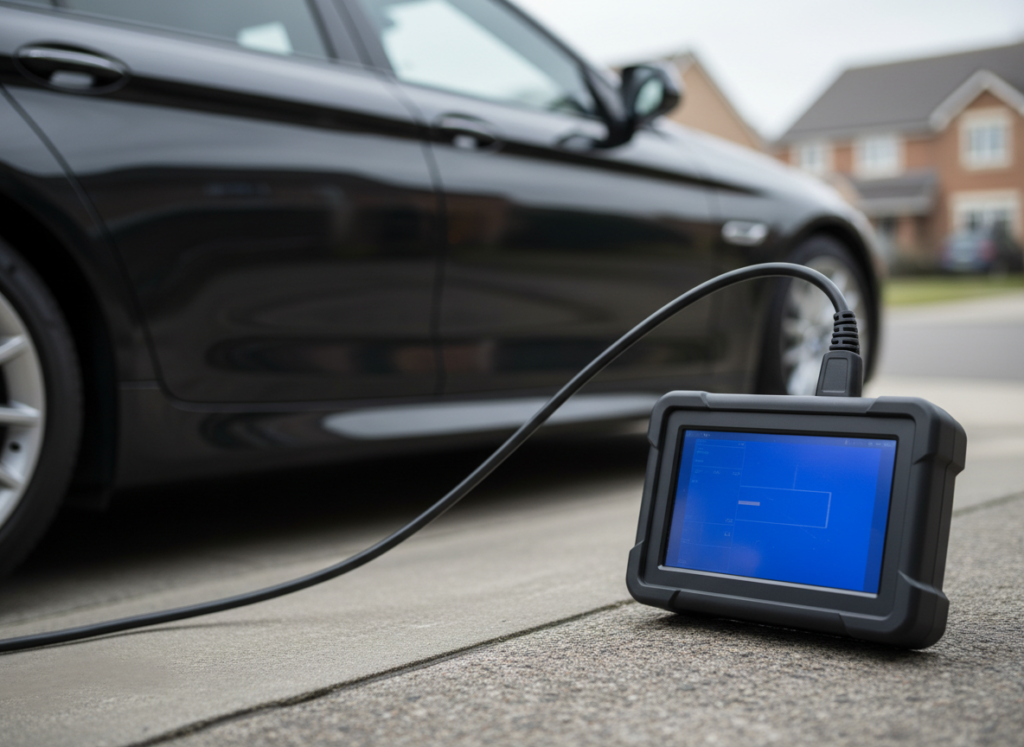
Mobile diagnosis works differently. A specialist comes to your home, workplace, or roadside location with professional diagnostic equipment capable of reading BMW-specific data streams. The root cause is confirmed before any repair is recommended. Most BMW AdBlue faults — including NOx sensor failures, heater faults, pump issues, and SCR reinitialisation after a no-start — can be resolved in a single mobile visit.
AdBlue Specialist covers Staffordshire, Cheshire East, and Staffordshire Moorlands with same-day availability for many faults. There is no recovery cost, no workshop wait, and no dealer markup on labour. Call 07503 134362 or visit the contact page to book a mobile diagnosis for your BMW.
BMW AdBlue Warning Light On? We Come to You
Same-day mobile diagnosis across Staffordshire, Cheshire East, and Staffordshire Moorlands. No recovery, no dealer booking, no guesswork.
Frequently Asked Questions
Can I still drive my BMW with an AdBlue warning light on?
At Stage 1 and Stage 2 you can continue driving normally, but you should arrange diagnosis promptly. At Stage 3 the vehicle is counting down its remaining starts. At Stage 4 the BMW will not restart once switched off. Avoid switching off the engine at Stage 3 or 4 unless you are in a safe location and have support arranged.
Will topping up AdBlue clear the warning on my BMW?
If the only issue is genuinely low fluid, topping up should extinguish the warning after a short drive. However, if a fault code such as P20EE or P207F has been logged, the warning will persist regardless of fluid level. The underlying fault needs to be diagnosed and cleared with specialist scan equipment.
How much does BMW AdBlue repair usually cost?
Costs vary depending on what has failed. A NOx sensor replacement typically costs £250–£500 for parts and labour. Heater element replacement ranges from £150–£350. SCR pump replacement is more involved and can range from £400–£800. Mobile diagnosis avoids dealer markup and ensures only the confirmed faulty component is replaced.
Does AdBlue fault affect my BMW’s MOT?
Yes. An active AdBlue system fault will cause an MOT failure under the emissions category. The SCR system must function correctly to meet Euro 6 NOx limits. Resolving the fault before your MOT avoids failure and re-test fees.