
AdBlue Specialist — Mobile EGR and Emissions Fault Support
EGR Fault Symptoms in Diesel Vehicles: What to Look For and What to Do Next
EGR faults are one of the most misunderstood diesel engine problems. The symptoms — limp mode, black smoke, rough idle, loss of power — are easy to confuse with other issues. This guide explains what the EGR valve does, the warning signs to look for, and how proper diagnosis avoids unnecessary parts and wasted money.
Quick Answer
EGR fault symptoms typically include a check engine light, rough idling, loss of power, limp mode activation, black exhaust smoke, and poor fuel economy. These symptoms appear because a clogged or failed EGR valve disrupts the air-fuel balance in the engine. EGR faults do not usually resolve on their own — and clearing the code without fixing the cause means the fault will return. Mobile diagnosis confirms whether cleaning, bypass, or removal is the right solution. Call 07503 134362 for same-day support.
Contents
What the EGR Valve Does and Why It Fails
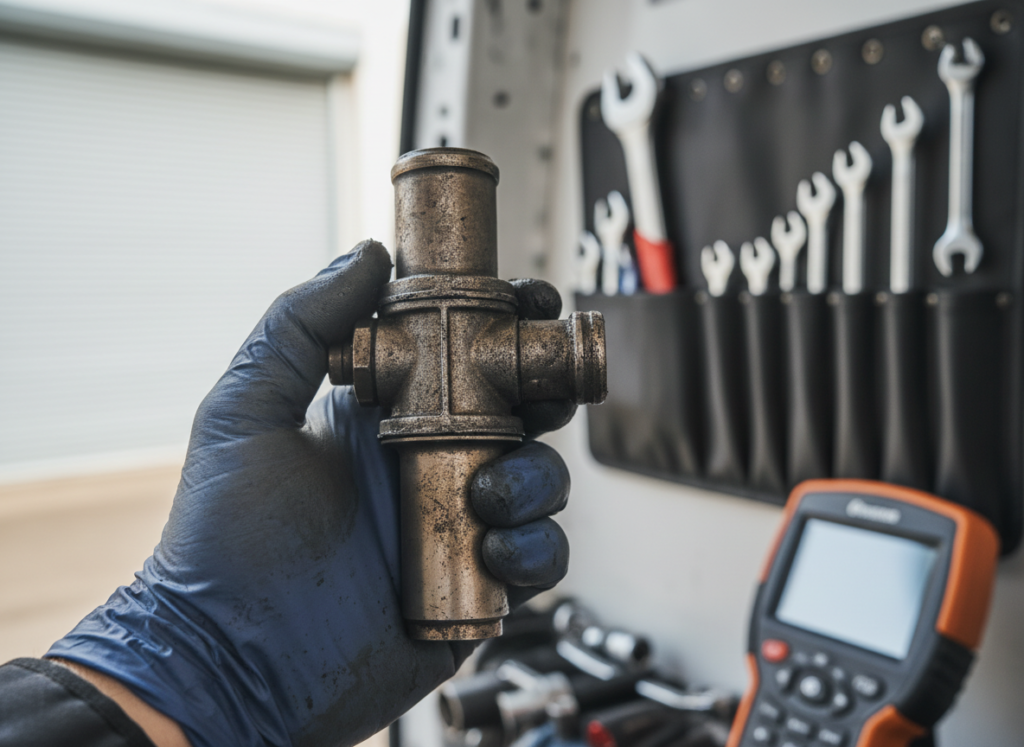
The EGR (Exhaust Gas Recirculation) valve routes a controlled portion of exhaust gases back into the engine’s intake manifold. Reintroducing exhaust gas reduces the oxygen concentration in the combustion chamber, which lowers combustion temperature and reduces NOx (nitrogen oxide) emissions.
In diesel engines, the EGR system works alongside the AdBlue SCR system on Euro 6 vehicles to meet emissions targets. Both systems target NOx — but they operate at different points. The EGR reduces NOx production inside the engine; the SCR system cleans up NOx in the exhaust after combustion.
EGR valves fail because diesel exhaust contains large amounts of soot and carbon particles. Over time, these deposits build up on the valve pintle, the valve seat, and the EGR cooler passages. The valve becomes sticky, stuck open, stuck closed, or partially blocked. None of these states allow the EGR system to operate within the tolerances the engine management system expects, so a fault is logged and the engine goes into protection mode.
High-mileage diesel vans, short-trip vehicles that never fully warm up, and engines that have run on poor-quality fuel are most vulnerable. EGR failures are not a sign of a poorly maintained vehicle — they are a known characteristic of diesel emissions systems operating in real-world conditions.
EGR Fault Symptoms: The Full Warning List
EGR faults produce a recognisable pattern of symptoms. Understanding the full picture helps you explain the problem accurately and avoid having unnecessary components replaced.
Check Engine Light (Engine Management Light)
The first indicator of an EGR fault is usually the amber engine management light (EML) on the dashboard. This does not tell you which system has failed — it simply signals that the engine management system has stored a fault code. Without scanning the vehicle, it is impossible to confirm whether the EML is caused by an EGR fault, an AdBlue issue, a sensor failure, or something else entirely.
Rough Idle and Misfire Feel
A stuck-open EGR valve allows exhaust gas to re-enter the intake at idle, when the engine does not need it. This dilutes the air-fuel mixture, causing the engine to run unevenly. Drivers describe this as a shudder, vibration, or lumpy feel at idle — often most noticeable when stationary at traffic lights. The engine may also feel like it is misfiring under low-load conditions.
Loss of Power and Poor Throttle Response
A stuck-closed EGR valve means exhaust gas is not being recirculated at all. The engine produces higher combustion temperatures, which the management system detects through NOx sensor readings or temperature sensors. To protect the engine and maintain emissions compliance, power is reduced. The result is a flat, unresponsive throttle — particularly noticeable when pulling away or overtaking.
Limp Mode Activation
Limp mode is the engine management system’s protective response to a confirmed fault. Engine output is reduced to a fixed, safe level — typically around 50–60% of normal power. The vehicle may feel barely driveable at speed. Limp mode caused by an EGR fault is often intermittent at first, appearing under load and clearing when the engine is restarted. Over time it becomes more persistent.
Black or Dark Exhaust Smoke
Excessive black smoke from the exhaust is a symptom of incomplete combustion — too much fuel relative to available oxygen. A stuck-open EGR valve reduces the oxygen entering the combustion chamber, which worsens the fuel-air ratio under load. Black smoke under acceleration is a strong indicator of EGR involvement, though it can also suggest injector or DPF issues, so diagnosis is needed to confirm the source.
Poor Fuel Economy
An EGR fault that alters combustion efficiency will reduce fuel economy. If your diesel van or car is using noticeably more fuel than normal without a clear reason — no change in driving style, load, or conditions — an EGR fault is one of the likely causes to investigate.
Increased Soot Output and Faster DPF Blockage
An EGR fault that causes incomplete combustion also increases soot production. More soot means the DPF (Diesel Particulate Filter) loads up faster and requires more frequent regeneration cycles. Drivers with an undiagnosed EGR fault often notice their DPF warning appearing more frequently — or their DPF becoming completely blocked — before the EGR problem is identified.
How Urgent Is an EGR Fault?
An EGR fault is not an emergency in the way an AdBlue no-start countdown is. The vehicle will generally continue to run. However, leaving an EGR fault unaddressed has consequences that worsen over time.
A stuck-open EGR valve will cause carbon build-up in the intake manifold. On some engines — particularly those with variable geometry turbochargers — this carbon can restrict airflow through the turbocharger actuator, causing turbo faults and limp mode on top of the EGR issue. The repair cost for combined EGR and turbo problems is significantly higher than addressing the EGR fault alone.
A failed EGR cooler is more urgent. If the cooler develops a crack or leak, engine coolant can enter the intake system. White exhaust smoke, unexplained coolant loss, and overheating are the indicators. This needs immediate attention to prevent serious engine damage.
If you see white exhaust smoke alongside a check engine light, stop driving and arrange diagnosis before continuing. Coolant in the intake is a serious fault that can cause head gasket failure.
EGR Faults vs AdBlue and NOx Faults: Key Differences
EGR faults and AdBlue or NOx sensor faults can produce overlapping symptoms — limp mode, check engine light, poor power, and emissions-related warnings — which makes it easy for general garages to confuse them.
| Symptom | EGR Fault | AdBlue / NOx Fault |
|---|---|---|
| Check engine / EML | Yes | Yes |
| Limp mode | Yes | Yes (advanced stages) |
| Countdown warning | No | Yes |
| No-start lockout | No | Yes (Stage 4) |
| Black smoke | Often | Rarely |
| Rough idle | Yes (valve stuck open) | Rarely |
| AdBlue warning light | No | Yes |
| NOx fault codes (P20EE, P207F) | Possible secondary | Primary |
The distinction matters because the repair route is completely different. An EGR cleaning or bypass is the correct approach for an EGR fault. Replacing a NOx sensor or SCR component will not resolve an EGR problem. Correct diagnosis is the only way to avoid treating the wrong system.
Common EGR Fault Codes
The most frequently logged EGR fault codes across diesel vans and cars are:
- P0400 — EGR flow malfunction (general flow fault)
- P0401 — EGR flow insufficient detected (valve not opening enough)
- P0402 — EGR flow excessive detected (valve stuck open)
- P0403 — EGR control circuit malfunction (electrical fault in the valve actuator)
- P0404 — EGR control circuit range/performance (valve position out of range)
- P0405 / P0406 — EGR sensor A circuit low / high voltage
- P0409 — EGR sensor A circuit malfunction
- P0489 / P0490 — EGR control circuit low / high (common on Ford and PSA engines)
Manufacturer-specific codes also exist. Ford Transit and Ranger, for example, often log unique Ford EGR codes that do not map directly to the generic OBD list. Mercedes Sprinter, Volkswagen Crafter, and Renault Master engines each have their own EGR fault code structures that require manufacturer-level scan tools to interpret correctly.
Vehicles and Engines Most Affected by EGR Faults
EGR faults are not unique to any one make — they affect the full range of Euro 5 and Euro 6 diesel engines. However, certain engines develop carbon build-up faster than others based on design, operating conditions, and typical use.
Vehicles used predominantly for short trips — urban deliveries, school runs, commuting less than 10 miles — never fully warm up their EGR systems. Cold EGR valves accumulate carbon significantly faster than those that reach operating temperature on every journey. Van operators in particular should be aware that a diesel van used for local deliveries will develop EGR problems earlier than the same vehicle used for motorway journeys.
Common vehicles presenting with EGR faults include the Ford Transit (2.2 and 2.0 EcoBlue), VW Transporter and Crafter (2.0 TDI), Mercedes Sprinter (OM651 2.1), Renault Master (2.3 dCi), Vauxhall Vivaro (1.6 and 2.0 CDTi), Peugeot Boxer and Citroen Relay (2.2 BlueHDi), and Land Rover Discovery Sport and Defender (Ingenium 2.0d).
EGR Cleaning, Bypass, or Delete?
Once an EGR fault is confirmed, there are three broad resolution routes. The right choice depends on the vehicle, the extent of the problem, and the owner’s priorities.
EGR Cleaning
Chemical cleaning and manual cleaning of the EGR valve, passages, and cooler can restore normal operation where the valve mechanism is still functional and the damage is limited to carbon build-up. This is appropriate for earlier-stage EGR faults where the valve has not seized and the cooler is intact. Cleaning requires the valve to be removed, inspected, and the passages to be cleared, along with a post-clean system check.
EGR Valve Replacement
Where the EGR valve has seized, the position sensor has failed, or the actuator has burned out, replacement is the correct repair. A faulty valve that has been freed or cleaned may return to normal operation temporarily but typically fails again within a short period if the underlying mechanism is worn.
EGR Solutions and Bypass
For vehicles where EGR faults are persistent, recurring, or where the cooler has failed, an EGR bypass or EGR solution may be the most cost-effective long-term option. AdBlue Specialist offers EGR solutions and EGR removal as part of its diesel emissions fault service. This is typically for off-road or specific use cases — discuss your situation and requirements when booking a diagnosis.
Mobile EGR Diagnosis — No Workshop Needed
Most EGR diagnosis and many EGR repairs can be carried out at your location without a workshop visit. A mobile specialist with the correct scan tools, live data monitoring, and cleaning equipment can confirm the fault, assess the condition of the valve and cooler, and carry out cleaning or replacement work on-site.
This avoids recovery costs, towing risks, and the uncertainty of leaving a vehicle at a garage without knowing what the bill will be. AdBlue Specialist operates across Staffordshire, Cheshire East, and Staffordshire Moorlands and is available seven days a week. Call 07503 134362 or use the contact page to arrange a mobile EGR diagnosis. For EGR delete or bypass options, visit the EGR solutions page.
EGR Fault on Your Diesel? Mobile Diagnosis Comes to You
We cover Staffordshire, Cheshire East, and Staffordshire Moorlands. Same-day availability for many faults. No recovery, no workshop wait.
Frequently Asked Questions
Can I drive with an EGR fault?
You can usually continue driving at Stage 1 (check engine light, no limp mode), but you should arrange diagnosis promptly. If the vehicle has entered limp mode, driving is difficult and continued use risks additional damage. If you notice white exhaust smoke — which indicates a potential EGR cooler leak — stop driving immediately.
Will cleaning the EGR valve fix the fault permanently?
Cleaning resolves the fault if the valve mechanism is still functional and the build-up is the root cause. However, if the vehicle continues to be used primarily on short trips, carbon will accumulate again. Some operators choose EGR solutions to avoid recurrence — this is a discussion to have during the diagnostic visit based on your vehicle’s use case.
Can an EGR fault cause a DPF to block?
Yes. A malfunctioning EGR valve that causes incomplete combustion produces more soot, which loads the DPF faster than normal. Vehicles with both an EGR fault and a blocked DPF often need both issues addressed together, as fixing only the DPF without resolving the EGR fault means the DPF will block again quickly.
How is an EGR fault different from an AdBlue fault?
Both affect emissions, but they are separate systems with different symptoms and repair routes. An EGR fault typically causes rough idle, black smoke, and power loss. An AdBlue fault produces warning lights with a countdown and eventually a no-start lockout. A proper scan will confirm which system is at fault so the correct repair is made first time.