
AdBlue Specialist — Staffordshire & Cheshire East
Audi & VW AdBlue Faults: SCR Warning Lights, Codes & What They Mean
Audi and Volkswagen diesel cars behave differently from vans when an AdBlue fault develops. This guide explains which models are affected, how the warning system works, the most common fault codes, and what to do before the countdown reaches zero.
Contents
Audi and VW diesel cars from around 2014 onwards use an AdBlue SCR system that counts down engine starts rather than kilometres once a fault is detected. Common codes include P20EE, P20E8, and P204F. Once the countdown reaches zero, the engine will not start again without specialist intervention. Mobile diagnosis identifies the fault and clears it at your location.
Which Audi and VW Models Use AdBlue?
The Volkswagen Group introduced AdBlue SCR systems across its diesel range in response to Euro 6 emissions legislation. If your Audi or VW is a diesel registered from approximately 2014 onwards, there is a strong chance it is equipped with an SCR system.
Audi Models with AdBlue
- Audi A4 TDI (B9 generation, 2016 onwards)
- Audi A5 TDI (2017 onwards)
- Audi A6 TDI (C7 from 2014, C8 from 2018)
- Audi A7 TDI (2015 onwards)
- Audi A8 TDI (2014 onwards)
- Audi Q5 TDI (2017 onwards)
- Audi Q7 TDI (2015 onwards)
- Audi Q8 TDI (2018 onwards)
- Audi SQ5 and SQ7 diesel variants
Volkswagen Models with AdBlue
- VW Passat TDI (B8 generation, 2015 onwards)
- VW Tiguan TDI (2016 onwards)
- VW Touareg TDI (2018 onwards)
- VW Crafter TDI (2017 onwards, commercial)
- VW Amarok TDI V6 (2016 onwards)
The AdBlue tank capacity varies by model, ranging from approximately 12 litres on some Audi A6 and Q7 variants to as little as 5 litres on the Passat. This means refill intervals can differ significantly between vehicles even within the same manufacturer range.
How the VAG AdBlue Warning System Works
The Volkswagen Group approach to AdBlue warnings differs meaningfully from other manufacturers, and this catches many Audi and VW owners off guard. Where some brands count down in kilometres remaining, VAG vehicles count down in remaining engine starts once a fault or critically low level is detected.
Low Level Advisory
When AdBlue drops to a low level, the dashboard displays an amber warning and a message such as “AdBlue: Refill, possible to start X more times.” At this point, the vehicle will continue running normally. The number of remaining starts shown is typically generous enough to allow you to source AdBlue and arrange a refill.
Countdown Warning
As the level drops further, or if a fault is stored in the SCR system, the warning becomes more urgent. The message may change to “AdBlue: Start possible X more times. Have system checked by a workshop.” The countdown reduces with each engine start. In some cases, the countdown may drop to a lower number than expected if the system detects an active fault rather than just a low level.
No-Start Lockout
Once the countdown reaches zero, the vehicle displays a message such as “AdBlue: No more starts possible. See workshop.” The engine will not start. At this point, the vehicle requires specialist diagnostic equipment to clear the lockout alongside resolution of the underlying fault. Simply adding AdBlue to the tank at this stage will often not be sufficient on its own if a fault code is stored.
This countdown-in-starts behaviour is a deliberate design choice under emissions regulations, ensuring that drivers cannot ignore AdBlue warnings indefinitely by only driving short trips.
Common Fault Codes on Audi and VW Diesel
The VAG diagnostic system (accessed through VCDS or equivalent professional tools) reveals fault codes across multiple control units. The most commonly seen on Audi and VW AdBlue faults include:
| Fault Code | Description | Typical Trigger |
|---|---|---|
| P20EE | SCR NOx Catalyst Efficiency Below Threshold Bank 1 | Catalyst degradation, NOx sensor drift, dosing fault |
| P20E8 | Reductant Injection Air Pressure Too Low | Pump failure, blocked filter, pressure line issue |
| P203F | Reductant Level Sensor Circuit High | Empty tank, faulty level sensor |
| P204F | Reductant System Performance Bank 2 | SCR system general performance issue |
| P2BAD | Reductant Quality Performance | Contaminated or wrong AdBlue used |
| P229F | NOx Sensor Circuit Range or Performance | NOx sensor failure or wiring fault |
On VAG vehicles, these codes are often accompanied by additional manufacturer-specific codes within the engine management or exhaust gas treatment control units. Full diagnostic access is essential for accurate fault identification, as generic OBD readers typically only access a fraction of the fault data stored on Audi and VW models.
Common Causes of Audi and VW AdBlue Faults
Low or Empty AdBlue Tank
This is the most straightforward cause and the easiest to rule out. Audi and VW passenger cars typically consume between 1 and 1.5 litres of AdBlue per 1,000 kilometres under normal driving conditions. Many owners of newer vehicles are unaware that AdBlue needs to be checked and topped up, particularly those who primarily service their vehicles at dealerships where the tank is filled as part of the service schedule.
Contaminated AdBlue
Using non-ISO 22241 compliant fluid, filling with tap water, or accidentally mixing AdBlue with diesel (or vice versa) will trigger a quality fault. The quality sensor monitors urea concentration continuously, and even a slightly diluted tank can produce a P2BAD or P20EE code. If contamination is suspected, the tank should be drained, flushed, and refilled with verified ISO 22241 fluid rather than simply topping up.
NOx Sensor Failure
The downstream NOx sensor is one of the most frequently replaced components on high-mileage Audi and VW diesels. When it fails or drifts out of specification, the system receives an inaccurate reading of catalyst performance. This leads to a P20EE code even when the catalyst is functioning correctly. Misdiagnosis here is costly, as replacing the SCR catalyst on an Audi Q7 or A6 is significantly more expensive than replacing a sensor that is reading incorrectly.
SCR Catalyst Degradation
Over time and at high mileage, the SCR catalyst’s ability to convert NOx diminishes. This is a gradual process rather than a sudden failure. The system detects declining efficiency through the NOx sensor comparison data and stores a P20EE code when efficiency falls below the required threshold. Catalyst degradation is more common on vehicles that have been driven predominantly on short trips where the exhaust does not reach operating temperature.
Dosing Injector Faults
The AdBlue dosing injector on VAG vehicles operates in a high-temperature environment. Crystallisation of AdBlue around the injector tip, caused by incomplete purging after engine shutdown, is a common fault mode. This restricts fluid delivery, reduces SCR efficiency, and can trigger P20EE or P20E8 codes. The injector can sometimes be cleaned rather than replaced, depending on the extent of the deposit build-up.
Passenger Cars vs Vans: Key Differences
Drivers familiar with AdBlue faults on commercial vans sometimes assume that Audi and VW passenger car systems behave identically. There are several practical differences worth understanding.
Passenger Cars (Audi, VW)
- Countdown measured in engine starts, not kilometres
- AdBlue tank typically accessible under bonnet or boot floor
- Smaller tank capacity in some models
- Dealer-level diagnostics often required for full access
- Catalyst replacement costs tend to be higher
Commercial Vans
- Countdown often displayed in kilometres
- Larger AdBlue tanks in most configurations
- Tank filler often located near the fuel cap
- Higher system pressure specifications on some models
- Fleet management context often means faults are caught earlier
These differences matter for diagnosis. A mobile specialist working on an Audi A6 TDI needs to interpret the fault data in the context of how that specific system operates, rather than applying a one-size approach drawn from van-focused experience.
How Mobile Diagnosis Resolves the Fault
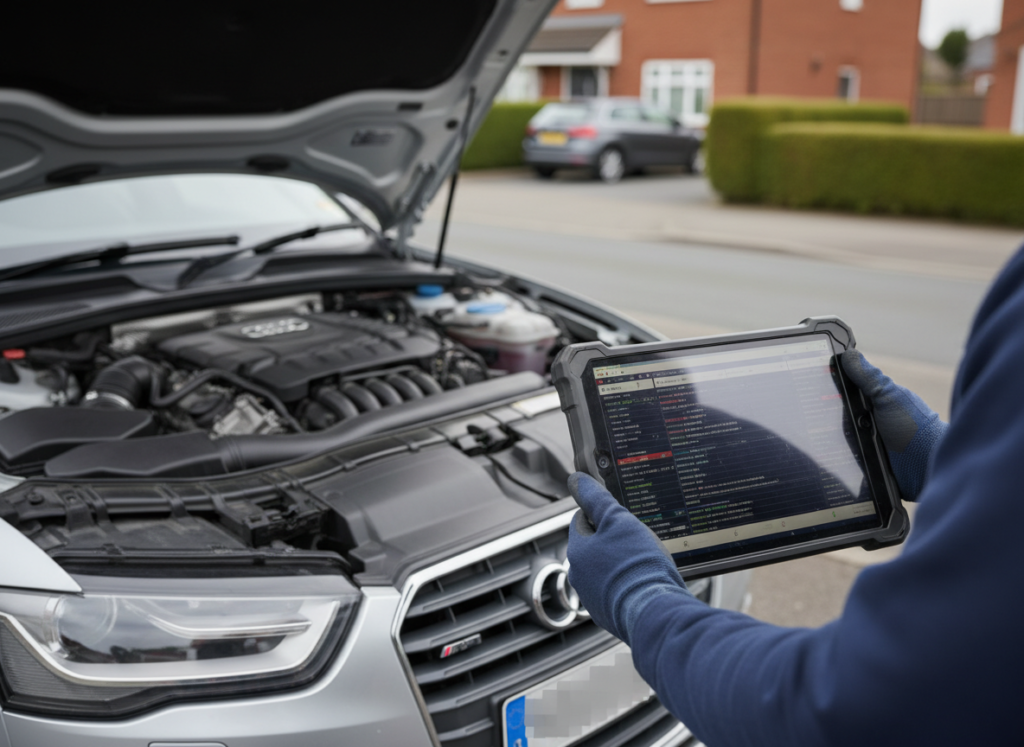
Resolving an Audi or VW AdBlue fault begins with a complete diagnostic scan using professional equipment capable of accessing all control units, not just the generic OBD port. This reveals the full picture: stored codes, pending codes, freeze frame data, and live sensor readings across the SCR system.
Live data is particularly important on VAG vehicles because of how the system uses comparative NOx sensor readings to calculate catalyst efficiency. Viewing both the upstream and downstream NOx sensor outputs in real time, alongside AdBlue pressure, temperature, and dosing rate, allows a trained specialist to pinpoint whether the fault is sensor-related, catalyst-related, or dosing system-related.
Once identified, the appropriate fix is applied. Common resolutions include AdBlue quality correction with a system flush and refill, NOx sensor replacement, dosing injector service, or pump repair. After the repair, the system is cleared and retested with live data to confirm the fault does not return before the job is signed off.
All of this takes place at the vehicle’s location — your driveway, workplace, or any accessible location across Staffordshire and Cheshire East. There is no need to arrange recovery or take a day out for a workshop appointment.
Audi or VW AdBlue Warning? Get It Sorted Today.
Mobile AdBlue diagnosis for Audi and Volkswagen diesel models across Staffordshire, Cheshire East, and Staffordshire Moorlands. Same-day help available.
Frequently Asked Questions
How many starts does an Audi or VW give you when AdBlue runs out?
This varies by model and software version, but most VAG vehicles give a countdown starting from around 1,000 starts when AdBlue is critically low, stepping down more quickly as the situation becomes urgent. In practice, the countdown behaves differently when a fault code is stored alongside the low level, and can reduce to zero faster than expected if the system detects an active SCR fault.
Can I top up AdBlue myself on an Audi or VW?
Yes, the AdBlue filler cap is typically located under the bonnet or in the boot, depending on the model. It is usually blue and clearly marked. Only use ISO 22241 compliant AdBlue. However, if a fault code is already stored, topping up alone will not reset the warning — the fault must be diagnosed and cleared by a specialist.
Is it the catalyst or the NOx sensor causing P20EE on my Audi?
This cannot be determined from the fault code alone. P20EE indicates that the system calculated insufficient NOx conversion efficiency, but the root cause could be a failing catalyst, a sensor reading incorrectly, contaminated AdBlue, or a dosing fault. Live data diagnosis is required to identify which component is actually at fault before any replacement work is carried out.
Why did my Audi AdBlue countdown go from 500 starts to zero overnight?
This typically happens when an active SCR fault is stored alongside a low level. The system treats a confirmed component fault differently from a simple level warning, and the countdown can accelerate significantly. Once a fault code triggers a more severe system response, the countdown to no-start lockout happens much faster than the initial low-level warning would suggest.
Does AdBlue Specialist cover Audi and VW passenger cars?
Yes. We diagnose and resolve AdBlue and SCR system faults on Audi and VW diesel passenger cars as well as commercial vehicles. Mobile service covers Staffordshire, Cheshire East, and Staffordshire Moorlands with same-day availability for many jobs.
Related reading: Nissan AdBlue Faults: NV300, NV400, Navara & Qashqai Warning Lights Explained.