
AdBlue Specialist — Mobile Emissions Fault Solutions, Staffordshire
Mercedes Vito AdBlue Faults: Warning Lights, Fault Codes and What to Do
Mercedes Vito showing an AdBlue warning or start countdown? This guide covers the warning stages, the most common fault codes, and how mobile diagnosis resolves Vito SCR faults without a dealer visit.
Quick Answer
The Mercedes Vito uses a urea-based SCR system shared with other Mercedes diesel vans. Common faults include NOx sensor failure, AdBlue heater circuit faults (especially in cold weather), and pump pressure issues. Most faults trigger a countdown warning — ignore it and the van will refuse to start. Mobile diagnosis typically confirms the root cause in 20–30 minutes without towing.
Contents
Vito AdBlue Warning Stages
The Mercedes Vito follows the same warning escalation pattern used across Mercedes commercial vans. Understanding the stages helps you judge how urgent the situation is.
Stage 1 — Advisory Warning
An amber AdBlue warning light appears on the dashboard. At this point the van is still running normally. The warning typically appears when the AdBlue level drops low, or when a fault is first detected. You have time to act, but you should not ignore it.
Stage 2 — Countdown Warning
The dashboard displays a countdown message showing how many starts or kilometres remain before the van locks out. Common messages include “AdBlue: 1500 km remaining” or “Engine will not restart in X starts”. This is the point where many drivers make the mistake of assuming a top-up will clear the problem.
Stage 3 — No-Start Lockout
If the countdown reaches zero, the van will complete its current journey but will not restart afterwards. Mercedes ECU lockouts are genuine — the van will not start again until the fault is cleared through software, not just by refilling the AdBlue tank.
Common Mercedes Vito AdBlue Fault Codes
These fault codes appear most frequently on the Vito W639 and W447 platforms. A diagnostic scan tool is needed to read them — they won’t appear as readable text on the dashboard.
| Fault Code | Description | Likely Cause |
|---|---|---|
| P20EE | SCR NOx catalyst efficiency below threshold | NOx sensor failure, contaminated AdBlue, SCR catalyst degradation |
| P207F | Reductant quality performance | Wrong AdBlue fluid, contamination, or NOx sensor giving false readings |
| P20E8 | Reductant pressure too low | AdBlue pump failure or blockage in the supply line |
| P204F | Reductant system performance | SCR system efficiency issue — often heater circuit related |
| P13DF | Reductant heater circuit fault | Failed heater element, wiring issue, or relay fault |
| P20BA | Reductant heater temperature low | Heater not reaching operating temperature — common in winter |
Most Vito AdBlue faults fall into one of three categories: NOx sensor issues, heater circuit faults, or pump/pressure faults. The fault code is the starting point, not the definitive answer — further live data testing is needed to confirm the actual component at fault.
What Actually Causes These Faults on the Vito
NOx Sensor Failure
The Vito uses upstream and downstream NOx sensors to monitor the SCR system’s performance. When a sensor starts failing — either giving incorrect voltage readings or dropping out entirely — the ECU sees an efficiency fault and triggers a warning. P20EE and P207F are the most common codes linked to sensor degradation.
NOx sensors on the Vito typically have a lifespan of 100,000–150,000 miles, but road salt exposure, heat cycling, and vibration can cause earlier failure. The sensor itself is not expensive compared to replacing the SCR catalyst — which is often the incorrect repair recommended by dealers who skip proper diagnosis.
AdBlue Heater Circuit Faults
The AdBlue system on the Vito includes a heater circuit to prevent the fluid from freezing in cold temperatures. AdBlue freezes at around -11°C, which is a realistic winter temperature in the UK. When the heater element fails or the relay circuit develops a fault, the ECU loses confidence in the SCR system and triggers warnings — even if the fluid level is fine.
Heater faults are particularly common on older Vito vans and on vehicles that are started frequently in cold conditions. The P13DF and P20BA codes are the main indicators. Heater element replacement is a straightforward repair when diagnosed correctly.
AdBlue Pump Pressure Faults
The pump draws AdBlue from the tank and delivers it at the correct pressure to the SCR injector. If the pump begins to fail — or if crystallisation blocks the supply line — pressure drops and the ECU raises a fault. P20E8 is the primary code here. This can present similarly to a sensor fault on the dashboard, which is why scanning with live data matters rather than replacing parts based on the code alone.
Contaminated or Wrong AdBlue Fluid
AdBlue is a precisely mixed 32.5% urea solution. Using a substandard product, overfilling with tap water, or accidentally mixing fluids causes the NOx sensor to detect incorrect reagent concentration. The ECU logs a quality fault and may trigger a countdown. In some cases, a full drain and refill with correct fluid resolves the issue — but the system must be rescanned and the fault cleared through software.
Vito vs Sprinter: Are the Faults the Same?
The Vito and Sprinter share a lot of SCR system architecture, particularly on OM651 and OM654 engine platforms. However, there are differences worth knowing:
- The Vito W447 (2014 onwards) uses a slightly more compact SCR packaging arrangement than the Sprinter, which affects heater pipe routing and can make heater faults more common.
- The W639 Vito (2003–2014) has an older SCR system with fewer electronic monitoring points — faults can present differently or with fewer stored codes.
- Both platforms share fault code families (P20EE, P207F, P20E8, P204F) but the diagnostic procedures and component locations differ.
- A Sprinter-specific fault reset procedure will not necessarily work on a Vito — the ECU calibration steps are model-specific.
If you’ve read Sprinter AdBlue guides and found the information doesn’t quite match what you’re seeing on your Vito, this is why. The Vito needs Vito-specific diagnosis.
What to Do When the Warning Appears
The right response depends on which stage the warning is at:
If the warning light has just appeared (Stage 1)
Check the AdBlue level using the dashboard menu. If it’s genuinely low, top it up with a quality ISO 22241-compliant product. If the level is fine but the light remains, or if the light clears and then returns within a few days, book a diagnostic scan. The fault is in the system, not the fluid level.
If a countdown message is showing (Stage 2)
Do not rely on topping up the tank to clear the countdown. The countdown in the Vito is controlled by the ECU based on fault status — it won’t reset until the fault is resolved and the system is rescanned. Book a mobile diagnosis as soon as possible. The van is still driveable, but the window is closing.
If the van won’t restart (Stage 3)
At this point, the van is not going to start without specialist software intervention. Towing to a main dealer is one option but comes with significant cost and lead time. A mobile specialist can attend your location and perform the same ECU-level reset procedure on-site, often within the same day.
How Mobile Diagnosis Works for Vito AdBlue Faults
Mobile diagnosis eliminates the need for recovery or a dealer appointment. Here is what the process looks like in practice:
- Attendance at your location — the van does not need to be moved.
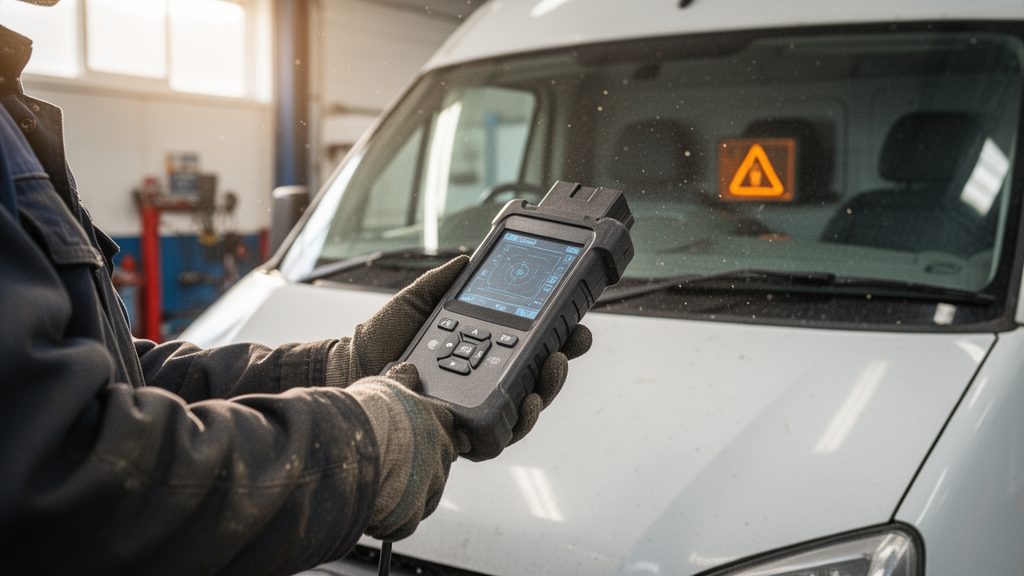
- Full OBD scan — all stored and pending fault codes are read across the ECU and SCR control module.
- Live data monitoring — NOx sensor voltages, pump pressure readings, and heater circuit status are reviewed in real time to confirm which component is actually at fault.
- Component-level diagnosis — the scan data identifies whether the fault is in the sensor, heater, pump, or software.
- Repair or reset — depending on the fault, repairs may be completed on-site or a clear plan provided for the specific parts needed.
- Verification — the system is rescanned after repair to confirm the fault is fully resolved and no pending codes remain.
Most Vito AdBlue faults are resolved in a single visit. The approach removes the guesswork and avoids the common mistake of replacing expensive parts based on fault codes alone.
Mercedes Vito AdBlue Warning? Get It Diagnosed Today
AdBlue Specialist covers Staffordshire, Cheshire East, and Staffordshire Moorlands. Mobile diagnosis comes to your van — no towing, no dealer delays, same-day availability for most callouts.
Frequently Asked Questions
Can I drive my Mercedes Vito with an AdBlue warning light on?
Yes, but only until the countdown reaches zero. Once the ECU lockout activates, the van will complete its current journey and then refuse to restart. If a countdown message is showing, treat it as urgent and book a diagnosis rather than waiting to see if it clears.
Will topping up AdBlue fix the warning on my Vito?
Only if the warning is caused by a genuinely low fluid level and the system has no underlying fault. If a fault code is stored, topping up the tank will not clear it. The ECU countdown is controlled by fault status, not just fluid level — it requires a diagnostic scan and software reset to clear.
How much does it cost to fix an AdBlue fault on a Mercedes Vito?
Cost depends on the specific fault. A NOx sensor replacement typically costs £200–£450 including parts and labour. A heater element repair is usually less. Pump replacement is mid-range. Mobile diagnosis is charged separately and confirms exactly what needs doing before any parts are ordered.
What fault codes are most common on the Mercedes Vito AdBlue system?
P20EE (SCR efficiency), P207F (reductant quality), P20E8 (low pressure), P204F (system performance), P13DF (heater circuit), and P20BA (heater temperature) are the most frequently seen codes. Each points to a different component — reading live data alongside the code is essential for accurate diagnosis.
Is the Vito AdBlue system the same as the Sprinter?
They share fault code families and similar system architecture, but the component locations, heater routing, and ECU calibration steps differ by model. A Sprinter reset procedure won’t necessarily work on a Vito. Vito-specific diagnosis is needed for accurate and lasting results.