
AdBlue Specialist — Staffordshire & Cheshire East
Toyota Hilux AdBlue Faults: Warning Lights, Codes & What to Do
The Toyota Hilux is a capable workhorse, but its SCR emissions system can catch owners off guard. Here is what each warning stage means, which fault codes to expect, and how mobile diagnosis resolves the issue without a workshop visit.
Contents
A Toyota Hilux AdBlue warning typically progresses through advisory, amber warning, and countdown stages before locking out engine starts. The most common fault codes are P20EE (SCR catalyst efficiency), P203F (low AdBlue level), and NOx sensor-related codes. Left unaddressed, the engine will not start once the countdown expires. Mobile diagnosis identifies the exact fault and resolves it at your location.
How the Toyota Hilux AdBlue System Works
From the 2015 model year onwards, Toyota equipped the Hilux with its GD-series engine and a Selective Catalytic Reduction (SCR) system to meet Euro 5 and Euro 6 diesel emissions standards. SCR technology works by injecting a precise amount of AdBlue — a solution of urea and deionised water — into the exhaust stream upstream of the SCR catalyst. This converts harmful nitrogen oxides (NOx) into harmless nitrogen and water vapour.
The Hilux SCR system includes several key components working together:
- AdBlue tank — typically positioned separately from the fuel tank, often near the rear axle or under the load bed on double-cab variants
- AdBlue dosing pump — draws fluid from the tank and pressurises it to the injector
- Dosing injector — sprays a fine mist of AdBlue into the exhaust pipe before the SCR catalyst
- SCR catalyst — where the NOx conversion reaction takes place
- NOx sensors — one upstream and one downstream of the catalyst, monitoring conversion efficiency
- AdBlue quality and level sensor — confirms the tank contains the correct concentration of urea
The engine management system constantly monitors all these components. When a fault is detected — whether that is low fluid, contaminated AdBlue, a sensor failure, or a component fault — the system escalates through a series of driver warnings that become increasingly urgent.
Warning Light Stages Explained
Toyota uses a staged warning system on the Hilux to alert drivers before the problem becomes critical. Understanding what each stage means helps you act at the right time and avoids unnecessary anxiety or unnecessary urgency.
Stage 1: Yellow Advisory Warning
The first warning appears as a yellow AdBlue symbol or a dashboard message indicating that AdBlue level is low. At this stage, the vehicle will continue to run normally, but you will need to top up the AdBlue tank. Toyota typically triggers this warning when there is approximately 2,000 to 2,500 kilometres of AdBlue remaining, depending on the model year and driving conditions.
If the level drops further without a refill, the system escalates to the next stage.
Stage 2: Amber Warning with Countdown
Once AdBlue reaches critically low levels, or if a fault is detected within the SCR system, the Hilux will display an amber warning alongside a countdown. This countdown is typically displayed in kilometres or remaining start cycles and tells you how long you have before the vehicle will refuse to start.
At this point, a fault code is usually stored in the engine management system. The underlying problem may be a genuinely low tank, a sensor reading incorrectly, or a component fault that the system has flagged as a failure.
Stage 3: No-Start Lockout
If the countdown expires without the fault being resolved, the Toyota Hilux will display a message indicating that the engine cannot be started. The vehicle will not start again until a compliant AdBlue level is confirmed or the underlying fault has been diagnosed and cleared by a specialist with appropriate diagnostic equipment.
This is not a situation where clearing the code with a basic OBD reader resolves the issue. The fault must be properly diagnosed, as the system will re-trigger the lockout if the root cause is not addressed.
Common Fault Codes on the Toyota Hilux
The Toyota Hilux stores specific OBD-II fault codes when the SCR system detects a problem. These codes give a starting point for diagnosis, though interpreting them accurately requires live data alongside the stored code.
| Fault Code | Description | Common Cause |
|---|---|---|
| P20EE | SCR NOx Catalyst Efficiency Below Threshold Bank 1 | Degraded catalyst, faulty NOx sensor, dosing fault |
| P203F | Reductant Level Sensor Circuit High | Low AdBlue, level sensor fault |
| P20E8 | Reductant Injection Air Pressure Too Low | Pump fault, blocked injector, pressure line issue |
| P2BAD | Reductant Quality Performance | Wrong or contaminated AdBlue, degraded fluid |
| P0420 | Catalyst System Efficiency Below Threshold | Catalyst degradation (broader code) |
| P229F | NOx Sensor Circuit Range/Performance | Faulty downstream NOx sensor |
It is worth noting that a single fault code rarely tells the full story. A P20EE on a Toyota Hilux, for example, can be caused by a genuinely failing SCR catalyst, a NOx sensor that is reading incorrectly, a dosing injector that has partially blocked, or contaminated AdBlue that is reducing conversion efficiency. Proper diagnosis uses live sensor data, pressure readings, and component tests alongside the stored codes.
What Usually Causes These Faults
Toyota Hilux AdBlue faults have several common root causes. The most frequently seen in mobile diagnosis work across Staffordshire and Cheshire East include:
Contaminated or Low-Quality AdBlue
AdBlue must be ISO 22241 compliant with a urea concentration of approximately 32.5%. If the tank has been filled with tap water, diluted fluid, or incorrect product, the quality sensor will flag a fault and P2BAD or P20EE codes will follow. This is more common on working vehicles that have been filled from unlabelled containers or non-automotive-grade sources.
Genuine Low AdBlue Level
The Hilux AdBlue tank holds approximately 7.5 litres depending on the variant. Consumption varies with mileage and load but typically falls between 1 and 2 litres per 1,000 kilometres in normal use. Heavy towing or high-temperature working conditions can increase consumption. Owners who are unaware the vehicle uses AdBlue sometimes allow the tank to run dry, triggering both level faults and pump damage from dry running.
Dosing Injector Blockage or Failure
The dosing injector operates in a hot, chemically aggressive environment. Over time, AdBlue can crystallise around the tip if the injector does not purge correctly after engine shutdown. This restricts or blocks fluid delivery and causes P20EE or P20E8 codes. Crystallisation is often visible as a white chalky deposit around the injector boss on the exhaust pipe.
NOx Sensor Failure
The Hilux uses upstream and downstream NOx sensors to calculate catalyst conversion efficiency. If either sensor fails or drifts out of specification, the system may incorrectly conclude that the catalyst is not working. This can trigger P20EE or P229F codes even when the catalyst itself is in good condition. NOx sensor failures are relatively common on high-mileage Hilux vehicles and are a straightforward diagnosis with professional equipment.
AdBlue Pump or Pressure System Faults
A failing dosing pump, damaged pressure lines, or a blocked strainer can all reduce the flow of AdBlue to the injector. When pressure falls below the required threshold, P20E8 is typically stored. The pump runs briefly during every engine start cycle to pressurise the system, so an intermittent fault often presents itself most clearly during cold mornings.
Can You Still Drive a Hilux with an AdBlue Warning?
This depends entirely on which stage the warning has reached.
At the advisory stage, the vehicle will drive normally. There is no immediate risk to the engine, and you have time to arrange a refill or diagnosis. At the amber countdown stage, the vehicle will still drive, but you are working against a deadline. The countdown reduces every time the engine is started, and you cannot know from the dashboard alone whether the root cause is a simple low level or a component fault that a refill will not fix.
If the countdown reaches zero, the vehicle will not start. At that point, the vehicle must be diagnosed and the system cleared by a specialist. Simply topping up the AdBlue tank after a lockout is not always sufficient if a fault code is stored alongside the level issue.
The sensible approach at any stage beyond the initial advisory is to have the system checked. This avoids arriving at a lockout situation unexpectedly, particularly if the vehicle is used commercially where downtime carries a direct cost.
How Mobile Diagnosis Works
Mobile AdBlue diagnosis on a Toyota Hilux follows a structured process that covers all the components the SCR system relies on. Professional diagnostic equipment connects to the vehicle’s OBD port and retrieves all stored and pending fault codes across all control units, not just the engine management system.
Live data readings are then taken from the NOx sensors, AdBlue pressure circuit, dosing injector, and quality sensor while the engine is running. This reveals whether a component is performing within specification or has drifted outside acceptable limits. A stored P20EE code with a healthy pressure reading and normal sensor output, for example, points strongly toward a catalyst or fluid quality issue rather than a pump fault.
Once the fault is identified, the appropriate fix is applied. This may involve an AdBlue system flush and refill with verified ISO 22241 compliant fluid, a dosing injector service, a NOx sensor replacement, or pump repair work. The system is then cleared and retested with live data to confirm the fault is resolved before the job is closed.
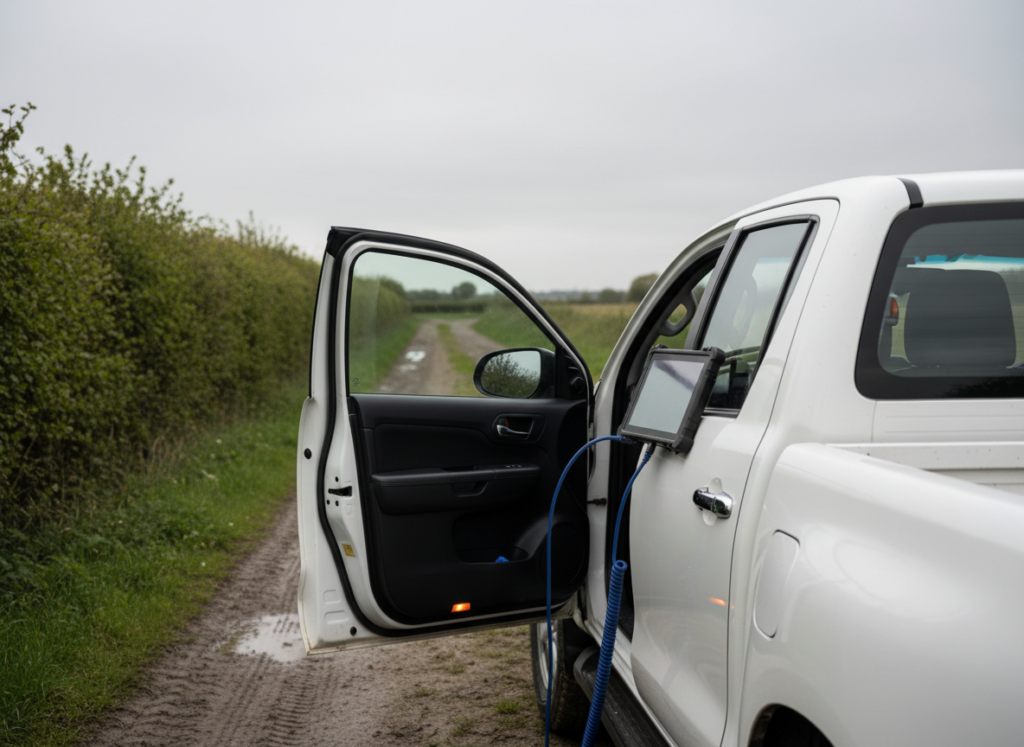
Because AdBlue Specialist operates as a mobile service, all of this happens at the vehicle’s location — whether that is a farm, a worksite, a home driveway, or a depot. There is no need to arrange a recovery or take a working vehicle off the road for a workshop visit.
Toyota Hilux AdBlue Fault? We Come to You.
Mobile AdBlue diagnosis across Staffordshire, Cheshire East, and Staffordshire Moorlands. Same-day availability. No workshop visit needed.
Frequently Asked Questions
How much AdBlue does a Toyota Hilux use?
A Hilux typically consumes between 1 and 2 litres of AdBlue per 1,000 kilometres under normal driving conditions. Towing heavy loads or driving at sustained high revs increases consumption. The tank holds approximately 7.5 litres, giving a range of roughly 4,000 to 7,000 kilometres between refills depending on use.
Will topping up AdBlue fix a P20EE fault on a Hilux?
Not necessarily. P20EE is an SCR catalyst efficiency code rather than a level code. If the fault has been triggered by low or contaminated AdBlue, a flush and refill with correct fluid may resolve it. But if the root cause is a NOx sensor failure, a blocked injector, or a degraded catalyst, the fault will return regardless of how much AdBlue is added.
Can I use any AdBlue in a Toyota Hilux?
You should only use AdBlue that meets ISO 22241 standards, which specifies a 32.5% urea concentration in deionised water. Using tap water, diluted product, or off-specification fluid will trigger a quality fault code and can damage the dosing injector and SCR catalyst over time.
How long does the Hilux countdown give you before it won’t start?
This varies depending on the trigger and model year. When the countdown begins, the Hilux typically shows remaining starts or a distance figure. It is not a fixed number of days — it reduces each time you start the engine. Once it reaches zero, the engine will not start until the fault is resolved by a specialist.
Does AdBlue Specialist cover Toyota Hilux vehicles?
Yes. We regularly diagnose and resolve AdBlue and SCR system faults on Toyota Hilux vehicles across Staffordshire, Cheshire East, and Staffordshire Moorlands. Mobile diagnosis means we come to the vehicle rather than you needing to arrange recovery or a workshop visit.
Related reading: Land Rover & Jaguar AdBlue Faults: Warning Lights, Codes & Mobile Fixes.