
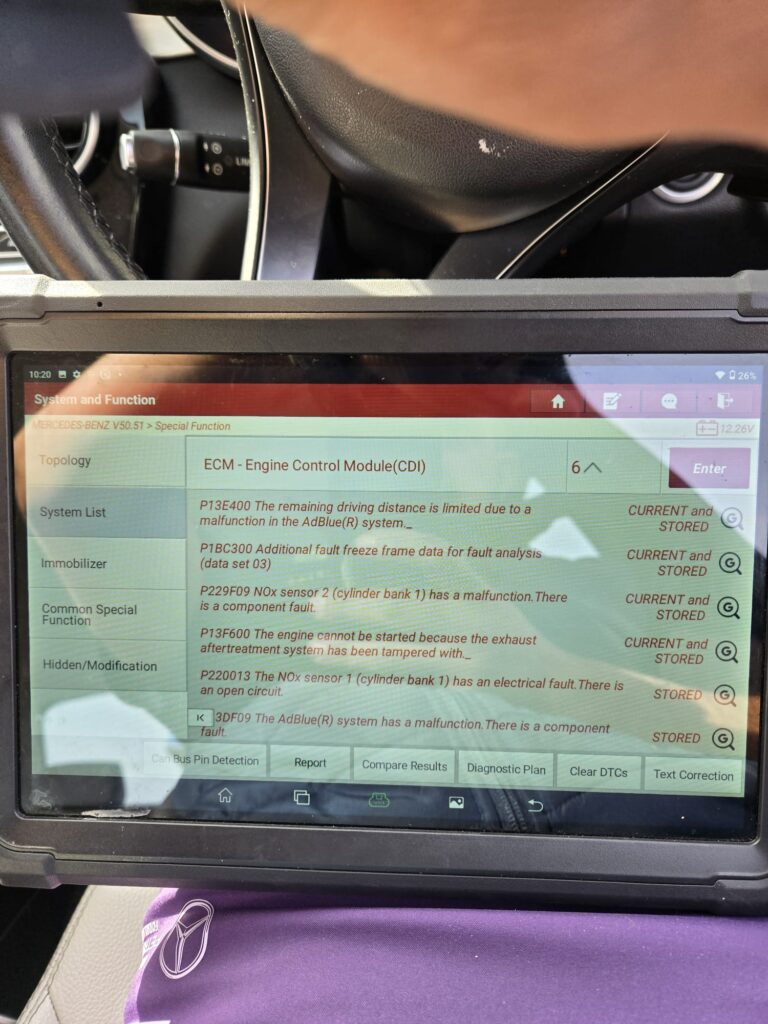
Quick answer: AdBlue fault codes tell you which part of the SCR (AdBlue) system the engine computer is unhappy with: efficiency, fluid quality, pressure, heating, dosing or the NOx sensors. Find your code in the table below, see what it usually means, then open the full guide. If your code is not listed, send it to us and we will tell you what it points to.
AdBlue fault code lookup
| Code | What it means | Most often seen on | Full guide |
|---|---|---|---|
| P20EE | SCR NOx catalyst efficiency below threshold | Peugeot, Citroën, Ford EcoBlue | Guide → |
| P207F | Reductant (AdBlue) quality performance | Ford Transit, VW Crafter and Transporter | Guide → |
| P20E8 | Reductant (AdBlue) pressure too low | Mercedes Sprinter, Peugeot, Citroën | Guide → |
| P20E9 | Reductant (AdBlue) pressure too high | Vauxhall Movano, Citroën, Peugeot | Guide → |
| P204F | Reductant system performance | Mercedes Sprinter, VW Transporter and Crafter | Guide → |
| P13DF | Mercedes AdBlue heater fault | Mercedes Sprinter and Vito | Guide → |
| P20BA | Reductant heater A control circuit performance | Ford Transit, Transit Custom and Ranger | Guide → |
| P229F | NOx sensor circuit range or performance (downstream sensor) | Mercedes | Guide → |
| P2200 / P2202 | NOx sensor circuit / circuit low | Land Rover, Range Rover | Guide → |
| U029D | Lost communication with NOx sensor A | Citroën, Vauxhall | Guide → |
| 4F5F | BMW AdBlue / SCR fault, engine start not possible | BMW 3 Series, 5 Series, X5 | Guide → |
| P3041 | Heated pipe / incorrect DEF quality | Jaguar and Land Rover Ingenium | Guide → |
| P2047 / P20BD | AdBlue injector and heater electrical circuit faults | Various diesels | Guide → |
| P2BAD / P2BAE | NOx exceedance: too much NOx leaving the exhaust | Peugeot, Citroën | Guide → |
P20EE: SCR NOx catalyst efficiency below threshold
P20EE is the most common AdBlue code we see. The engine computer compares the NOx sensors before and after the SCR catalyst and has decided the system is not cutting NOx enough. It is a result, not a part: the cause can be a failing NOx sensor, poor AdBlue dosing, a crystallised injector, poor-quality fluid or a tired catalyst.
- Full guide: Peugeot P20EE fault code: causes, fix and cost
- Also see: Ford 2.0 EcoBlue P20EE tests and P207F vs P20EE
P207F: AdBlue quality performance
P207F means the system thinks the AdBlue is the wrong strength or quality. Contaminated or diluted fluid is one cause, but a faulty quality or level sensor, or a dosing problem, can set the same code, so draining the tank does not always fix it.
- Full guide: When P207F isn’t bad fluid
- Also see: Ford Transit P207F and VW Crafter and Transporter P207F/P204F
P20E8: AdBlue pressure too low
P20E8 means the AdBlue pump cannot build or hold the pressure it needs. Common causes are a weak or failed pump, a blocked filter or line, a leak, or fluid that has frozen or crystallised. Left alone it usually leads to a no-start countdown.
- Full guide: P20E8 low AdBlue pressure: causes and fixes
- Also see: Mercedes OM651/OM654: P13DF heater vs P20E8 low pressure
P20E9: AdBlue pressure too high
P20E9 is the opposite of P20E8: pressure above what the system expects. It usually points to a blocked or stuck injector, a restricted return line or a pressure sensor reading wrongly.
- Full guide: Vauxhall Movano P20E9 high-pressure alert
- Also see: Citroën and Vauxhall AdBlue faults
P204F: Reductant system performance
P204F is a general “the AdBlue system is not performing” code. It often appears alongside a more specific code, so the first job is to read everything stored and the live data, then test pump, dosing and sensors rather than guessing.
- Full guide: Mercedes Sprinter AdBlue codes: P20E8 to P204F
- Also see: Mercedes P204F guide and VW Transporter T6.1 AdBlue codes
P13DF and P20BA: AdBlue heater faults
AdBlue freezes at around minus 11°C, so the tank and lines are heated. P13DF (Mercedes) and P20BA (Ford and others) point to the heater or its circuit. They show up most in winter, often with a countdown warning.
- Mercedes: Sprinter AdBlue heater fault: P20BA and P13DF
- Ford: Ford P20BA heater fault and P20BA on Ranger and Transit
NOx sensor codes: P229F, P2200, P2202, U029D
NOx sensors measure NOx before and after the SCR catalyst. These codes cover a sensor reading out of range, a circuit fault, or the engine computer losing contact with the sensor altogether. A wiring or connector fault can look exactly like a failed sensor, so we test before replacing.
Other AdBlue codes we see
- 4F5F (BMW): AdBlue or SCR fault with “engine start not possible” warnings. BMW 4F5F guide
- P3041 (Jaguar, Land Rover): heated pipe and “incorrect DEF quality” warnings. P3041 guide
- P2047 / P20BD: electrical circuit faults rather than blockages. P2047 and P20BD guide
- P2BAD / P2BAE: too much NOx leaving the exhaust; a symptom with several possible causes. P2BAD guide and P2BAE guide
What to do when an AdBlue code appears
- Do not just clear it. Most AdBlue codes come straight back if the cause is still there, and some start a no-start countdown.
- Note every code. Several codes together tell a clearer story than one on its own.
- Check the simple things. Fluid level, fluid age and whether it has been topped up with the right fluid.
- Get it diagnosed properly. We test pressure, dosing, heater and sensors with live data at your home or work, then repair the actual fault.
Countdown already running? See our same day service. We are mobile across Stoke-on-Trent, Staffordshire and Cheshire, open 09:00 to 20:00, 7 days a week.
AdBlue fault codes: your questions
Can I clear an AdBlue fault code myself?
You can clear it with a scanner, but if the fault is still there it will return, often within a few miles, and the countdown carries on. Clearing is only useful after the cause has been fixed.
Is it safe to drive with an AdBlue fault code?
Usually for a short while, but many vehicles limit power or count down to a no-start. Get it looked at before the countdown runs out.
Why does the same code keep coming back?
Because the code describes a symptom. P20EE, for example, can be caused by a sensor, dosing, fluid or the catalyst. Replacing the wrong part leaves the real fault in place.
Do you come to me?
Yes. We are fully mobile across Stoke-on-Trent, Staffordshire and Cheshire. Prices start from £150, quoted on the vehicle, the fault and where you are.