
AdBlue Specialist — Mobile Ford Fault Diagnosis
P20BA Fault Code on Ford Ranger and Transit: Causes, Diagnosis and Fix
P20BA is a DEF dosing performance fault that affects the Ford Ranger, Transit, and Transit Custom. Here is what causes it, how urgent it is, and how mobile diagnosis clears it without a dealer appointment.
Quick Answer
P20BA means the SCR system’s AdBlue (DEF) delivery is not meeting the commanded dosing target. On Ford Ranger and Transit models, the most common causes are a faulty AdBlue dosing injector, a blocked or restricted supply line, a failing reductant pump, or contaminated fluid causing the system to under-perform. P20BA will not clear with a basic code reset — the root cause needs to be identified and fixed. Mobile diagnosis takes 30–45 minutes with live dosing data. Call 07503 134362 for same-day availability in Stoke-on-Trent and the surrounding area.
Contents
What Does P20BA Mean?
The fault code P20BA is defined as Reductant Injection Air Purge Control Circuit Low in some documentation, but in practice across Ford EcoBlue applications it more accurately describes a condition where the AdBlue dosing system is failing to deliver the commanded injection quantity — the actual delivered dose is falling short of the target.
The SCR system on modern Ford diesels works by injecting a precise amount of AdBlue into the hot exhaust gases ahead of the catalyst. The NOx sensor downstream then measures whether emissions are being reduced as expected. When the reduction is insufficient — because not enough AdBlue is being injected, or the injection is not happening at the right point in the exhaust cycle — the ECU logs P20BA to record that the reductant delivery system is not performing within specification.
It is important to distinguish P20BA from P20EE. P20EE is an SCR catalyst efficiency fault, which means the catalyst itself is not reducing NOx effectively. P20BA is a dosing delivery fault, meaning the AdBlue is not being injected as commanded. The two can appear together, but they point to different components and require different diagnostic approaches.
Which Ford Vehicles Are Affected?
P20BA appears most commonly on Ford vehicles fitted with the 2.0-litre EcoBlue diesel engine and the associated SID217 or SID213EVO ECU variants. The vehicles most frequently presenting with this code include:
- Ford Ranger (2019 onwards, 2.0 EcoBlue)
- Ford Transit (2019 onwards, 2.0 EcoBlue)
- Ford Transit Custom (2019 onwards, 2.0 EcoBlue)
- Ford Tourneo Custom (2019 onwards, 2.0 EcoBlue)
- Ford Focus and Kuga (some 2.0 EcoBlue applications from 2020)
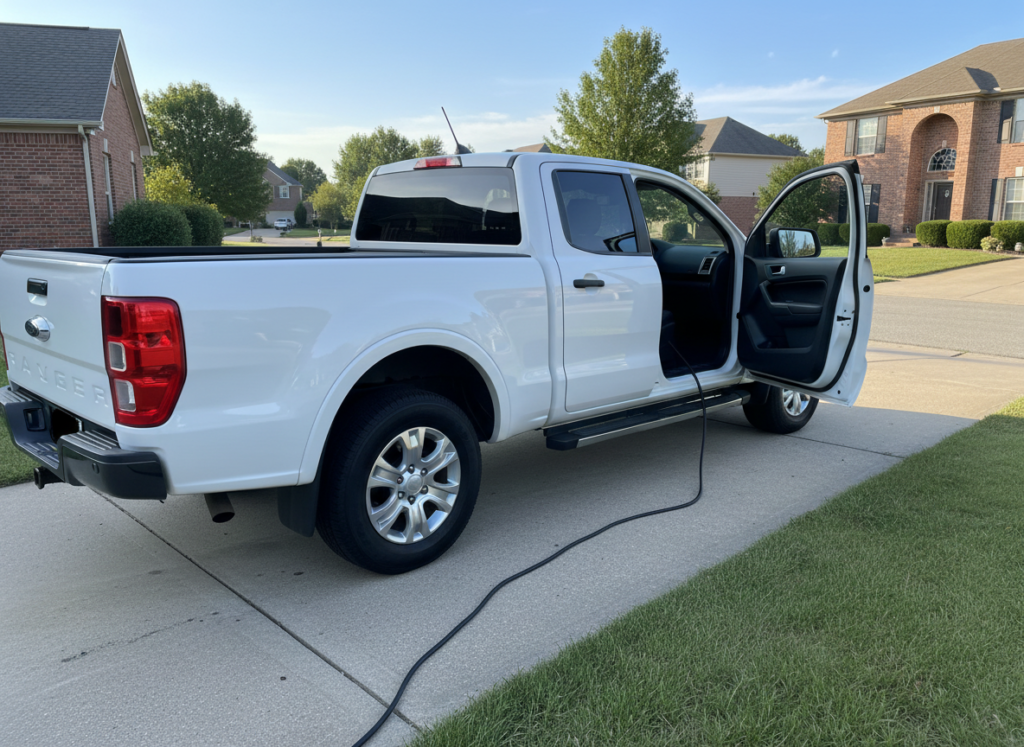
The Ranger is the most common vehicle we see this code on. This is partly because Rangers are frequently used in demanding off-road and towing conditions that place greater thermal stress on the AdBlue system, and partly because many Rangers are fitted with accessories or modifications that can affect the area around the AdBlue components.
Symptoms You Will Notice
P20BA does not always produce dramatic symptoms initially. On many Ford vehicles, the first indication is simply an amber AdBlue warning light on the dashboard, sometimes accompanied by a message in the instrument cluster referencing the emissions system or requesting a workshop visit.
As the fault persists and accumulates drive cycles, you may notice:
- An AdBlue warning light that stays on after a top-up
- A start countdown appearing in the instrument cluster — often beginning at 50 or 100 starts remaining
- In some cases, slight hesitation or reduced performance if the engine enters a protective mode
- Faster-than-expected AdBlue consumption, if the dosing system is operating erratically
- Secondary fault codes appearing alongside P20BA, particularly P20EE or P207F
The vehicle will typically continue to start and drive normally in the early stages of P20BA. The no-start event only occurs once the ECU has exhausted the programmed countdown — which is why it is worth acting on the fault before that point rather than after.
Root Causes of P20BA
Faulty or Partially Blocked Dosing Injector
The dosing injector is the most common physical cause of P20BA on the Ford Ranger and Transit. It is a precision solenoid valve that opens and closes at high frequency to deliver exactly the right quantity of AdBlue. Over time, AdBlue crystallises at the injector tip — a natural result of the urea solution being exposed to heat at the exhaust — and this build-up restricts the nozzle, reducing or stopping delivery.
When the injector delivers less than the commanded dose consistently, the ECU detects the discrepancy between the target and the actual dosing rate and logs P20BA. In some cases the injector solenoid itself fails electrically, producing a circuit fault variant of P20BA with a different sub-code.
Reductant Pump or Pressure Fault
The AdBlue pump draws fluid from the tank and pressurises it for delivery to the injector. If the pump is worn, air-locked, or its internal pressure relief valve has failed, it may not be able to sustain the supply pressure required. The injector then cannot deliver a full dose even when it commands one.
Pump faults are sometimes triggered by running the AdBlue tank very low or completely empty: air drawn into the pump circuit can cause cavitation that damages the pump or causes it to lose prime. Vehicles that have been allowed to run out of AdBlue completely are at higher risk of a pump-related P20BA.
Restricted or Leaking Supply Line
The heated supply line that runs from the tank to the injector is another common point of failure, particularly on Ranger models where the underbody routing exposes the line to off-road debris and thermal cycling. A kinked, chafed, or partially blocked line reduces flow to the injector and produces the same under-dosing result as a faulty injector.
Internal line blockages can be caused by crystallised AdBlue if a section of the heated line has lost heating function, allowing the fluid to freeze and then block the passage as the ice expands and crystallises on thawing.
Contaminated or Sub-Quality AdBlue Fluid
Contaminated AdBlue — fluid with incorrect urea concentration, water ingress, or foreign particles — can cause the dosing system to behave erratically. The quality sensor may flag a separate code, but in some cases the contamination affects pump performance and injector operation directly before the quality fault is formally logged. If P20BA appears shortly after a top-up from an unusual source, contamination should be considered alongside the hardware causes.
How Urgent Is It?
P20BA is not a code you can safely ignore for weeks. Ford’s ECU calibration on EcoBlue models escalates AdBlue system faults relatively quickly, particularly on commercial van variants where emissions compliance carries higher regulatory weight.
In practical terms, here is the typical escalation timeline:
- Initial fault logged: Warning light on, fault stored, vehicle drives normally
- After several confirmed drive cycles: A countdown notice may appear — typically 100, then 50, then 10 starts remaining
- Countdown exhausted: Vehicle refuses to start; ECU locked until specialist reset
The actual speed of escalation depends on the specific Ford model, the ECU software version, and whether secondary faults are also active. A Ranger used daily will reach a critical countdown much faster than a Transit that only does short runs.
As a general rule: if P20BA is active on your vehicle, book diagnosis within the week. If a countdown is already showing, book it today.
Related Fault Codes
P20BA rarely appears alone. The following codes are commonly stored alongside it and are part of the same diagnostic picture:
| Code | Meaning | Relationship to P20BA |
|---|---|---|
| P20EE | SCR NOx catalyst efficiency below threshold | Secondary result of under-dosing — catalyst not being fed enough reductant |
| P207F | Reductant quality performance | May appear if contaminated fluid is involved |
| P20BA:00 | P20BA no sub-type — general dosing fault | Most common variant |
| P20BA:EC | P20BA — performance/incorrect operation variant | Often indicates injector or pressure fault specifically |
| P2BAE | Reductant consumption too low | May appear if injector is blocked and barely dosing |
Reading the full fault picture — not just the primary P20BA code — is essential for pinpointing the correct repair. Treating P20BA alone without checking whether P20EE or P207F are also stored can lead to fixing the wrong component first.
Diagnosis and Repair Process
A proper P20BA diagnosis requires a combination of fault code reading, live data monitoring, and physical inspection. The specific steps involved are:
- Full fault code scan across engine ECU, SCR module, and NOx sensor — reading all stored, pending, and historical codes
- Live data monitoring of the dosing injector: commanded dose versus actual dose, pump pressure, and AdBlue temperature during operation
- AdBlue quality check using a refractometer to confirm the urea concentration is within the 31.8–33.2% specification
- Injector function test — commanding the injector directly via the diagnostic tool to assess electrical operation and mechanical response
- Visual inspection of supply lines, tank connections, and the dosing module for signs of crystallisation, leaks, or physical damage
Once the root cause is identified, repair typically involves one of the following: removing and cleaning or replacing the dosing injector, replacing the AdBlue pump assembly, clearing a blocked supply line, or draining and refilling the tank with quality-certified fluid. In most cases, the repair is completed in the same visit as the diagnosis.
After the physical repair, the ECU requires a reset using manufacturer-level diagnostic software to confirm the fault is cleared. A generic OBD reset is not sufficient — Ford’s SCR system stores adaptive values that must be reinitialised correctly, or the fault will return within a few drive cycles even if the underlying component has been fixed.
Our mobile AdBlue repair service for cars and vans covers Ford Ranger and Transit P20BA diagnosis and repair at your location. We carry the parts and tooling to resolve most P20BA faults in a single callout. If you have already received a start countdown notice, call us on 07503 134362 so we can prioritise your booking. our comprehensive Ford Ranger AdBlue fault guide covers all common codes and causes
Ford Ranger or Transit Showing P20BA? Get It Fixed Today
Mobile diagnosis and repair at your driveway, yard, or workplace. Live dosing data, full ECU reset, and same-day availability across Stoke-on-Trent and the Midlands.
Frequently Asked Questions
Can P20BA on a Ford Ranger be cleared with a basic OBD reader?
The code can be cleared temporarily with a basic reader, but it will return within a few drive cycles unless the underlying cause has been fixed. P20BA is a performance fault that Ford’s ECU re-evaluates on every drive cycle. A genuine fix requires repairing or replacing the faulty component and performing a proper ECU reset with manufacturer-level tooling.
How much does it cost to fix P20BA on a Ford Transit?
The cost depends on what is causing the fault. An injector clean with circuit reset typically costs significantly less than a full pump replacement or injector replacement. Diagnosis first is always the right approach — attempting to replace parts without knowing the root cause can lead to unnecessary expense. Mobile diagnosis confirms the fault cause before any parts are ordered.
Will P20BA cause my Ford to fail its MOT?
Yes. An active AdBlue system fault will cause an emissions failure. On Ford EcoBlue models, P20BA means the SCR system is not reducing NOx to the required level, which is a direct emissions compliance failure. The fault needs to be properly resolved — not just code-cleared — before presenting the vehicle for its MOT.
Is P20BA covered under Ford warranty?
If your vehicle is within the Ford manufacturer warranty period, an AdBlue system fault such as P20BA should be covered. Out-of-warranty vehicles are not covered, and many owners find dealer pricing for AdBlue system work significantly higher than a mobile specialist. If your vehicle is out of warranty, a mobile diagnosis is usually the most cost-effective first step.
Can I drive from Stoke to a garage if P20BA is active?
If there is no start countdown showing yet, the vehicle should still start and drive normally. However, if a countdown is already active, every engine start uses up remaining starts. A mobile callout means the fault is fixed at your location without using up more of your countdown. If the countdown is at 10 or fewer starts, we would strongly recommend not driving unless necessary.
Related reading: Mercedes P204F Fault Code: Causes, Diagnosis & Fix Guide.